










Abstract
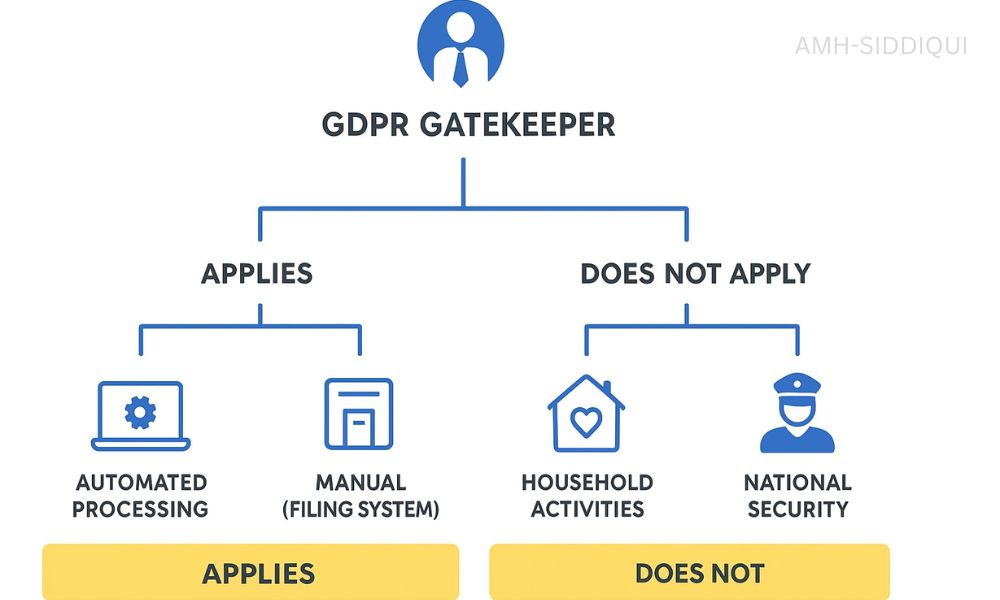
Article 2 of the EU GDPR defines when the regulation applies by outlining its material scope: it covers any processing of personal data done by automated means or stored within a structured manual filing system, unless a specific exemption applies. It could be applying such as purely household use or certain national security and law-enforcement activities. Because this article determines whether an organisation must meet GDPR duties. These duties are like lawful processing, transparency, rights management, and security. it acts as the first essential checkpoint in any compliance journey. Mapping data, reviewing processing methods, and checking for exemptions, organisations can clearly determine whether GDPR applies and confidently move forward with the required compliance steps.
Explanation
So, what does Article 2 of the GDPR really say? In simple terms: it asks the question, “When does the GDPR apply?”. It sets out the material scope that is, which types of personal data processing are covered. According to Article 2 (1), the regulation applies to two main kinds of processing: (a) personal data processed wholly or partly by automated means, and (b) personal data processed manually (i.e., not automated) if the data form part of (or are intended to form part of) a “filing system.”
Then Article 2(2) lists key exceptions, situations where the GDPR does not apply. For example: purely household/personal activities, or certain law‑enforcement or national security processing. The takeaway is from the Article 2 is that if you are processing someone’s personal data (that is, identifiable or identified person), and you’re doing so by automated means – or you’re keeping data in a structured system (filing system) even manually – then you’re likely “within” GDPR’s scope. If you’re doing something outside those bounds (household use, certain public authority law enforcement, etc) then maybe you’re out of scope.
That matters because being within scope triggers the full set of GDPR obligations. If you’re out of scope, you may not have to meet all of those (though other laws may apply).
Key Points
Here are some of the standout things to keep front of mind
- Automated means or filing system: If data processing is done by computer, software, algorithm – that’s automated. If it’s manual but the data is organised in a way you can retrieve it (“filing system”), then it’s covered too.
- Personal data: The data must relate to an identified or identifiable natural person. Without that, GDPR won’t bite.
- Intended for a filing system: Even if the processing is manual and the data are not yet in a filing system, it still falls under coverage if they are meant to be part of one.
- Exemptions (Article 2(2)): Some types of processing are excluded, such as activities outside EU law, purely personal or household use, and certain public law enforcement or national security functions.
- Technology Neutral: The regulation applies regardless of the technology used, meaning the scope remains the same across different systems. Whether you use a spreadsheet, a CRM system, cloud‑tools or paper files (if part of a filing system), it doesn’t matter.
- Filing system defined broadly: A filing system is any structured set of personal data accessible according to specific criteria (so you could retrieve sets of data by some rule). Even paper-based systems can qualify.
General Activation Steps
If your organisation wants to check whether Article 2 applies and then activate relevant compliance steps, you might follow something like this:
- Map your personal data flows
- Start by identifying all the personal data you collect, store, use, process. Ask: “Is this data about identifiable people?” If yes, go to step 2.
- Check the means of processing / system
- Ask: Is the processing automated (software, database, cloud) or is it manual but stored in a filing system (or intended to be)? If yes, GDPR is likely in scope.
- Check for exemptions
- Ask: Is this processing purely personal/household? Is it in the course of an activity that falls outside Union law (if you’re in the EU context)? Is it by a competent authority for criminal law / national security purposes? If yes to any of those, Article 2 might say GDPR does not apply.
- Decide scope‑coverage status
- If you’re covered: you must apply GDPR rules (and jump into the rest of the compliance journey). If not covered: you document why it’s not covered, because you still need to show you considered this.
- Embed controls and policies
- Once you’ve concluded you’re within scope, you need to implement the usual GDPR toolkit. These could be lawful basis for processing, transparency notices, rights management, data security, vendor/processor controls, retention policies, etc.
- Review regularly
- Because processing evolves (you might add new systems, new data sets). So the “Is this processing in scope?” question needs periodic revisit.
Use Cases
Here are some real‑world situations to illustrate how Article 2 kicks in (or doesn’t):
- A small business uses a cloud‑based CRM to store customer names, addresses, emails, purchase history, marketing preferences. This is automated processing of personal data and so it falls within GDPR’s scope.
- A company keeps printed employee records in a structured filing cabinet, indexed by employee ID, and uses them to manage payroll manually. Even though it’s “manual,” the data form part of a filing system, so it’s in scope.
- A hobby blogger writes a list of friends’ addresses purely for personal correspondence (no business, no services, no commercial activity). This is a “purely personal or household activity” and so it might fall outside GDPR scope.
- A national security agency processes data about suspects for investigation of criminal offences. That might be covered by a separate law, so GDPR may not apply under Article 2(2)(d).
- A controller outside the EU offering services to EU residents, processing their names and addresses: even if the controller is non‑EU, the material scope step (Article 2) says “yes if data processed by automated means or in a filing system.” Then you also check territorial scope under Article 3. So Article 2 is the first gate to pass.
Dependencies
The question of material scope (Article 2) doesn’t stand alone. It ties into several other parts of GDPR and broader context:
- Definitions (Article 4): What counts as “personal data”? What is “processing”? What is a “filing system”? You need to know definitions to apply Article 2 properly.
- Territorial Scope (Article 3): Even if material scope says you’re covered, Article 3 may determine. It may shows that whether GDPR applies based on where you’re established or where the data subject is.
- Exemption regimes: The exceptions in Article 2(2) rely on concepts like “activities outside Union law,” “purposes of prevention/investigation…” etc. These link into other legal frameworks (e.g., law enforcement directive).
- National laws: Member States may have their own rules for specific situations, especially involving public authorities. So, Article 2 cannot be viewed on its own.
- Filing system clarity: The phrase “intended to form part of a filing system” means you should check how your manual data is managed. See if it is organized or meant to become more structured.
- Technological context: Data processing can move from manual to automated. You must track this change because moving to a digital system can bring you under Article 2.
Tools / Technologies
What tools and technologies can make it easier to apply Article 2 (and thereby help ensure you meet GDPR obligations)? Here are some suggestions:
- Audit / review tools: Scheduling regular reviews of processing activities so you re‑check whether you’re still in scope.
- Data mapping and inventory tools: These tools help you list all personal data processing activities. They show what data is used, by whom, how, and where. This helps you check if your organization falls under GDPR.
- Document management and audit tools: These tools assess both paper and digital systems. They help you find out if your setup qualifies as a “filing system” under GDPR. Some can also tag, classify, and index documents.
- Automation and workflow platforms: These tools track processes as you move from manual to digital. They help you notice when processing becomes automated, which activates GDPR Article 2.
- Compliance and GRC platforms: These platforms help manage policies, risks, and records. They ensure your decisions about scope and exemptions are properly documented.
- Privacy-by-design tools: These tools help build privacy features into new systems. They support principles like data minimization, purpose limitation, and user rights management to maintain compliance.
- Training and awareness platforms: These platforms help staff understand GDPR triggers. They clarify the difference between manual and automated processing, and between filing systems and unstructured data..
In Summary
Article 2 of the GDPR is your first checkpoint: does the GDPR apply to what you’re doing? If you process personal data through automated means or keep it in a filing system, you’re likely within scope. In that case, GDPR rules will apply. It depends on your activities. If they are personal or related to national security or law enforcement, you may not be covered under Article 2. Being clear about this helps you know whether GDPR applies to you or not. Use the steps and tools mentioned earlier to confirm your position and move confidently toward compliance. Once you know where your processing stands under Article 2, the rest of the GDPR becomes easier to follow and apply effectively.
For Your Further Reading
- KSA PDPL – Article 5 (Consent Management and Withdrawal Mechanism)
- KSA PDPL – Article 9 (Data Access Timeframes and Limitations)
- Data Strategy vs. Data Platform Strategy
- KSA PDPL – Article 11 (Purpose Limitation and Data Minimization)
- KSA PDPL – Initial Framework
- The Far-Reaching Consequences of Personal Data Breaches
- Big Data vs. Traditional Data, Data Warehousing, AI, and Beyond
- Attribute-Based Access Control (ABAC) – A Modern Approach
- KSA PDPL – Article 12 (Data Collection Transparency – The Role of Privacy Policies in Data Management)
- KSA PDPL – Article 13 (Transparency in Personal Data Collection – Guidelines for Controllers)
- Big Data Security, Privacy, and Protection
- Designing Big Data Infrastructure and Modeling for Diverse Data Elements
- Leveraging Big Data through NoSQL Databases
- KSA PDPL – Article 23 (Ensuring Privacy and Rights Protection in Health Data Processing)
- KSA PDPL – Article 24 (Privacy Controls and Compliance in Credit Data Processing)
- KSA PDPL – Article 8 (Processor Selection and Monitoring)
- What is Content and Content Management?
