










Abstract
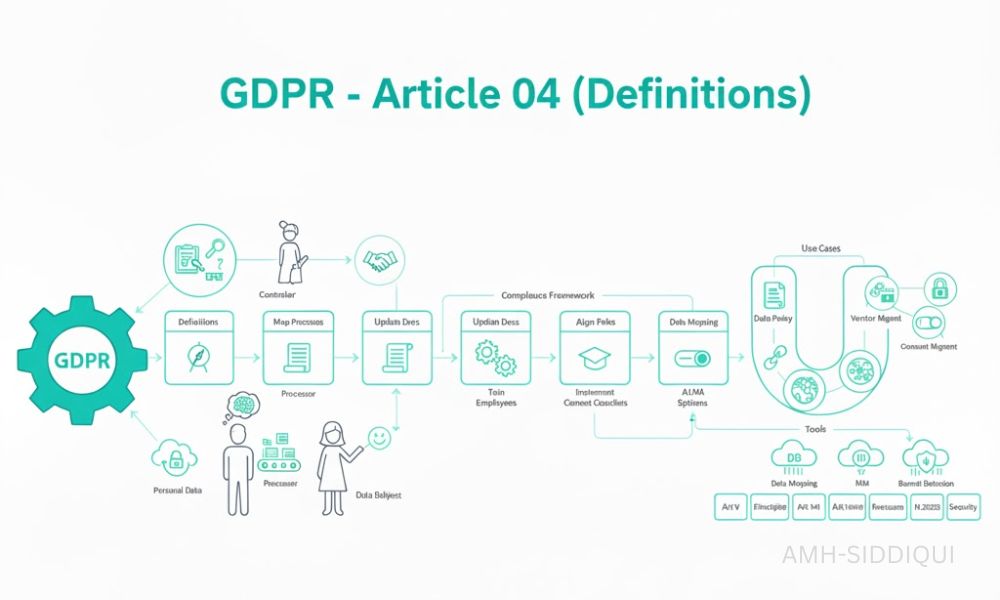
Article 4 of the EU General Data Protection Regulation (GDPR) provides 26 foundational definitions that shape how the regulation is interpreted and applied. These definitions establish the meaning of critical terms, such as personal data, processing, controller, processor, and consent, and they serve as the backbone for every compliance requirement in the GDPR. Without understanding these terms, organizations cannot implement the regulation properly, nor can individuals fully understand their rights. This article breaks down the purpose of Article 4, explains its significance, highlights key definitions, and outlines activation steps, dependencies, tools, and use cases to help organizations build a strong GDPR compliance framework.
Explanation
Article 4 does not impose direct obligations; instead, it acts as the dictionary of the GDPR. These definitions provide the legal building blocks that every subsequent article relies upon.
For example:
- You cannot understand what “data processing” obligations are without knowing what “processing” legally means.
- You cannot know who is responsible for what without understanding “controller” vs. “processor.”
- You cannot apply “data protection by design” unless you understand what counts as “personal data.”
Because GDPR applies across different industries, sectors, cultures, and jurisdictions, Article 4 makes sure standardized meaning across all contexts. Every organization working with EU personal data must align its internal policies and operational workflows with these definitions.
Key Points
Below are some of the most important definitions from Article 4:
- Personal Data: Any information relating to an identified or identifiable natural person. This includes names, emails, IDs, IP addresses, biometrics, and more.
- Processing: Any operation performed on personal data, collecting, recording, storing, structuring, analyzing, sharing, or deleting.
- Controller: The entity that determines the purposes and means of processing. They make the decisions.
- Processor: The entity that processes data on behalf of the controller. They follow instructions.
- Consent: A freely given, specific, informed, and unambiguous indication of the data subject’s wishes.
- Personal Data Breach: A security incident leading to accidental or unlawful destruction, loss, alteration, unauthorized disclosure, or access.
- Pseudonymisation: Replacing identifiers with artificial labels to reduce risk.
- Profiling: Automated processing used to evaluate personal aspects such as behavior, preferences, or performance.
- Third Party: Anyone other than the data subject, controller, processor, or those authorized under their authority.
- Recipient: Any person or entity that receives personal data, whether or not they are a third party.
Understanding these key definitions ensures clarity and consistency in how data protection responsibilities are assigned and carried out.
General Activation Steps
Organizations can operationalize Article 4 by ensuring all internal policies, contracts, and workflows align with the definitions. Here’s a step-by-step approach:
- Map all terms to internal processes: Identify how each definition applies to your organization. This includes Who is the controller? Are there processors involved? What personal data is handled?
- Update internal documentation: Policies, guidelines, and data processing agreements must use GDPR-accurate definitions.
- Align roles and responsibilities: Job descriptions, access rights, and data-handling duties should reflect Article 4 roles such as: Data Controller, Data Processor, Data Protection Officer (DPO)
- Review processing activities: Ensure that all operations fit within the GDPR definition of “processing,” and evaluate if lawful bases apply.
- Implement consent standards: Rebuild consent mechanisms to comply with Article 4’s strict definition of valid consent.
- Train employees: Staff must understand basic Article 4 terminology, especially those handling personal data.
- Update contracts: Controller–processor contracts must explicitly reference GDPR definitions to avoid ambiguity.
- Establish breach classification criteria: Use the GDPR’s definition of a “personal data breach” to design incident response procedures.
Use Cases
Building a Data Protection Policy: Article 4 definitions help craft policies that match the legal language of the GDPR and create consistent understanding across departments.
- Vendor Management: Organizations use Article 4 to Identify “processors”, Assign responsibilities, evaluate third-party risks and Design correct Data Processing Agreements (DPAs)
- Consent Management Systems: Platforms that manage customer consent rely on the specific definition of “consent” to ensure validity and auditability.
- Data Mapping and Inventory: Article 4 helps categorize Personal data types, Data subjects, Purposes of processing, and Recipients and transfers. This enables accurate record-keeping under Article 30.
- Incident Response: The legal definition of a “personal data breach” determines when an incident qualifies as a breach, when to notify supervisory authorities, whether to inform affected individuals
- AI and Automated Decision-Making: The definition of “profiling” is critical for ML/AI systems that analyze or predict user behavior.
Dependencies
To implement Article 4 correctly, organizations must also understand:
- Article 5: Principles of processing
- Article 6: Lawful bases
- Article 7: Consent conditions
- Article 13/14: Information notices
- Article 17: Right to erasure
- Article 30: Record of processing activities
- Article 32: Security of processing
These articles rely heavily on Article 4’s definitions for proper interpretation.
Tools and Technologies
Organizations often use the following tools to operationalize Article 4:
- Data Mapping Software
- OneTrust
- Collibra
- BigID
- Consent Management Systems (CMPs)
- Cookiebot
- TrustArc
- Osano
- Identity & Access Management (IAM) Tools
- Okta
- Azure AD
- Breach Detection & Incident Response Tools
- SIEM systems (Splunk, IBM QRadar)
- Endpoint detection tools
- Contract Lifecycle Management Tools: Used to embed GDPR definitions into Data Processing Agreements.
Let’s Wrap
Article 4 is more than a glossary; it is the foundation upon which the entire GDPR framework stands. The 26 definitions shape responsibilities, rights, obligations, and compliance expectations for controllers, processors, and any entity handling personal data. By fully understanding and operationalizing these terms, organizations can build a strong, legally accurate, and consistent data protection ecosystem. This article provides the essential knowledge and practical steps to ensure Article 4 becomes a functional part of your GDPR compliance strategy rather than a mere list of definitions.
For Your Further Reading:
- Data Management – Security Metrics
- Data Security – Tools
- Content Management – Recordkeeping Principles
- Data Management – Knowledge and Semantic Modeling / Search
- ECM – Enterprise Content Management and Content Metadata
- Climate Change
- Data Management – Define Data Security Standards
- Data Management – DAM, Data Map, e-Discovery and EDRM
- Data Management – Data Security Policy
- Data Management – Record Management
- Data Management – Document Management
- Kidney
- Data Security – Types, Restrictions and Risks
- Data Security – Essential Concepts
- Data Security – Goals and Principles
- Data Security – Initiation
- Data Security – At a Glance
