










Abstract
EU GDPR Article 5 is widely recognized as the cornerstone of data protection regulations. Essentially, it establishes the fundamental principles that every organisation must follow when processing personal data. These principles ensure that individuals’ rights, privacy, and freedoms are respected at all times. More importantly, they act as a comprehensive guide for lawful, ethical, and transparent data handling. Therefore, whether you are a business owner, a data protection officer, or simply someone curious about GDPR compliance, understanding Article 5 is crucial. It provides the essential framework for building trust with customers and maintaining robust data governance practices.
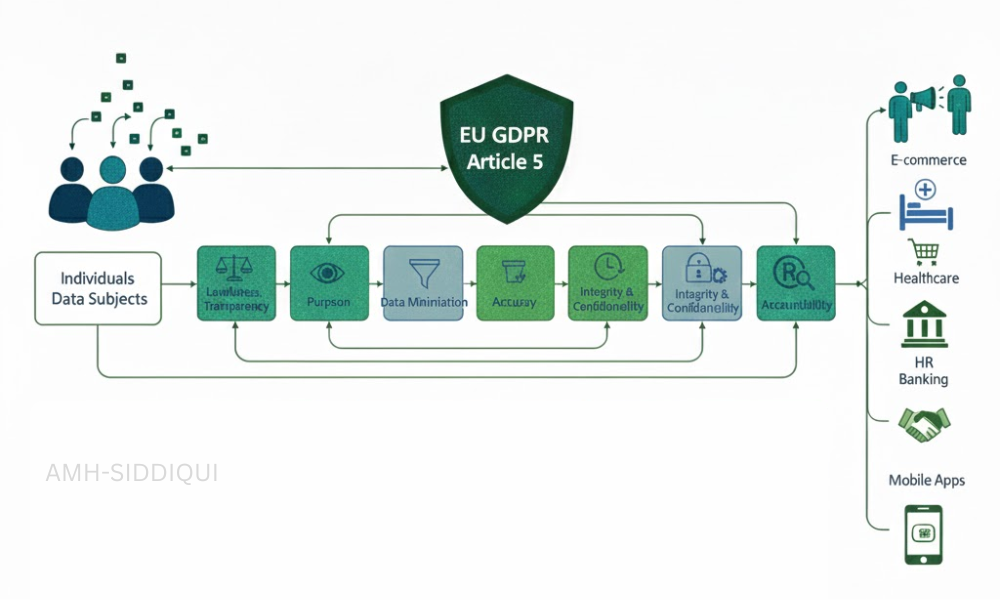
Explanation
To begin with, EU GDPR – Article 5 (Principles Relating to Processing of Personal Data) defines how personal data should be processed, rather than prescribing technical methods. It lays down universal principles applicable to all organisations that handle personal data, regardless of size or sector.
In other words, it serves as a guideline to ensure that data processing is lawful, fair, and transparent. Furthermore, the regulation stresses that personal data must be handled with respect, clarity, and purpose. Organisations are expected to be upfront about what data they collect, the reasons for collecting it, and the duration for which it will be retained. Moreover, Article 5 highlights the importance of accuracy, security, and accountability.
In simple terms, this Article communicates:
“Process personal data responsibly, ethically, and only to the extent necessary.” Ultimately, the principles of Article 5 not only protect individual privacy but also enhance operational efficiency and build public trust. Therefore, it is essential for organisations to embed these principles into their everyday processes.
Key Points
Article 5 includes seven fundamental data processing principles:
- Lawfulness, Fairness, and Transparency: First and foremost, personal data must be processed legally, fairly, and transparently. Organisations must inform individuals about the purposes and methods of data collection. Additionally, individuals have the right to understand how their data will be used.
- Purpose Limitation: Next, data should only be collected for specific, explicit, and legitimate purposes. Furthermore, using the data for unrelated objectives without the individual’s consent is strictly prohibited.
- Data Minimisation: Equally important, organisations must only collect data that is strictly necessary. Avoiding excessive data collection not only ensures compliance but also reduces the risk of data breaches.
- Accuracy: Moreover, personal data must be accurate and, when necessary, kept up-to-date. Organisations are required to correct any inaccuracies without delay, which helps maintain reliability and trust.
- Storage Limitation: In addition, data should not be retained longer than necessary. Establishing clear retention policies and securely deleting outdated data is critical for GDPR compliance.
- Integrity and Confidentiality: Equally, data must be protected against unauthorized access, loss, or damage. Implementing robust technical and organisational security measures is essential for safeguarding personal information.
- Accountability: Finally, organisations must demonstrate compliance with GDPR principles. This involves maintaining documentation, conducting audits, and ensuring internal processes are robust.
These principles protect individuals’ privacy and help organisations build more efficient and trustworthy data systems.
General Activation Steps
Activating the Article 5 principles within the organisation, consider the given steps below:
- Map All Data Processing Activities: Begin by identifying all personal data collected, its source, and how it is used.
- Define Clear Purposes: Ensure that every data point has a specific, documented purpose.
- Review Consent and Lawful Bases: Verify that every processing activity has a legal basis, such as consent, contractual obligation, or legitimate interest.
- Implement “Data Minimisation by Design”: Limit data collection to only what is necessary and review systems periodically.
- Maintain Accurate Data: Establish processes allowing individuals to update or correct their personal data.
- Establish Retention Schedules: Define clear storage timelines and automate secure deletion where possible.
- Strengthen Security Controls: Use encryption, access control, authentication, and regular security audits.
- Document Everything: Maintain records, policies, DPIAs, and training logs to demonstrate compliance.
- Train Your Team: Ensure that all employees understand GDPR principles and data handling responsibilities.
By following these steps, organisations can embed compliance into daily operations, thereby reducing risks and building trust with stakeholders.
Use Cases
To illustrate, Article 5 applies across industries and organisational contexts. Consider the following examples:
- E-Commerce: Online stores must only collect relevant customer information and explain clearly how it will be used, such as for shipping or billing.
- Healthcare: Hospitals must ensure patient data is accurate, secure, and used solely for medical purposes, not marketing.
- Banking and Finance: Financial institutions need to store sensitive data securely and maintain accuracy to prevent fraud.
- HR and Recruitment: HR departments must retain job applicants’ data only as long as necessary and maintain transparency in usage.
- Marketing Agencies: Consent must be obtained before contacting individuals, and data usage must align with approved campaigns.
- Mobile Apps: Apps must explain why they request permissions “in plain language” and avoid collecting unnecessary data.
These examples show that Article 5 is universal, any organisation dealing with personal data must follow it.
Dependencies
To comply successfully with Article 5, companies may rely on:
- GDPR Article 6 – Lawful bases for processing
- GDPR Article 13 and 14 – Transparency and information obligations
- GDPR Article 24 and 25 – Controller responsibility and data protection by design
- GDPR Article 30 – Record-keeping requirements
- DPIAs (Data Protection Impact Assessments)
- Internal data governance frameworks
Compliance does not happen in isolation; it requires alignment with other GDPR articles and organisational policies.
Tools and Technologies
To implement GDPR principles effectively, companies often use:
- Consent management platforms (CMPs)
- Data governance software
- Encryption and tokenization tools
- Access control systems
- Data loss prevention (DLP) tools
- Identity and access management (IAM) systems
- Secure cloud storage solutions
- Automated data retention/deletion systems
These tools help organisations enforce data minimisation, improve transparency, and strengthen security.
Let’s Wrap
In conclusion, EU GDPR Article 5 is not just a legal obligation; it is a blueprint for ethical, responsible, and transparent data processing. By following its principles, organisations enhance trust, mitigate risk, and build stronger data governance frameworks. Moreover, embedding these principles into daily operations ensures that personal data is handled securely, efficiently, and ethically. Ultimately, compliance with Article 5 benefits both individuals and organisations, fostering a safer digital ecosystem for everyone.
For Your Further Reading:
- ISMS – ISO/IEC-27001:2013 – Annex A
- Digital Learning: The New Era
- Self-Paced Learning Program
- Data Security in Data Management
- Data Modeling – Metrics and Checklist
- Content Management – Terms Management
- Data Modeling – Schema and Notation
- Data Modeling – De-Normalization and Canonical Model
- Normalization
- Benefits of Online Education
- Data Masking – Data Subsetting
- Data Modeling – Arity of Relationships
- Content Modeling – Controlled Vocabularies and Format
- Data Modeling – Identifiers / Keys
- Why choose Virtual Learning?
- Content Modeling and Delivery Methods
- What is The Difference between Diffusion and Osmosis?
