










Abstract
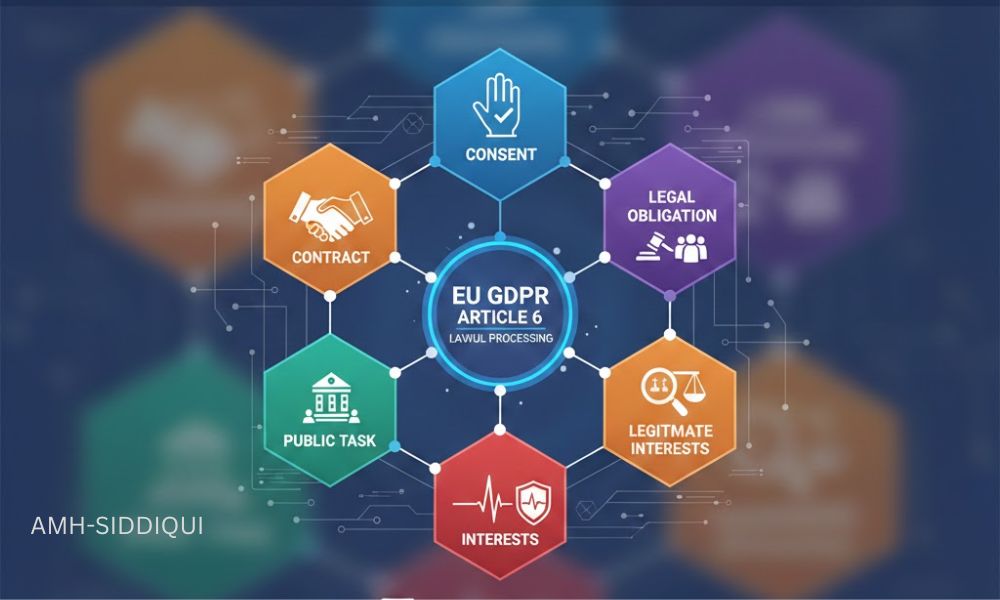
EU GDPR – Article 6 (Lawfulness of Processing) is one of the most powerful, influential, and foundational components of European data protection law. To begin with, it defines exactly when processing personal data becomes lawful and outlines six specific legal bases that organisations must rely on before collecting, using, storing, or sharing any personal information. Moreover, under the GDPR, it is strictly illegal to process personal data without identifying at least one valid legal basis. As a result, this rule ensures that individuals maintain meaningful control over their personal data while simultaneously encouraging organisations to operate transparently, responsibly, and ethically. In addition, understanding Article 6 is essential not only for legal compliance but also for operational efficiency, risk reduction, and maintaining public trust in today’s digital environment where data flows continuously, rapidly, and often invisibly across systems and borders.
Explanation
At the very heart of GDPR lies a simple but powerful rule: no processing of personal data is permitted unless a legally justified reason exists. Furthermore, Article 6 clarifies precisely what those reasons are and how organisations must apply them. Before any processing begins, organisations must select one legal basis, document it, communicate it, and stay consistent with it. However, once a legal basis has been chosen, changing it later is not allowed unless a completely new purpose emerges that fully complies with GDPR.
The six legal grounds work like a structured checklist. In other words, if at least one ground is satisfied, processing becomes lawful; if not, the processing is strictly prohibited. Consequently, this framework supports fairness, prevents arbitrary data use, and protects individuals from misuse of their personal information.
Six Lawful Bases
Here are the six lawful bases explained more fully:
- Consent: Consent must be explicit, informed, specific, and freely given. Individuals must understand what they are agreeing to. Additionally, they must have an easy way to withdraw that consent whenever they want, and organisations must respect that withdrawal immediately.
- Contract: If personal data is required to deliver a service, fulfil an agreement, or prepare for entering into a contract, this basis applies. For example, collecting a shipping address to deliver a product is contract-based processing.
- Legal Obligation: Certain laws require organisations to process personal data, such as tax laws, employment laws, or financial regulations. Therefore, when a government mandates this, organisations must comply even if the individual disagrees.
- Vital Interests: This basis is used only in extreme emergencies where the processing of personal data is necessary to protect someone’s life or physical safety. It is rare yet important in crisis situations.
- Public Task: Organisations performing tasks in the public interest, including universities, government agencies, and public-sector bodies, may rely on this basis. However, the task must be rooted in law and tied to public benefit.
- Legitimate Interests: This is the most flexible basis. It applies when processing is necessary for an organisation’s legitimate purpose, as long as that purpose does not outweigh the individual’s rights. Consequently, a balancing test is required to justify this basis.
Key Points
- Consent Must Be High-Quality
- Must be active, not passive
- Requires a clear explanation of what will be done with the data
- Individuals must be able to opt out easily
- Cannot be bundled with other terms
- Contractual Necessity Is Specific
- Applies only when data is essential to fulfil the contract
- Should not be used to justify unrelated marketing or analytics
- Legal Obligation Is Mandatory
- Organisations cannot avoid or negotiate these requirements
- Typical areas include accounting, labour law, anti-fraud obligations
- Vital Interests Are Rare
- Mostly used in medical or emergency contexts
- Not applicable for routine business purposes
- Public Task Requires Authority
- Must be supported by an official legal obligation
- Often used by institutions handling research, public records, or governmental duties
- Legitimate Interest Requires a Balancing Test
- Assess whether the purpose is necessary
- Document the risks and protections
- Avoid using this basis for intrusive activities without safeguards
General Activation Steps
Proper implementation of Article 6 requires a systematic and documented approach. Therefore, organisations should follow the steps below:
- Step 1: Identify the Purpose: Define exactly why you need the personal data. Without this clarity, you cannot justify processing.
- Step 2: Pick the Right Legal Basis: Match each processing activity to one of the six lawful grounds. In many cases, different purposes may require different bases.
- Step 3: Document Your Decision: GDPR expects organisations to maintain a clear record showing:
- Why the processing is necessary
- Which legal basis applies
- How the conclusion was reached
- This documentation is crucial for audits and accountability.
- Step 4: Inform Individuals Transparently: Your privacy notice must explain:
- What data you’re collecting
- Why you’re collecting it
- The legal basis powering the processing
- How individuals can exercise their rights
- Step 5: Maintain Compliance Through Regular Reviews: Businesses evolve, and likewise, your compliance must evolve too. Conduct routine audits to ensure:
- Processing activities still align with the chosen legal basis
- No new purposes have been added without assessment
- Step 6: Apply GDPR Core Principles: Even with a legal basis, organisations must still follow principles such as:
- Data minimisation
- Storage limitation
- Integrity and confidentiality
- Purpose limitation
- Accuracy
Use Cases
Below are more detailed examples illustrating how each legal basis works in practice. For instance:
- Consent
- Subscribing to a newsletter
- Collecting user preferences for personalisation
- Consent for cookies or tracking technologies
- Participation in non-essential surveys or marketing campaigns
- Contract
- Collecting billing information for subscription platforms
- Processing job applications where data is needed for hiring
- Managing online shopping orders, accounts, or refunds
- Legal Obligation
- Keeping payroll records for government inspection
- Maintaining health-and-safety reports
- Identity verification required by financial regulations
- Vital Interests
- Sharing allergy or medical information with emergency medical teams
- Reporting critical information during natural disasters
- Public Task
- Universities conducting research funded by legislation
- Municipal authorities processing citizen records
- Public libraries managing membership systems
- Legitimate Interests
- Monitoring office premises using CCTV
- Analysing website behaviour for improvement
- Preventing financial fraud
- Basic direct marketing with opt-out options
Dependencies
To fully support lawful processing under Article 6, organisations need several foundational elements. These include, for example:
- Data governance policies defining lawful processing standards
- Records of Processing Activities (RoPA)
- Legal consultation, especially when using legitimate interests
- Data Protection Impact Assessments (DPIAs) for high-risk processing
- Employee awareness and training programmes
- Technical security measures such as encryption, firewalls, IAM solutions
- These dependencies ensure that compliance is integrated at every operational level.
Tools and Technologies
Companies often rely on modern tools to ensure Article 6 compliance. Among the most widely used are:
- Consent Management Platforms (CMPs) for banners, opt-ins, and withdrawal tracking
- Data discovery and mapping tools to visualise how data flows through systems
- Workflow engines and compliance software to automate documentation
- Identity and Access Management (IAM) systems for role-based data control
- Audit tools for ongoing monitoring and reporting
- Encryption and pseudonymisation tools to protect sensitive information
- These technologies reduce compliance efforts while strengthening data security.
Let’s Wrap
EU GDPR Article 6 serves as the legal backbone of data protection rules, ensuring that every piece of personal data is collected with respect, fairness, and a clearly defined purpose. Ultimately, organisations that apply Article 6 correctly build stronger customer trust, reduce legal exposure, and improve operational clarity. Additionally, by choosing the right legal basis, keeping thorough records, and remaining transparent with individuals, organisations not only follow the law but also build a culture of responsibility and ethical handling of data.
In summary, understanding these six legal bases is both a GDPR requirement and a practical roadmap for building smarter, safer, and more trustworthy data governance across any organisation.
For Your Further Reading:
- Data Quality Rules
- Data Quality – Improvement (Part 1)
- Data Quality Assessment
- RDM – Reference Data Management
- Data Management – What is Master Data?
- Reference and Master Data Management – Guiding Principles
- Data Quality – Parsing and Transformation
- Data Quality – Cleansing and Enrichment
- Data Quality – Data Profiling
- Data Quality – Causes of Data Quality Issues – Part-03
- Data Quality – Causes of Data Quality Issues – Part-02
- Data Quality – Business Rules
- Data Quality Programs – Guidance and Principles
- Data Quality – Core Dimensions
- Data Quality – Momentary Look
- Data Warehouse / Business Intelligence Projects – Critical Success Factors
- Data Quality – Causes of Data Quality Issues – Part-01
