










Abstract
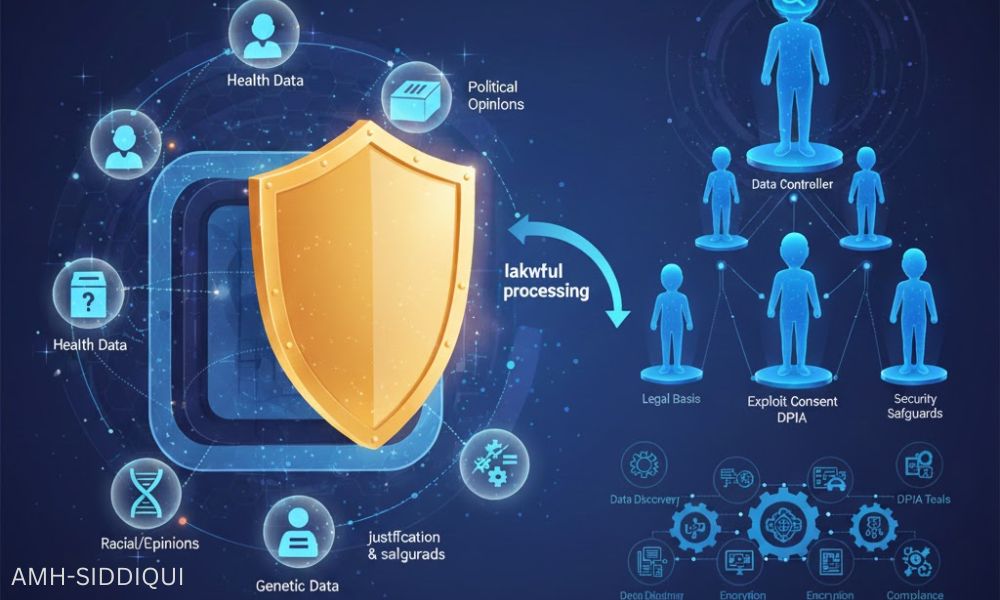
EU GDPR Article 9(Processing Special Categories of Personal Data) is one of the most sensitive and critical provisions within the General Data Protection Regulation. While GDPR generally governs all personal data, Article 9 goes a step further by imposing strict limitations on processing special categories of personal data. These include information revealing racial or ethnic origin, political opinions, religious or philosophical beliefs, trade union membership, genetic data, biometric data, health data, sex life, and sexual orientation.
In principle, the processing of such data is prohibited. However, under specific and carefully defined circumstances, such as explicit consent, legal obligations, or vital interests, processing may be permitted. Consequently, Article 9 ensures stronger protection for individuals while also providing limited flexibility for organisations that have legitimate reasons to process highly sensitive data.
Explanation
To begin with, Article 9 recognises that not all personal data carries the same level of risk. While names or email addresses are personal data, information about a person’s health, religion, or political beliefs can expose them to discrimination, harm, or social exclusion if misused. Therefore, GDPR treats these categories with extra caution. As a general rule, organisations are not allowed to process special category data. Nevertheless, GDPR acknowledges that certain situations make such processing unavoidable. For this reason, Article 9 outlines specific legal grounds under which processing becomes lawful.Moreover, the regulation places the responsibility squarely on data controllers. Not only must they identify a valid exception under Article 9, but they must also ensure transparency, data minimisation, and strong security safeguards. In short, Article 9 is about balancing fundamental rights with practical necessity.
Key Points
- First and foremost, Article 9 defines special categories of personal data, which include:
- Racial or ethnic origin
- Political opinions
- Religious or philosophical beliefs
- Trade union membership
- Genetic data
- Biometric data (used for identification)
- Health data
- Data concerning a person’s sex life or sexual orientation
- Secondly, the general rule is clear: processing this data is prohibited. Nevertheless, processing may be lawful if at least one of the following conditions applies:
- The data subject has given explicit consent
- Processing is necessary for carrying out obligations in employment, social security, or social protection law
- Processing is required to protect vital interests where the data subject is incapable of giving consent
- Data has been manifestly made public by the data subject
- Processing is necessary for legal claims
- Processing is required for substantial public interest
- Processing is necessary for healthcare or public health purposes
- Processing is required for archiving, research, or statistical purposes
Thus, organizations must not only identify the data category but also clearly justify the legal basis before proceeding.
General Activation Steps
- When an organization intends to process special category data, it must follow a structured and compliant approach. First of all, the organization should identify whether the data truly falls under Article 9. This step is crucial because misclassification can lead to severe compliance failures.
- Next, the organization must determine the lawful exception under Article 9(2). For instance, if relying on explicit consent, that consent must be freely given, specific, informed, and clearly documented.
- After that, organizations should conduct a Data Protection Impact Assessment (DPIA). This is especially important because special category data processing is considered high risk by default.
- Furthermore, appropriate technical and organizational measures must be implemented. These may include encryption, access controls, data minimization, and staff training.
- Finally, organizations must ensure ongoing monitoring and documentation, demonstrating accountability and readiness for regulatory audits.
Use Cases
- In practice, Article 9 applies across many sectors. For example, in the healthcare industry, hospitals process health and genetic data to diagnose and treat patients. Here, processing is lawful because it is necessary for medical purposes and subject to professional confidentiality.
- Similarly, in the employment sector, employers may process health data to assess workplace accommodations or sick leave entitlements. However, such processing must strictly align with labor laws and remain proportionate.
- In addition, research institutions often process sensitive data for scientific or statistical research. In these cases, safeguards such as anonymization or pseudonymization are essential.
- Moreover, government authorities may process biometric or ethnic data for reasons of substantial public interest, such as public health monitoring, provided legal safeguards are clearly defined Thus, while Article 9 is restrictive, it does not prevent essential societal functions.
Dependencies
- Article 9 does not operate in isolation. Instead, it closely depends on other GDPR provisions. For instance, Article 6 must still be satisfied, meaning a valid lawful basis for processing is required in addition to an Article 9 exception.
- Furthermore, Article 5 principles, such as lawfulness, fairness, transparency, data minimization, and integrity, remain fully applicable
- Additionally, Article 7 plays a crucial role when explicit consent is used as the legal ground. The consent must be demonstrable and withdrawable at any time.
- Likewise, Articles 24, 25, and 32 require controllers to implement privacy by design, privacy by default, and appropriate security measures
- Consequently, compliance with Article 9 requires a holistic GDPR strategy, not a standalone effort.
Tools and Technologies
To effectively manage Article 9 compliance, organizations often rely on specialized tools.
- First, Data Discovery and Classification Tools help identify where special category data is stored across systems.
- Next, Consent Management Platforms allow organizations to collect, record, and manage explicit consent efficiently.
- Additionally, DPIA Tools support risk assessments and documentation, ensuring compliance with high-risk processing requirements.
- Security-focused solutions such as encryption, access control systems, and secure identity management are also essential to prevent unauthorized access.
- Finally, Compliance Management Software helps centralize policies, training records, incident logs, and audit trails, reinforcing accountability.
Let’s Wrap
In conclusion, EU GDPR Article 9 represents one of the strongest privacy safeguards within the regulation. By default, it prohibits the processing of highly sensitive personal data, thereby protecting individuals from discrimination, harm, and misuse of their most private information.
At the same time, Article 9 provides carefully designed exceptions that enable essential activities, such as healthcare, employment compliance, legal proceedings, and research, to continue lawfully.
Ultimately, organizations that process special category data must act with heightened responsibility. Through clear legal justification, robust safeguards, and continuous monitoring, compliance with Article 9 becomes not just a legal obligation, but a commitment to ethical data handling and respect for human dignity.
For further reading:
- KSA PDPL – Personal Data Protection Law – Key Aspects and Mandatory Clauses
- EU GDPR – Article 8 (Conditions Applicable to Child’s Consent in Information Society Services)
- Difference between Architecture and Architectural Diagram
- KSA NDMO – Personal Data Protection – PDP Plan – PDP.1.2 Priority 1
- Digital Marketing Overview with Some Examples
- TOGAF – ADM (Architecture Development Method) vs. Enterprise Continuum
- EU GDPR – Article 7 (Conditions for Consent)
- EU GDPR – Article 6 (Lawfulness of Processing)
- EU GDPR – Article 4 (Definitions)
- EU GDPR – Article 3 (Territorial Scope)
- EU GDPR- Article 2 (Material Scope)
- EU GDPR- Article 01 (Subject-matter and objectives)
- BDaaS (Big Data As-a-Service) – Data Governance Frameworks
- EU GDPR – Article 4 (Definitions)
- Big Data and Great Privacy Challenges in the Digital Era – A Comprehensive Study
- KSA PDPL – Article 5 (Consent Management and Withdrawal Mechanism)
- KSA PDPL – Article 33 (Accreditation, Licensing and Compliance Mechanisms)
