










Abstract
In today’s data-driven world, individuals increasingly want to understand how their personal information is being collected, stored, and used. Article 15 of the EU General Data Protection Regulation (GDPR) directly addresses this concern by granting data subjects the Right of Access. Essentially, this right allows individuals to confirm whether their personal data is being processed and, if so, to obtain detailed information about that processing. As a result, Article 15 plays a vital role in promoting transparency, accountability, and trust between organisations and individuals. This article explores Article 15 in depth, explains how it works in practice, and highlights its importance within the broader GDPR framework.
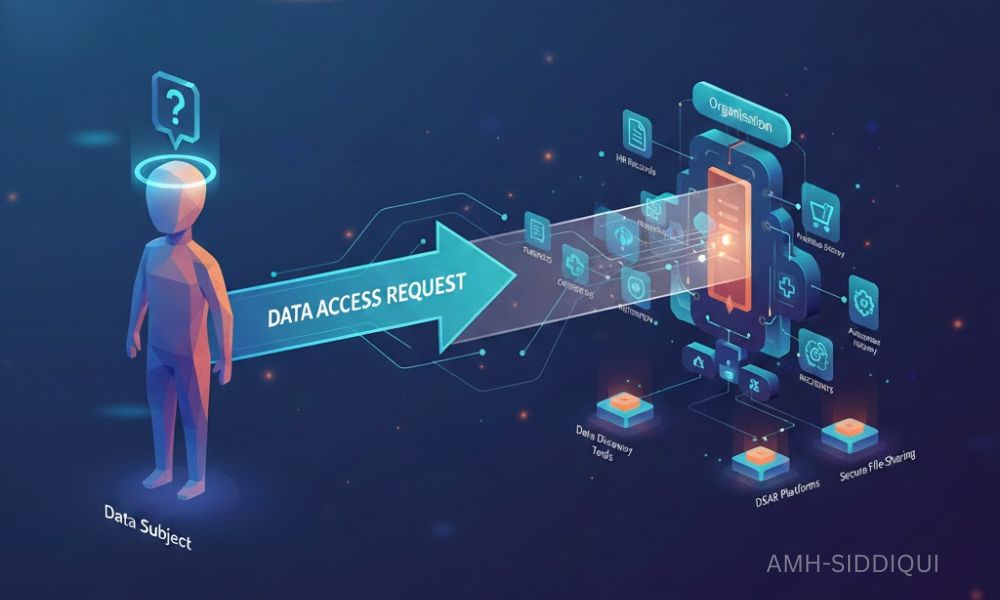
Explanation
To begin with, Article 15 empowers data subjects by giving them visibility into how organisations handle their personal data. Specifically, it allows individuals to ask a simple yet powerful question: “Is my personal data being processed, and if yes, how?”
If the answer is yes, the organisation must provide access to the personal data itself along with essential background information. Moreover, this information must be meaningful and not vague or misleading. In other words, organisations cannot merely confirm processing; they must clearly explain it.
This includes details such as:
- The purposes of processing
- Categories of personal data involved
- Recipients or categories of recipients
- Data retention periods
- The source of the data (if not collected directly)
Additionally, if personal data was not collected directly from the individual, the organisation must explain the source of the data. This requirement further strengthens transparency and helps individuals understand how their information entered the organisation’s systems.
Most importantly, Article 15 acts as a gateway right. Without access to their data, individuals would not be able to effectively exercise other rights, such as correcting inaccurate data or requesting its deletion. Therefore, the Right of Access forms the foundation upon which many other GDPR rights depend.
Key Points
- First and foremost, data subjects have the right to confirm whether processing is taking place.
- In addition, they can request a copy of their personal data, not just a description of it.
- Organisations must clearly explain the purpose and legal basis of processing activities.
- Furthermore, information about data recipients and international transfers must be provided.
- Data subjects must be informed of their related rights, including rectification, erasure, and restriction.
- Responses must generally be provided within one month of receiving the request.
- Lastly, access must usually be provided free of charge, ensuring the right remains accessible to everyone.
General Activation Steps
To activate the Right of Access, a data subject does not need to follow complex procedures. GDPR deliberately keeps this process simple.
- Submission of Request: The individual submits a request, often called a Data Subject Access Request (DSAR). This can be made via email, online form, letter, or even verbally.
- Verification of Identity: Organisations may verify the requester’s identity to prevent unauthorised disclosure of personal data.
- Data Collection and Review: The organisation identifies all systems, databases, and third parties where the individual’s data may be stored.
- Preparation of Response: Personal data is compiled, reviewed, and redacted where necessary to protect third-party rights.
- Delivery of Information: The response is provided securely, commonly through encrypted files or secure portals.
Use Cases
Article 15 is frequently used in both everyday and complex scenarios.
- Customers request access to data held by e-commerce platforms to understand marketing profiling or purchase history.
- Employees use the right to review HR records, performance evaluations, or monitoring data.
- Patients request access to personal data processed by healthcare providers or insurance companies.
- Users of digital platforms seek clarity on automated decision-making or profiling activities.
These use cases highlight how Article 15 supports transparency across sectors such as retail, healthcare, finance, and employment.
Dependencies
The effectiveness of Article 15 depends on several other GDPR provisions:
- Article 5 (Principles of Processing): Ensures data accuracy and transparency, making access meaningful.
- Article 12 (Transparent Communication): Defines how organisations must communicate access responses.
- Article 20 (Data Portability): Builds upon access by enabling transfer of data.
- Article 32 (Security of Processing): Ensures accessed data is shared securely.
Without strong internal governance, records of processing activities, and security controls, compliance with Article 15 becomes difficult.
Tools and Technologies
Organisations rely on various tools to manage access requests efficiently:
- Data Discovery Tools – Identify where personal data is stored across systems.
- DSAR Management Platforms – Automate request tracking, deadlines, and responses.
- Identity Verification Tools – Confirm requester identity securely.
- Access Control Systems – Ensure only authorised staff handle personal data.
- Secure File Sharing Solutions – Deliver responses safely to data subjects.
These technologies help organisations respond accurately, on time, and in compliance with GDPR requirements.
Let’s Wrap
In conclusion, Article 15 of the GDPR is a cornerstone of data subject rights. By granting individuals access to their personal data, it promotes transparency, accountability, and trust. More importantly, it enables individuals to take meaningful control of their information in an increasingly digital world.
For organisations, complying with Article 15 is not just about meeting legal obligations. Rather, it is an opportunity to demonstrate ethical data practices and strengthen relationships with customers, employees, and users.
Ultimately, when implemented effectively, the Right of Access benefits everyone, creating a more transparent, fair, and responsible data ecosystem.
For further reading:
- EU GDPR – Article 14 (Information to Provide When Personal Data Is Not Obtained from the Data Subject)
- EU GDPR – Article 13 (Information to Be Provided Where Personal Data Are Collected From the Data Subject)
- EU GDPR – Article 12 (Transparent Information, Communication, and Modalities for Exercising Data Subject Rights)
- EU GDPR – Article 11 (Processing Which Does Not Require Identification)
- EU GDPR – Article 10 (Processing Personal Data Related to Criminal Convictions and Offenses)
- EU GDPR – Article 9 (Processing Special Categories of Personal Data)
- EU GDPR – Article 8 (Conditions Applicable to Child’s Consent in Information Society Services)
- EU GDPR – Article 7 (Conditions for Consent)
- EU GDPR – Article 6 (Lawfulness of Processing)
- EU GDPR – Article 5 (Principles Relating to Processing of Personal Data)
- EU GDPR – Article 4 (Definitions)
- EU GDPR – Article 3 (Territorial Scope
- EU GDPR – Article 2 (Material Scope)
- EU GDPR – Article 1 (Subject-matter and objectives)
- Navigating the Big Data Lifecycle: From Collection to Insight
- Zero-Knowledge Proof (ZKP) – A Professional Review
- Big Data and Great Privacy Challenges in the Digital Era – A Comprehensive Study
