










Abstract
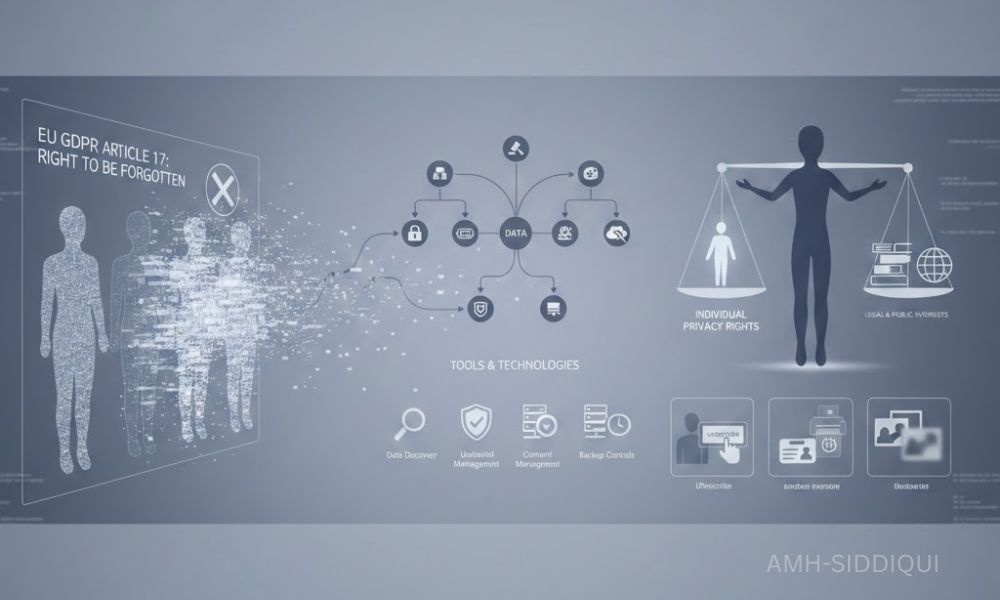
EU GDPR Article 17, commonly known as the Right to Be Forgotten or Right to Erasure, empowers individuals to request the deletion of their personal data under specific circumstances. In today’s data-driven world, personal information is continuously collected, stored, and shared across digital platforms. As a result, individuals increasingly demand greater control over their personal data. Responding to this need, the EU General Data Protection Regulation (GDPR) introduced Article 17, widely known as the Right to Be Forgotten or Right to Erasure. This provision allows data subjects, under certain conditions, to request the deletion of their personal data. However, while the right strengthens individual privacy, it is not absolute. Instead, it operates within a framework of legal obligations, public interest considerations, and fundamental rights such as freedom of expression. Consequently, Article 17 represents a careful balance between personal autonomy and societal needs.
Explanation
To begin with, Article 17 of the GDPR gives individuals the right to request the erasure of their personal data without undue delay when specific conditions apply. Essentially, this means that organizations acting as data controllers must remove personal data when it is no longer justified to keep it.
More specifically, the Right to Be Forgotten applies when personal data is no longer necessary for the purpose for which it was originally collected. Additionally, it applies when a data subject withdraws consent and no other legal basis exists for processing. Furthermore, if data has been processed unlawfully or must be erased to comply with a legal obligation, Article 17 becomes applicable.
However, it is equally important to understand that this right does not guarantee automatic deletion in every case. On the contrary, GDPR acknowledges situations where retaining personal data is necessary. Therefore, Article 17(3) outlines exceptions, including compliance with legal obligations, public interest, scientific or historical research, and the exercise of freedom of expression.
As a result, Article 17 functions not as a blanket erasure rule, but rather as a conditional right that must be assessed carefully in each individual case.
Key Points
- Data subjects can request erasure of personal data in specific situations.
- Controllers must erase data without undue delay once conditions are met.
- The right applies both to data held directly and daGeneral Activation Stepsa shared with third parties.
- Article 17 includes important exceptions that limit erasure obligations.
- Controllers must balance individual rights with legal and societal responsibilities.
General Activation Steps
To exercise the Right to Be Forgotten, a structured process is usually followed:
- Request Submission: The data subject submits a request to the data controller, typically through email, online forms, or designated privacy channels.
- Identity Verification: Controllers must verify the requester’s identity to prevent unauthorized data deletion.
- Request Evaluation: The controller assesses whether the request meets one or more Article 17 conditions, such as:
- Data is no longer necessary
- Consent has been withdrawn
- Data was unlawfully processed
- Legal obligation requires erasure
- Exception Assessment: Controllers evaluate whether any Article 17(3) exceptions apply, such as legal obligations or public interest grounds.
- Data Erasure: If valid, personal data is erased from systems, archives, and backups where technically feasible.
- Third-Party Notification: If data was shared, reasonable steps must be taken to inform other controllers or processors.
- Response to Data Subject: The controller must confirm completion or explain refusal within one month.
Use Cases
Article 17 applies across a wide range of real-world scenarios:
- Withdrawal of Consent: A user revokes consent for marketing emails and requests deletion of their contact details.
- Obsolete Data: A former employee requests deletion of personal records no longer required for legal or contractual purposes.
- Unlawful Processing: Data collected without valid consent or legal basis must be erased upon request.
- Online Reputation Management: Individuals request removal of outdated or irrelevant personal information from digital platforms, where applicable.
- Children’s Data: Data collected from minors, especially online, often qualifies for erasure when no longer justified.
Dependencies
Article 17 is closely linked with other GDPR provisions:
- Article 6 (Lawfulness of Processing): Determines whether the original processing had a valid legal basis.
- Article 7 (Consent): Withdrawal of consent directly triggers the right to erasure.
- Article 12 (Transparent Communication): Governs how erasure requests must be handled and communicated.
- Article 19 (Notification Obligation): Requires informing recipients of erased data where feasible.
- Article 21 (Right to Object): Objection to processing may lead to erasure if no overriding grounds exist.
These dependencies ensure Article 17 functions within a broader compliance ecosystem rather than in isolation.
Tools and Technologies
Organizations rely on various tools to implement the Right to Be Forgotten effectively:
- Data Discovery Tools: Identify where personal data is stored across systems and databases.
- Consent Management Platforms: Track consent status and automate withdrawal-triggered erasure workflows.
- Privacy Request Management Systems: Centralize data subject requests and ensure timely responses.
- Data Mapping Solutions: Visualize data flows to locate all instances of personal data.
- Backup and Retention Controls: Manage deletion schedules while maintaining lawful archival requirements.
- Audit and Logging Tools: Provide evidence of compliance and actions taken.
These technologies reduce manual effort and minimize the risk of non-compliance.
Let’s Wrap
In conclusion, EU GDPR Article 17 represents one of the most influential and widely discussed data protection rights. By granting individuals the Right to Be Forgotten, GDPR reinforces the principle that personal data should not exist indefinitely without justification.
At the same time, Article 17 carefully balances individual privacy with legal obligations, public interest, and fundamental freedoms. For organizations, compliance requires more than deleting records, it demands thoughtful policies, trained staff, and reliable technical systems.
Ultimately, when implemented correctly, the Right to Be Forgotten enhances trust, transparency, and accountability. In an era where data permanence is the norm, Article 17 serves as a powerful reminder that individuals retain control over their digital identities.
For further reading:
- EU GDPR – Article 16 (Right to Rectification)
- EU GDPR – Article 15 (Right of Access by the Data Subject)
- EU GDPR – Article 14 (Information to Provide When Personal Data Is Not Obtained from the Data Subject)
- EU GDPR – Article 13 (Information to Be Provided Where Personal Data Are Collected From the Data Subject)
- EU GDPR – Article 12 (Transparent Information, Communication, and Modalities for Exercising Data Subject Rights)
- EU GDPR – Article 11 (Processing Which Does Not Require Identification)
- EU GDPR – Article 10 (Processing Personal Data Related to Criminal Convictions and Offenses)
- EU GDPR – Article 9 (Processing Special Categories of Personal Data)
- EU GDPR – Article 8 (Conditions Applicable to Child’s Consent in Information Society Services)
- EU GDPR – Article 7 (Conditions for Consent)
- EU GDPR – Article 6 (Lawfulness of Processing)
- EU GDPR – Article 5 (Principles Relating to Processing of Personal Data)
- EU GDPR – Article 4 (Definitions)
- EU GDPR – Article 3 (Territorial Scope)
- EU GDPR – Article 2 (Material Scope)
- EU GDPR – Article 1 (Subject-matter and objectives)
- Navigating the Big Data Lifecycle: From Collection to Insight
