










Abstract
In the broader framework of the General Data Protection Regulation (GDPR), Article 19 plays a vital role in ensuring that data subject rights are fully respected beyond a controller’s internal systems.
While rights such as rectification, erasure, and restriction of processing are powerful on their own, Article 19 ensures these rights are not isolated actions. Instead, it requires controllers to notify all recipients of personal data whenever such changes occur. Consequently, this article strengthens transparency, reinforces accountability, and ensures that personal data remains accurate and lawful throughout its entire lifecycle.
Ultimately, Article 19 bridges the gap between internal compliance and external data-sharing responsibility.
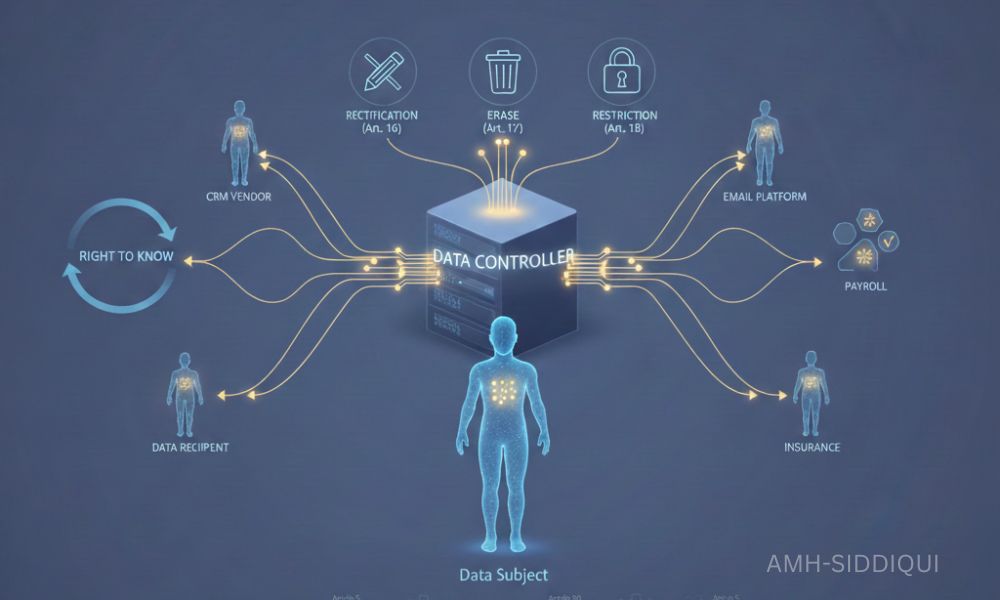
Explanation
To fully understand Article 19, it is important to look at its purpose within the GDPR ecosystem. Article 19 states that when a controller rectifies or erases personal data, or restricts its processing in accordance with Articles 16, 17, or 18, the controller must communicate these changes to every recipient to whom the personal data has been disclosed. However, this obligation does not apply if such communication proves impossible or would involve disproportionate effort.
Additionally, if the data subject requests it, the controller must inform them about those recipients. The core purpose of this article is to ensure consistency and accuracy of personal data across all entities that process it.
Without Article 19, rectification or erasure could become ineffective. For example, even if a controller deletes incorrect data internally, the same inaccurate data could still exist with partners, vendors, or processors. Article 19 prevents such gaps by extending responsibility beyond the original controller’s system.
Key Points
- Controllers must notify all recipients of personal data about rectification, erasure, or restriction of processing.
- Notification is required unless it is impossible or disproportionate.
- Applies when actions are taken under Articles 16 (rectification), 17 (erasure), and 18 (restriction).
- Data subjects have the right to know who received their data Encourages end-to-end data accuracy and compliance.
- Strengthens accountability and transparency in data sharing.
- Supports trust between data subjects, controllers, and third parties
General Activation Steps
- Trigger Event Occurs: The process begins when a data subject exercises their rights, requesting correction, deletion, or restriction of their personal data.
- Controller Verifies the Request: The controller validates the identity of the data subject and assesses the legitimacy of the request under GDPR rules.
- Action Taken on Data: The controller rectifies, erases, or restricts processing of the personal data within its systems.
- Identify Data Recipients: A record of all third parties, processors, or partners who received the data is reviewed.
- Notify Recipients: Each recipient is informed of the change and instructed to update, delete, or restrict the data accordingly.
- Document the Process: All notifications and actions are logged to demonstrate compliance.
- Inform the Data Subject (If Requested): If the data subject asks, the controller provides information about the notified recipients.
Use Cases
- Customer Data Correction: A customer updates their name or contact details. The controller corrects the data and notifies CRM vendors, email marketing platforms, and analytics providers
- Employee Data Erasure: A former employee requests data deletion. The employer erases the data internally and informs payroll processors, insurance providers, and external HR platforms.
- Marketing Opt-Out and Restriction: A user restricts the use of their data for marketing. The controller ensures all advertising partners and email service providers apply the same restriction.
- Healthcare Data Rectification: Incorrect medical information is corrected. The hospital notifies external labs, insurers, and specialist clinics that accessed the data
- Financial Record Updates: A bank rectifies inaccurate transaction data and informs credit agencies and regulatory reporting partners.
Dependencies
Article 19 does not operate independently. It relies heavily on other GDPR provisions:
- Article 16 (Right to Rectification) – defines a person’s right to have incomplete or erroneous data corrected.
- Article 17 (Right to Erasure) – this one Enables deletion of personal data.
- Article 18 (Right to Restriction of Processing) – Allows limiting data usage
- Article 5 (Data Accuracy & Integrity) – Underpins the principle of correct and up-to-date data
- Article 30 (Records of Processing Activities) – This helps in identifying recipients.
- Article 28 (Processors)– Governs obligations between controllers and processors.
Without these dependencies, Article 19 would lack practical enforceability
Tools and Technologies
To comply with Article 19 effectively, organizations rely on a combination of technical and organizational tools:
- Data Mapping & Discovery Tools: Identify where personal data is stored and which third parties receive it.
- Consent and Preference Management Platform: Track changes to data subject preferences and trigger notifications.
- CRM and ERP Systems: Centralize personal data and automate updates across integrated platforms.
- Privacy Management Software: Document compliance actions, manage data subject requests, and store audit trails.
- Workflow Automation Tools: Ensure notifications to recipients are sent promptly and consistently.
- Vendor Management Systems: Maintain updated records of processors and third-party recipients.
Let’s Wrap
In conclusion, EU GDPR Article 19 ensures that data subject rights are not limited to internal databases or isolated systems. Instead, it extends accountability to every recipient of personal data, creating a fully synchronized compliance environment. By requiring controllers to notify recipients of rectification, erasure, or restriction, Article 19 guarantees that personal data remains accurate, lawful, and up to date wherever it is processed.
This article reinforces GDPR’s accountability principle and highlights that data protection is a shared responsibility. For organizations, compliance with Article 19 is not just about sending notifications, it is about maintaining trust, transparency, and control over data throughout its lifecycle.
More importantly, this article reinforces trust between individuals and organizations. It demonstrates that data protection is not merely a legal obligation but an ongoing commitment to transparency and responsibility. When implemented effectively, Article 19 transforms individual rights into real-world outcomes, ensuring that data protection principles are upheld across the entire data-sharing ecosystem.
For further reading:
- EU GDPR – Article 18 (Right to Restriction of Processing)
- EU GDPR – Article 17 (Right to Be Forgotten)
- EU GDPR – Article 16 (Right to Rectification)
- EU GDPR – Article 15 (Right of Access by the Data Subject)
- EU GDPR – Article 14 (Information to Provide When Personal Data Is Not Obtained from the Data Subject)
- EU GDPR – Article 13 (Information to Be Provided Where Personal Data Are Collected From the Data Subject)
- EU GDPR – Article 12 (Transparent Information, Communication, and Modalities for Exercising Data Subject Rights)
- EU GDPR – Article 11 (Processing Which Does Not Require Identification)
- EU GDPR – Article 10 (Processing Personal Data Related to Criminal Convictions and Offenses)
- EU GDPR – Article 9 (Processing Special Categories of Personal Data)
- EU GDPR – Article 8 (Conditions Applicable to Child’s Consent in Information Society Services)
- EU GDPR – Article 7 (Conditions for Consent)
- EU GDPR – Article 6 (Lawfulness of Processing)
- EU GDPR – Article 5 (Principles Relating to Processing of Personal Data)
- EU GDPR – Article 4 (Definitions)
- EU GDPR – Article 3 (Territorial Scope)
- EU GDPR – Article 2 (Material Scope)
