










Abstract
EU GDPR Article 30 introduces a critical accountability requirement for organizations that process personal data: the obligation to maintain Records of Processing Activities (RoPA). Rather than being a mere administrative task, these records serve as tangible proof of compliance, transparency, and responsible data governance. Article 30 requires controllers and processors, or their representatives, to document how personal data is collected, used, stored, shared, and protected. This article explains what Article 30 entails, who must comply, what information must be recorded, and how organizations can practically implement and manage this requirement to strengthen their overall GDPR compliance framework.
Explanation
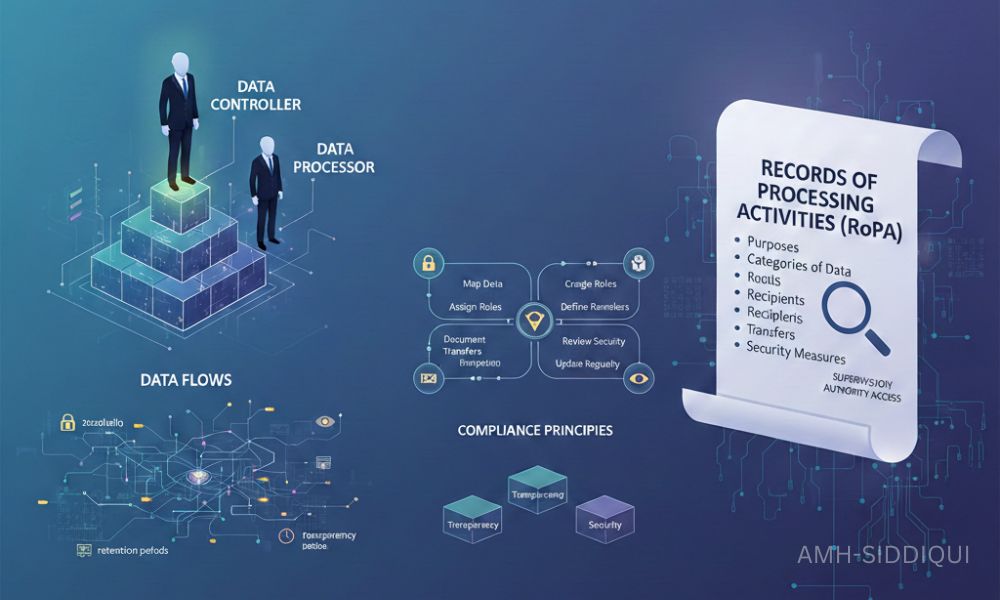
Article 30 of the General Data Protection Regulation (GDPR) focuses on documentation and accountability. It mandates that controllers and processors maintain written records of their personal data processing activities. These records must be made available to supervisory authorities upon request.
The purpose of this article is to ensure that organizations fully understand and can demonstrate how personal data flows through their systems. By maintaining detailed records, organizations can identify risks, improve data protection measures, and respond more effectively to regulatory inquiries or data subject requests.
While there is a limited exemption for organizations with fewer than 250 employees, this exemption does not apply if processing is ongoing, involves special categories of data, or poses a risk to individuals’ rights and freedoms. As a result, most businesses, regardless of size, are required to maintain some form of processing records.
Key Points
- Controllers must document all categories of processing activities under their responsibility.
- Processors also have obligations to record processing activities carried out on behalf of controllers.
- Records must be written, which includes electronic formats.
- Documentation must be accurate, up to date, and readily available for supervisory authorities.
- Required details include:
- Name and contact details of the controller, processor, and DPO (if applicable)
- Purposes of processing
- Categories of data subjects and personal data
- Categories of recipients
- Transfers to third countries and safeguards used
- Retention periods
- Technical and organizational security measures
- Small organizations are not automatically exempt if their processing is regular or sensitive.
- Records support compliance with other GDPR principles such as transparency, data minimization, and security.
General Activation Steps
Implementing Article 30 effectively requires a structured and methodical approach. Below are the general steps organizations can follow:
- Map All Data Processing Activities: Begin by identifying every activity where personal data is collected, used, stored, or shared. This includes HR data, customer information, marketing databases, and vendor processing.
- Identify Roles and Responsibilities: Clearly determine whether your organization acts as a controller, processor, or both. Assign responsibility for maintaining and updating records, typically to compliance teams or a Data Protection Officer.
- Create a Standardized RoPA Template: Develop a consistent format that captures all required Article 30 information. This ensures clarity and uniformity across departments.
- Document Data Flows and Transfers: Record where data originates, where it is stored, and whether it is transferred outside the EU, including safeguards such as Standard Contractual Clauses.
- Define Retention Periods: Specify how long each category of personal data is retained and the criteria used to determine retention.
- Review Security Measures: Document technical and organizational measures such as encryption, access controls, and staff training.
- Review and Update Regularly: Records should be reviewed periodically and updated whenever processing activities change.
Use Cases
Article 30 records are valuable in many real-world situations, including:
- Regulatory Audits: When a supervisory authority requests information, RoPA serves as immediate proof of compliance.
- Data Protection Impact Assessments (DPIAs): Accurate records help identify high-risk processing activities that require DPIAs.
- Responding to Data Subject Requests: Records make it easier to locate personal data and respond to access, rectification, or erasure requests.
- Third-Party Risk Management: Organizations can better evaluate processors and ensure contractual GDPR compliance.
- Internal Compliance Reviews: RoPA supports internal audits and continuous improvement of data protection practices.
Dependencies
Article 30 is closely connected with several other GDPR provisions, making it a foundational compliance requirement:
- Article 5 (Principles of Processing) – Records help demonstrate lawfulness, purpose limitation, and data minimization.
- Article 24 (Responsibility of the Controller) – Maintaining RoPA supports the controller’s obligation to implement appropriate measures.
- Article 28 (Processor Obligations) – Processors must document activities carried out on behalf of controllers.
- Article 32 (Security of Processing) – Documented security measures align with Article 30 requirements.
- Article 35 (DPIA) – RoPA provides essential input for assessing high-risk processing.
Tools and Technologies
Organizations often rely on a combination of tools to maintain and manage Records of Processing Activities effectively:
- GDPR Compliance Management Software: Platforms designed to automate RoPA creation and maintenance.
- Data Mapping and Discovery Tools: These tools identify where personal data resides across systems.
- Document Management Systems: Centralized repositories ensure records are accessible and version-controlled.
- Spreadsheets and Templates: Suitable for smaller organizations when properly maintained.
- Workflow and Audit Tools: Help track updates, approvals, and compliance reviews.
Using the right tools reduces manual effort and minimizes the risk of incomplete or outdated records.
Let’s Wrap
EU GDPR Article 30 plays a pivotal role in transforming data protection from theory into practice. By requiring controllers and processors to maintain detailed Records of Processing Activities, the GDPR enforces accountability, transparency, and operational awareness. These records are not just compliance paperwork, they are strategic assets that help organizations understand their data landscape, manage risks, and respond confidently to regulatory scrutiny.
Organizations that treat Article 30 as a living process rather than a one-time task are better positioned to meet GDPR obligations and build trust with customers, employees, and regulators alike. In today’s data-driven environment, maintaining accurate and comprehensive processing records is not optional, it is a cornerstone of responsible data protection.
For further reading:
- EU GDPR – Article 29 (Processing Under the Authority of the Controller or Processor)
- EU GDPR – Article 28 (Processor)
- EU GDPR – Article 27 (Representatives of Controllers or Processors Not Established in the Union)
- EU GDPR – Article 26 (Joint Controllers)
- EU GDPR – Article 25 (Data Protection by Design and by Default)
- EU GDPR – Article 24 (Responsibility of the Controller)
- EU GDPR – Article 23 (Restrictions on Data Subject Rights)
- EU GDPR – Article 22 (Automated Individual Decision-Making, Including Profiling)
- EU GDPR – Article 21 (Right to Object)
- EU GDPR – Article 20 (Right to Data Portability)
- EU GDPR – Article 19 (Notification Obligation Regarding Rectification or Erasure of Personal Data or Restriction of Processing)
- EU GDPR – Article 18 (Right to Restriction of Processing)
- EU GDPR – Article 17 (Right to Be Forgotten)
- EU GDPR – Article 16 (Right to Rectification)
- EU GDPR – Article 15 (Right of Access by the Data Subject)
- EU GDPR – Article 14 (Information to Provide When Personal Data Is Not Obtained from the Data Subject)
- EU GDPR – Article 13 (Information to Be Provided Where Personal Data Are Collected From the Data Subject)
