










Abstract
EU GDPR Article 14 focuses on transparency and fairness when an organization collects personal data indirectly, meaning not directly from the individual (data subject). In today’s data-driven environment, personal data is often sourced from third parties, public records, partners, or analytics providers. Article 14 ensures that even in such cases, individuals are not left in the dark. It obligates data controllers to proactively inform data subjects about how and why their data is being processed, reinforcing trust, accountability, and compliance with GDPR’s broader objectives.
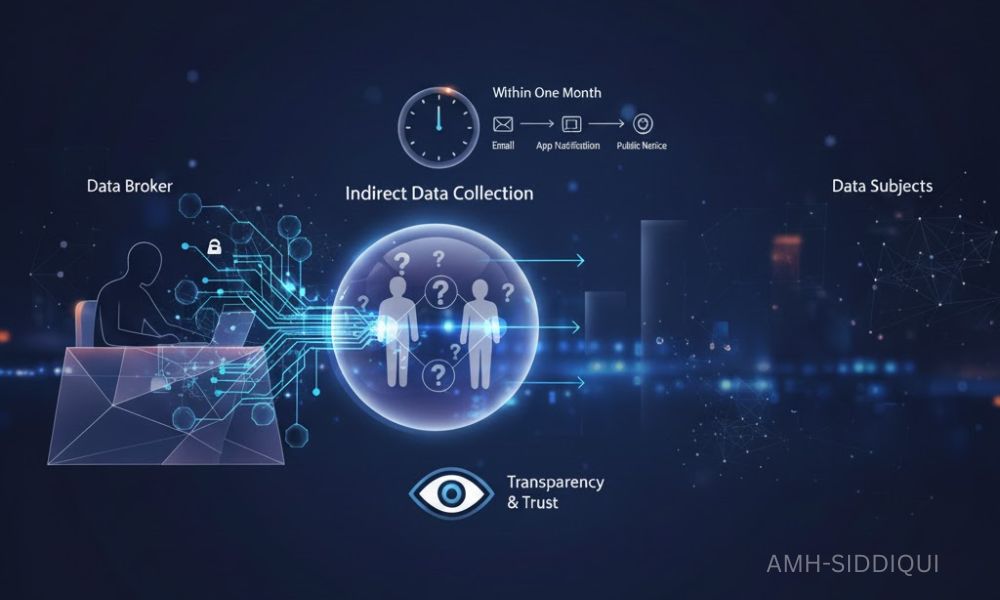
Explanation
Unlike Article 13, which applies when data is collected directly from individuals, Article 14 applies when personal data is obtained from other sources. These sources may include data brokers, business partners, publicly available databases, social media platforms, or internal group companies.
The core idea behind Article 14 is simple but powerful:
Individuals have the right to know about the use of their personal data, regardless of where it was obtained from.
Therefore, the data controller must provide specific information to the data subject within a reasonable time after obtaining the data, generally within one month, or at the first communication, or before disclosure to another recipient.
However, Article 14 also recognizes practical limitations. In certain situations, such as when providing information would involve disproportionate effort or compromise legitimate purposes, limited exemptions apply. Even then, controllers must adopt alternative transparency measures, such as public privacy notices.
Key Points
Article 14 outlines what information must be provided to the data subject. This includes:
- Identity and contact details of the data controller and, where applicable, the Data Protection Officer (DPO)
- Purpose and legal basis for processing the personal data
- Categories of personal data collected
- Source of the data, including whether it came from publicly accessible sources
- Recipients or categories of recipients of the data
- International data transfers, if applicable, and safeguards used
- Data retention period or criteria used to determine it
- Data subject rights, such as access, rectification, erasure, restriction, and objection
- Right to lodge a complaint with a supervisory authority
- Existence of automated decision-making, including profiling, if applicable
Importantly, this information must be provided in clear, plain, and accessible language, ensuring true transparency rather than legal complexity.
General Activation Steps
To activate and implement Article 14 compliance effectively, organizations should follow structured steps:
- Map indirect data sources: Identify where personal data is collected indirectly—third parties, vendors, partners, or public datasets.
- Assess applicability: Confirm whether Article 14 applies and whether any exemptions (such as disproportionate effort) are relevant.
- Prepare transparency notices: Draft clear privacy notices tailored specifically for indirectly collected data.
- Define communication timelines: Ensure information is delivered within one month or earlier if required by the regulation.
- Choose communication channels: Decide whether to inform individuals via email, postal communication, in-app notifications, or public disclosures.
- Document compliance actions: Maintain records to demonstrate compliance during audits or regulatory inspections.
By following these steps, organizations can operationalize transparency without disrupting business processes.
Use Cases
Article 14 is especially relevant across multiple real-world scenarios:
- Data brokers and marketing agencies: When customer data is purchased or sourced externally, individuals must be informed of its use.
- Recruitment and HR screening: Employers collecting candidate data from job portals or references must comply with Article 14.
- Fraud detection and risk scoring: Financial institutions using third-party datasets must notify individuals accordingly.
- Business-to-business (B2B) data processing: Contact details sourced from professional databases still qualify as personal data.
- Research and analytics: Organizations using public or aggregated datasets must assess transparency obligations.
These use cases highlight how Article 14 applies beyond consumer-facing platforms, extending deep into enterprise and B2B environments.
Dependencies
Article 14 does not operate in isolation. It closely depends on and aligns with several other GDPR provisions:
- Article 5 (Principles of Processing): Especially transparency, fairness, and lawfulness.
- Article 6 (Lawful Bases): The controller must clearly identify and communicate the legal basis for processing.
- Article 12 (Transparent Communication): Governs how information must be provided concise, intelligible, and accessible.
- Article 30 (Records of Processing Activities): Accurate documentation supports Article 14 disclosures.
- Article 24 (Accountability): Requires organizations to prove compliance, not just claim it.
Understanding these dependencies helps organizations build a coherent and compliant data protection framework.
Tools and Technologies
To manage Article 14 obligations efficiently, organizations rely on a combination of legal, technical, and operational tools:
- Privacy Management Platforms: Centralize privacy notices, policies, and compliance workflows.
- Data Mapping & Discovery Tools: Identify where personal data comes from and how it flows through systems.
- Consent & Preference Management Tools: Track objections and data subject rights requests.
- Customer Relationship Management (CRM) Systems: Enable timely communication with data subjects.
- Compliance Documentation Software: Helps maintain audit trails and accountability evidence.
When integrated properly, these tools transform Article 14 from a regulatory burden into a manageable process.
Let’s Wrap
EU GDPR Article 14 plays a crucial role in maintaining transparency in indirect data collection practices. In an era where data is frequently shared, traded, and repurposed, this article ensures individuals remain informed and empowered.
For organizations, compliance is not just about avoiding penalties, it is about building trust, reducing legal risk, and strengthening ethical data practices. By understanding the requirements, implementing structured processes, and leveraging the right tools, controllers can meet Article 14 obligations effectively and confidently.
Ultimately, Article 14 reinforces one of GDPR’s core messages:
Personal data belongs to individuals, and they have the right to know how it is used—no matter where it comes from.
For further reading:
- EU GDPR – Article 13 (Information to Be Provided Where Personal Data Are Collected From the Data Subject)
- EU GDPR – Article 12 (Transparent Information, Communication, and Modalities for Exercising Data Subject Rights)
- EU GDPR – Article 11 (Processing Which Does Not Require Identification)
- EU GDPR – Article 10 (Processing Personal Data Related to Criminal Convictions and Offenses)
- EU GDPR – Article 9 (Processing Special Categories of Personal Data)
- EU GDPR – Article 8 (Conditions Applicable to Child’s Consent in Information Society Services)
- EU GDPR – Article 7 (Conditions for Consent)
- EU GDPR – Article 6 (Lawfulness of Processing)
- EU GDPR – Article 5 (Principles Relating to Processing of Personal Data)
- EU GDPR – Article 4 (Definitions)
- EU GDPR – Article 3 (Territorial Scope)
- EU GDPR – Article 2 (Material Scope)
- EU GDPR – Article 1 (Subject-matter and objectives)
- RACI Matrix
- Electronegativity
- Factors Affecting Electronegativity
- CDO – Chief Data Officer
