










Abstract
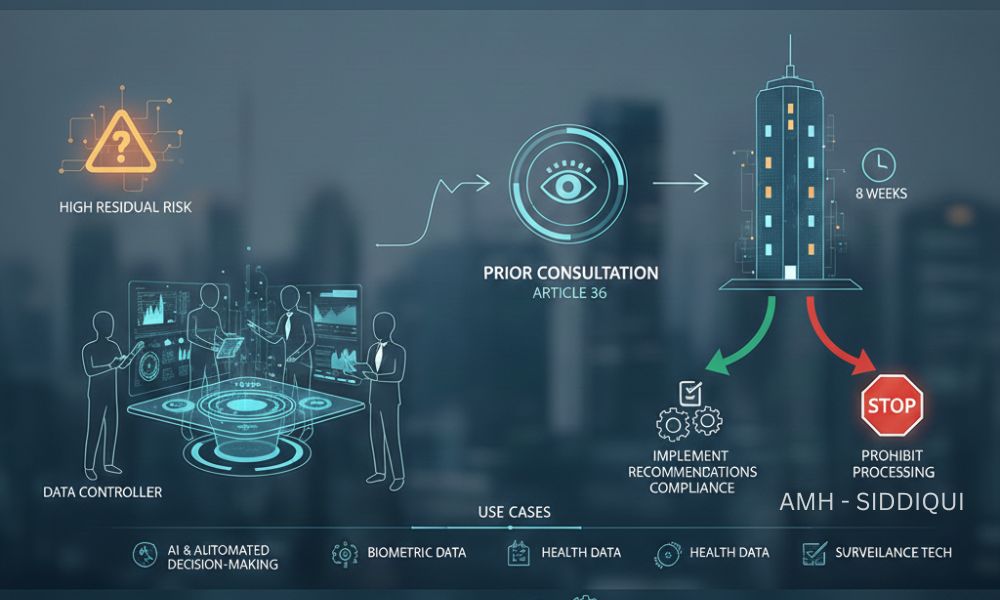
Explanation
Article 36 acts as a safeguard when organizations plan high-risk data processing operations involving personal data. While Article 35 mandates the completion of a DPIA, Article 36 comes into play when the DPIA reveals unresolved high risks. In such cases, controllers must not proceed blindly. Instead, they are required to consult the supervisory authority to seek expert guidance.
The consultation process allows regulators to review the intended processing activities, assess associated risks, and recommend additional safeguards. Supervisory authorities may advise on compliance improvements, request further information, or, in extreme situations, use their enforcement powers to restrict or prohibit processing.
The GDPR sets a clear expectation that supervisory authorities respond within eight weeks of receiving the consultation request, with the possibility of extending this period by six additional weeks in complex cases. This ensures timely regulatory input without causing unnecessary operational delays.
Key Points
- Prior consultation is mandatory when a DPIA identifies high residual risks.
- The obligation applies before processing begins,not after.
- Controllers must provide detailed documentation, including:
- DPIA findings
- Proposed safeguards
- Processing purposes and methods
- Supervisory authorities have eight weeks to issue advice.
- The consultation period may be extended in complex cases.
- Authorities can recommend changes or exercise corrective powers.
- Failure to consult can lead to significant GDPR penalties.
General Activation Steps
To properly activate Article 36 compliance, organizations should follow a structured approach:
- Conduct a DPIA: Identify potential risks to data subjects and evaluate their severity and likelihood.
- Assess Residual Risk: Determine whether mitigation measures sufficiently reduce risks. If high risk remains, proceed to consultation.
- Prepare Documentation: Compile all relevant information, including:
- Nature and scope of processing
- Categories of data subjects and personal data
- Technical and organizational safeguards
- Submit Consultation Request: Contact the competent supervisory authority with the complete consultation package.
- Await Regulatory Feedback: Pause processing activities until advice is received.
- Implement Recommendations: Apply any required changes or additional safeguards suggested by the authority.
- Document Outcomes: Maintain records of the consultation and resulting actions for accountability.
Use Cases
Article 36 is particularly relevant in scenarios involving innovative or sensitive data processing, such as:
- AI and Automated Decision-Making: Systems using profiling or algorithmic decision-making that significantly affect individuals.
- Biometric Data Processing: Facial recognition or fingerprint systems used for identification or access control.
- Large-Scale Health Data Projects: Digital health platforms processing sensitive medical records.
- Surveillance Technologies: Widespread monitoring using CCTV, tracking, or behavioral analytics.
- Cross-Border Data Transfers: Processing involving third countries with complex legal implications.
In each case, prior consultation ensures that potential harm to individuals is reviewed before implementation.
Dependencies
Article 36 does not operate in isolation. It depends on and complements several other GDPR provisions:
- Article 35 (DPIA) – Prior consultation is triggered by DPIA results.
- Article 5 (Data Protection Principles) – Lawfulness, fairness, and minimization guide risk assessments.
- Article 24 (Controller Responsibility) – Establishes accountability obligations.
- Article 25 (Data Protection by Design and by Default) – Preventive risk management supports compliance.
- Article 32 (Security of Processing) – Safeguards reduce residual risk.
Together, these articles form a cohesive framework focused on proactive data protection.
Tools and Technologies
Organizations can rely on a range of tools to support Article 36 compliance:
- DPIA Management Software: Tools that structure risk assessments and documentation workflows.
- Governance, Risk, and Compliance (GRC) Platforms: Centralized systems for tracking regulatory obligations.
- Data Mapping and Inventory Tools: Help identify where high-risk processing occurs.
- Encryption and Anonymization Technologies: Reduce risk exposure during sensitive processing.
- Collaboration and Documentation Platforms: Facilitate communication with supervisory authorities.
Leveraging the right tools enhances accuracy, efficiency, and regulatory readiness.
Let’s Wrap
EU GDPR Article 36 reinforces the GDPR’s preventive and risk-based philosophy by ensuring that high-risk processing activities receive regulatory oversight before harm occurs. Prior consultation is not a hurdle, it is a protective mechanism that supports responsible innovation while safeguarding individuals’ rights.
By engaging supervisory authorities early, organizations demonstrate accountability, transparency, and respect for data protection principles. In an era of complex data ecosystems and emerging technologies, Article 36 plays a critical role in balancing progress with privacy. Proactive consultation today can prevent costly compliance failures tomorrow.
For further reading:
- EU GDPR – Article 35 (Data Protection Impact Assessment (DPIA))
- EU GDPR – Article 34 (Communication of a Personal Data Breach to the Data Subject)
- EU GDPR – Article 33 (Notification of a Personal Data Breach to the Supervisory Authority
- EU GDPR – Article 32 (Security of Processing)
- EU GDPR – Article 31 (Cooperation with the Supervisory Authority)
- EU GDPR – Article 30 (Records of Processing Activities)
- EU GDPR – Article 29 (Processing Under the Authority of the Controller or Processor)
- EU GDPR – Article 28 (Processor)
- EU GDPR – Article 27 (Representatives of Controllers or Processors Not Established in the Union)
- EU GDPR – Article 26 (Joint Controllers)
- EU GDPR – Article 25 (Data Protection by Design and by Default)
- EU GDPR – Article 24 (Responsibility of the Controller)
- EU GDPR – Article 23 (Restrictions on Data Subject Rights)
- EU GDPR – Article 22 (Automated Individual Decision-Making, Including Profiling)
- EU GDPR – Article 21 (Right to Object)
- EU GDPR – Article 20 (Right to Data Portability)
- EU GDPR – Article 19 (Notification Obligation Regarding Rectification or Erasure of Personal Data or Restriction of Processing)
