










Abstract
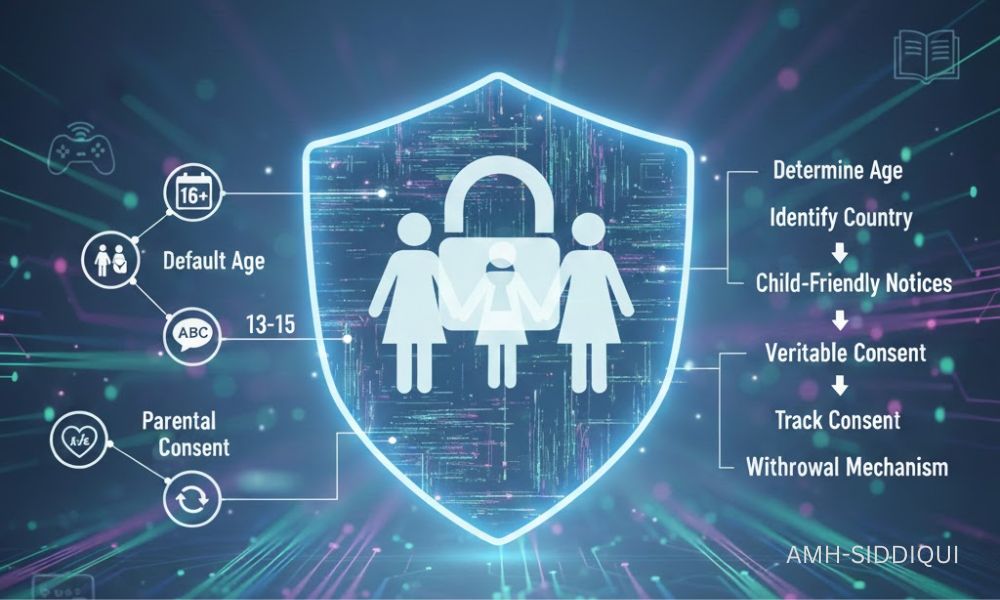
EU GDPR – Article 8 (Conditions Applicable to Child’s Consent in Information Society Services) sets the rules for how organisations must handle the personal data of children when offering Information Society Services (ISS) such as apps, social media platforms, online games, streaming websites, and educational portals. Since children are more vulnerable online, GDPR ensures their data is processed lawfully, transparently, and responsibly. Essentially, children over 16 can give valid consent themselves. However, if the child is under 16, consent must be obtained from a parent or legal guardian. This article not only strengthens online child safety but also encourages organisations to adopt age-appropriate controls, clear language, and verifiable consent mechanisms.
Explanation
To begin with, GDPR recognises that children may not fully understand how their data is collected, stored, or used. Therefore, Article 8 establishes additional safeguards. It states that if a company offers digital services and wishes to process the personal data of a user under the age of 16, it must obtain “parental responsibility holder consent.”
Moreover, Article 8 does not work in isolation. It operates alongside other GDPR provisions such as transparency, fairness, and purpose limitation. Additionally, it encourages organisations to consider children’s cognitive and emotional development. For instance, consent forms must be written in language that a child can easily understand.
Furthermore, EU Member States are allowed to lower the age of digital consent to 13, but not below that threshold. Consequently, organisations operating across multiple EU countries must understand local age requirements.
Ultimately, Article 8’s goal is simple: protect minors from manipulation, unauthorised profiling, targeted advertising, and unsafe data-sharing practices.
Key Points
- Default Age of Consent-16: Under GDPR, a child aged 16 years or older may lawfully provide consent for online services without parental involvement. This applies to social networks, gaming services, cloud storage platforms, and most digital subscriptions.
- Lower Age Allowed: 13–15 (Country-Specific): EU Member States may choose to set the digital consent age between 13 and 15. Therefore, businesses must check country-specific regulations when offering services across Europe.
- Parental Consent Required for Under 16: If a child is below the applicable national age limit, companies must secure verifiable parental or guardian consent. This means organisations must use systems that reasonably confirm the adult giving consent actually holds parental responsibility.
- Clear and Child-Friendly Language: Consent forms must be easy to understand. Complex legal terminology must be avoided since GDPR prioritises the child’s comprehension of how their data is used.
- Right to Withdraw Consent: Just like adults, children and parents can withdraw consent at any time. This forces organisations to stop processing the child’s data unless another lawful basis applies.
- Responsibility Lies with the Service Provider: Platforms must demonstrate compliance. They bear the burden of proof when verifying parental consent and ensuring the child’s data is handled appropriately.
- Enhanced Safety and Privacy Controls: Organisations must integrate enhanced privacy defaults such as limited data collection, reduced profiling, and restricted sharing with third parties.
General Activation Steps
To comply with Article 8, organisations must follow a structured process:
- Determine the Child’s Age: First, organisations must understand the age of the child using their platform. This often requires implementing an age-verification mechanism. Although it must be reliable, GDPR also warns against collecting unnecessary additional data.
- Identify the Country of Operation: Next, companies must confirm the digital age of consent for each country they operate in. If the business works across the EU, it must map all age thresholds (13–16).
- Design Child-Friendly Consent Notices: After that, organisations need to create simple, age-appropriate consent texts that explain:
- What data is collected
- Why it is collected
- How long it will be used
- Whether it will be shared
- Implement Verifiable Parental Consent: Companies must adopt a method to confirm parental responsibility such as:
- Email confirmation combined with offline verification
- Payment card verification
- Government-issued ID cross-checks
- Parental portals
- SMS code sent to a parent
- Track Consent and Ensure Auditability: Furthermore, systems must record when consent was given, how it was verified, and who provided it. This audit trail is essential for GDPR compliance.
- Provide an Easy Withdrawal Mechanism: Children and their guardians must be able to withdraw consent through a clear and simple process, ideally with a single click or form submission.
- Update Privacy Policies and Notices: Lastly, documentation must be updated regularly to reflect changes in age requirements, consent mechanisms, and data protection practices.
Use Cases
- Social Media Platforms: Apps like Instagram or TikTok must verify age and obtain parental consent for underage users. Additionally, they should turn on high-privacy settings by default.
- Online Gaming Services: Platforms offering multiplayer games or in-game purchases must ensure minors have parental approval before creating accounts or sharing chat data.
- Educational Apps and EdTech Tools: Since these services process student information, they must obtain consent from parents, especially for features involving analytics, webcam usage, or location tracking.
- E-Commerce Websites: If a child attempts to register or make purchases, the platform must verify age and secure parental consent if required.
- Streaming Services: Music and video streaming platforms must implement age checks and display tailored privacy options for young users.
Dependencies
Compliance with Article 8 depends on several interconnected elements:
- Transparent Privacy Notices written in child-friendly language
- Accurate age-verification tools that do not excessively collect data
- Active parental involvement where required
- Strong cybersecurity controls to prevent misuse of children’s data
- Backend systems capable of storing consent logs
- Regular audits and risk assessments to maintain data integrity
- Moreover, compliance also depends on local legislation, since each EU country may set a different minimum age for consent.
Tools and Technologies
Several tools help organisations meet Article 8 requirements:
- Age Verification Systems (e.g., AI-based age estimation, digital identity checks)
- Consent Management Platforms (CMPs) for tracking consent histories
- Parental Control Management Systems
- Secure Identity Verification APIs
- Automated risk assessment tools for evaluating online child safety
- Child-friendly UI/UX design frameworks
- These tools collectively ensure lawful, secure, and transparent processing.
Let’s Wrap
In conclusion, Article 8 of the EU GDPR plays an essential role in safeguarding children in the digital world. By setting strict conditions for processing the personal data of minors, it ensures that online services operate responsibly and ethically. Additionally, it empowers parents to stay involved while giving older teenagers the autonomy to make informed choices. When organisations follow these principles, age verification, clear communication, parental consent, and strong data protection, they create safer online environments for children everywhere.
For furthur reading:
- Big Data – Metrics
- Big Data – Key Cross-Functional Roles
- Big Data – Readiness and Risk Assessment
- Big Data – Visualization Tools
- Big Data – Cloud Solutions and Statistical Computing
- Big Data – Distributed File-Based Databases
- Big Data – MPP Shared-nothing Technologies and Architecture
- Big Data Strategy- Activities
- Sentiment Analysis and Data/Text Mining
- Machine Learning
- Services-Based Architecture – SBA
- Data Lake
- What is Big Data: A Comprehensive Overview
- Data Science – Process and Iterative Phases
- Data Science – Dependency
- Big Data and Data Science – A Glance
- Data Quality – Policy and Metrics
