










Managing privacy and security in Big Data environments requires multi-layered strategies that address volume, velocity, and variety of datasets while ensuring GDPR compliance. The following nine features provide a comprehensive framework to initiate robust Big Data Security.
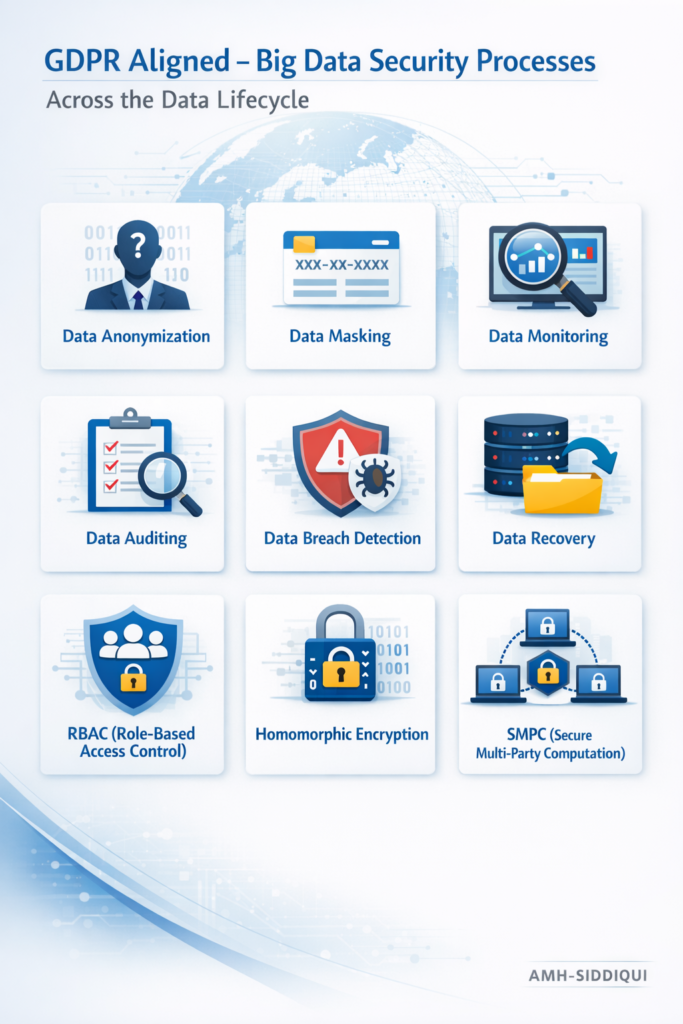
Data Anonymization: In Big Data, datasets often include sensitive PII (Personally Identifiable Information) such as names, CNICs, phone numbers, or email addresses. Data anonymization removes or irreversibly transforms PII so individuals cannot be re-identified, enabling safe analytics, research, or machine learning. This aligns with data minimization and protection by design (GDPR Articles 5 & 25). For example, a healthcare provider analyzing treatment outcomes may replace patient names with random IDs before running predictive models. Techniques such as tokenization, k-anonymity, differential privacy, and encryption of anonymized datasets further enhance protection in high-volume analytics.
Data Masking
Big Data testing, development, and analytics often require realistic datasets, but exposing full sensitive values can lead to breaches, supporting confidentiality and integrity (Article 32). For instance, a bank can mask credit card numbers as “XXXX-XXXX-1234” to allow developers to test transaction workflows without accessing actual financial data. Combining dynamic masking, format-preserving encryption, and role-based access controls ensures secure usage of large datasets while maintaining operational functionality.
Data Monitoring: In Big Data ecosystems, data flows continuously across platforms, applications, and users. Continuous monitoring tracks access, transfers, and processing to detect unusual or unauthorized activities, supporting GDPR accountability (Articles 5(2) & 30). For example, an e-commerce company monitoring user behavior may flag an employee downloading a terabyte of customer purchase history outside business hours. AI/ML-driven anomaly detection, intrusion detection systems, and real-time dashboards help organizations manage high-velocity streams while maintaining traceability.
Data Auditing: Auditing systematically reviews logs, access records, and processing activities to verify compliance with organizational policies and GDPR (Articles 5(2), 24, 30). In Big Data environments, an organization may audit which employees accessed customer transaction logs over the last quarter to confirm proper authorization. Immutable audit logs, automated compliance reporting, and periodic third-party audits enhance transparency and accountability across large-scale data operations.
Data Breach Detection: The scale and complexity of Big Data increase the risk of unauthorized access or leaks. Data breach detection identifies incidents quickly, maintaining confidentiality and integrity (Articles 32, 33, 34). For example, a telecom company may detect an unusual data transfer of millions of user call records to an external IP, triggering automated alerts and access blocks. Integrating endpoint security, AI-based anomaly detection, and automated incident response ensures rapid containment and regulatory compliance.
Data Recovery: Accidental deletions, system failures, cyberattacks, or natural disasters can compromise Big Data platforms. Data recovery restores lost information, safeguarding availability and integrity (Articles 5(1)(d) & 32). For instance, a cloud-based retail analytics system may rely on encrypted geo-redundant backups to recover sales and inventory datasets after a ransomware attack. Regular disaster recovery drills and immutable storage solutions enhance resilience and compliance.
RBAC (Role-Based Access Control): Big Data platforms involve multiple users and departments, increasing the risk of unauthorized access. RBAC restricts data access based on user roles, ensuring individuals access only necessary information (Articles 5 & 32). For example, in a global logistics company, warehouse managers can access shipment data, but finance or HR teams cannot access customer location details. Multi-factor authentication, context-aware sessions, and fine-grained permissions enforce confidentiality and accountability across distributed storage and cloud environments.
Homomorphic Encryption: Big Data analytics often requires processing sensitive datasets. Homomorphic encryption allows computations on encrypted data without revealing underlying information, maintaining GDPR compliance (Articles 5(1)(f) & 32). For example, a financial analytics platform can calculate risk scores on encrypted customer portfolios without ever decrypting the data. Secure key management, access logging, and secure computation protocols further protect sensitive analytics in large-scale processing pipelines.
SMPC (Secure Multi-Party Computation): Collaborative Big Data analysis across organizations can expose sensitive information. SMPC enables multiple parties to compute results jointly without revealing individual inputs, supporting privacy-by-design and GDPR compliance (Articles 25 & 32). For example, multiple hospitals can jointly analyze patient outcomes for research without sharing individual patient records. Encrypted communication, access controls, and verifiable computation ensure secure analytics while protecting each participant’s confidential data.
For further reading:
- Zero-Knowledge Proof (ZKP) – A Professional Review
- Navigating the Big Data Lifecycle: From Collection to Insight
- EU GDPR – Article 16 (Right to Rectification)
- EU GDPR – Article 15 (Right of Access by the Data Subject)
- EU GDPR – Article 14 (Information to Provide When Personal Data Is Not Obtained from the Data Subject)
- EU GDPR – Article 13 (Information to Be Provided Where Personal Data Are Collected From the Data Subject)
- EU GDPR – Article 12 (Transparent Information, Communication, and Modalities for Exercising Data Subject Rights)
- EU GDPR – Article 11 (Processing Which Does Not Require Identification)
- EU GDPR – Article 10 (Processing Personal Data Related to Criminal Convictions and Offenses)
- EU GDPR – Article 9 (Processing Special Categories of Personal Data)
- EU GDPR – Article 8 (Conditions Applicable to Child’s Consent in Information Society Services)
- EU GDPR – Article 7 (Conditions for Consent)
- EU GDPR – Article 6 (Lawfulness of Processing)
- EU GDPR – Article 5 (Principles Relating to Processing of Personal Data)
- EU GDPR – Article 4 (Definitions)
- EU GDPR – Article 3 (Territorial Scope)
- EU GDPR – Article 2 (Material Scope)
- EU GDPR – Article 1 (Subject-matter and objectives)
- Why choose Virtual Learning?
- Benefits of Online Education
- Data Modeling – Identifiers / Keys
- Content Modeling – Controlled Vocabularies and Format
- Data Modeling – Arity of Relationships
