










Abstract
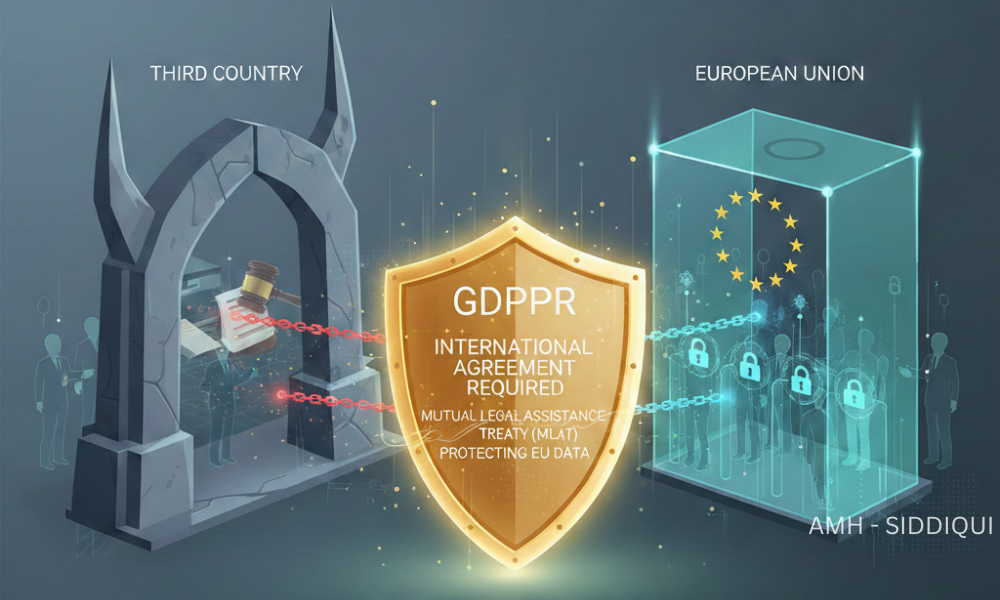
General Data Protection Regulation (GDPR) Article 48 addresses situations where courts or administrative authorities outside the European Union request access to personal data held within the EU. It establishes a clear rule: such decisions are only enforceable if they are grounded in an international agreement, such as a mutual legal assistance treaty (MLAT), between the requesting third country and the EU or a Member State.This provision protects individuals’ personal data from being transferred based solely on foreign legal demands that may not meet EU data protection standards. Article 48 ensures that EU data protection rules are not bypassed by external authorities and reinforces the principle that personal data cannot leave the EU legal framework without proper safeguards and lawful grounds.
Explanation
Article 48 sits within Chapter V of the GDPR, which governs international data transfers. While Articles 44 to 47 focus on mechanisms such as adequacy decisions and appropriate safeguards, Article 48 specifically deals with requests from foreign courts or administrative bodies seeking disclosure of personal data.If a company established in the EU receives a subpoena, court order, or regulatory demand from a third country authority requesting access to personal data, that request cannot automatically be fulfilled.
The GDPR makes it clear that such decisions are only recognized if they are based on an international agreement in force between the requesting country and the EU or one of its Member States.This typically means a formal treaty, such as a Mutual Legal Assistance Treaty (MLAT), must exist. Without such an agreement, complying directly with a foreign order may breach the GDPR.
Article 48 does not prohibit cooperation with third-country authorities altogether. Instead, it ensures that cooperation occurs within structured legal frameworks that respect EU data protection principles. Organizations must carefully assess whether the request has a valid legal basis under EU law before transferring data.
In practice, this article protects data subjects from foreign surveillance or enforcement actions that do not align with EU standards of privacy and fundamental rights. It also places responsibility on controllers and processors to verify the legitimacy of foreign requests before acting.
Key Points
- A decision from a third-country court or authority cannot automatically justify data transfer from the EU.
- Transfers based on foreign legal demands are only valid if supported by an international agreement.
- Mutual Legal Assistance Treaties (MLATs) are common examples of acceptable agreements.
- Controllers and processors must ensure compliance with GDPR before responding to foreign orders.
- Article 48 reinforces the protection of fundamental rights under EU law.
- It prevents foreign authorities from bypassing EU data protection safeguards.
General Activation Steps
- Receive and Review the Request: Carefully examine the court order, subpoena, or administrative demand from the third-country authority.
- Verify Jurisdiction and Scope: Confirm whether the request falls within the authority’s legal jurisdiction and what data is being requested.
- Check for an International Agreement: Determine whether an applicable international agreement exists between the requesting country and the EU or the relevant Member State.
- Consult Legal and Compliance Teams: Engage data protection officers (DPOs) and legal advisors to evaluate compliance obligations.
- Assess GDPR Requirements: Ensure that any transfer also complies with Articles 44–47, including safeguards and lawful basis requirements.
- Document the Decision-Making Process: Maintain records demonstrating due diligence and legal assessment.
Use Cases
- Foreign Criminal Investigations: A non-EU country court issues a subpoena to an EU-based cloud service provider seeking access to user data. The provider must verify whether an MLAT supports the request before disclosure.
- Regulatory Enforcement Actions: A financial regulator in a third country requests personal data from an EU subsidiary of a multinational corporation. The subsidiary must determine whether an international cooperation agreement authorizes the transfer.
- Cross-Border Litigation: A foreign civil court demands disclosure of employee records held in the EU. Without a recognized treaty framework, complying directly may violate the GDPR.
- Technology and Cloud Service Providers: Multinational tech companies frequently receive data access demands from foreign authorities. Article 48 ensures that such requests are filtered through EU legal standards.
- Healthcare Data Requests: A third-country authority seeks medical records of an EU resident for investigative purposes. The healthcare provider must confirm the existence of an international legal basis before transferring sensitive data.
- Law Enforcement Cooperation: Law enforcement agencies may collaborate through formal agreements. Article 48 ensures that such cooperation respects established international legal channels.
Dependencies
- International Agreements: The enforceability of foreign decisions depends on treaties such as MLATs or other bilateral or multilateral agreements.
- National Implementation Laws: Member State laws governing international judicial cooperation influence how Article 48 operates in practice.
- Other GDPR Transfer Mechanisms: Articles 44–47 must also be satisfied. Even with an international agreement, data transfers must respect general transfer rules.
- Fundamental Rights Framework: The Charter of Fundamental Rights of the EU underpins GDPR protections and shapes interpretation of Article 48.
- Organizational Governance Structures: Effective compliance depends on internal policies, trained staff, and active involvement of the Data Protection Officer.
- Supervisory Authorities: National data protection authorities may provide guidance or intervene if a transfer breaches GDPR rules.
Tools and Technologies
- Data Mapping Systems: Tools that identify where personal data is stored help organizations respond accurately to foreign requests.
- Access Control Mechanisms: Role-based access systems prevent unauthorized disclosure during evaluation of legal requests.
- Legal Case Management Software: Platforms that track legal demands ensure proper documentation and accountability.
- Encryption Technologies: Strong encryption protects data in transit and at rest, reducing exposure risks.
- Compliance Management Platforms: GDPR compliance software helps track international transfer obligations and treaty requirements.
- Audit and Logging Systems: Detailed logs provide evidence of how decisions were made and whether disclosures occurred.
- Secure Communication Channels: Encrypted communication tools ensure safe exchanges with authorities during lawful cooperation.
Let’s Wrap
Article 48 of the GDPR plays a vital role in protecting personal data from unauthorized foreign access. It sends a clear message: third-country court orders or administrative demands cannot override EU data protection law unless backed by a valid international agreement.
For organizations, this means careful evaluation is essential before responding to foreign legal requests. You must confirm treaty support, assess GDPR compliance, and document every step.By reinforcing structured international cooperation and safeguarding individuals’ rights, Article 48 strengthens the EU’s commitment to high data protection standards. It ensures that global collaboration does not come at the expense of privacy and legal certainty.
For further reading:
- EU GDPR – Article 47 (Binding corporate rules)
- EU GDPR – Article 46 (Transfers Subject to Appropriate Safeguards)
- EU GDPR – Article 45 (Transfers on the Basis of an Adequacy Decision)
- EU GDPR – Article 44 (General Principle for Transfers)
- EU GDPR – Article 43 (Certification Bodies)
- EU GDPR – Article 42 (Certification)
- EU GDPR – Article 41 (Monitoring of Approved Codes of Conduct
- EU GDPR – Article 40 (Codes of Conduct)
- EU GDPR – Article 39 (Tasks of the Data Protection Officer)
- EU GDPR – Article 38 (Position of the Data Protection Officer (DPO))
- EU GDPR – Article 37 (Designation of the Data Protection Officer (DPO))
- EU GDPR – Article 36 (Prior Consultation)
- EU GDPR – Article 35 (Data Protection Impact Assessment (DPIA))
- EU GDPR – Article 34 (Communication of a Personal Data Breach to the Data Subject)
- EU GDPR – Article 33 (Notification of a Personal Data Breach to the Supervisory Authority
- EU GDPR – Article 32 (Security of Processing)
- EU GDPR – Article 31 (Cooperation with the Supervisory Authority)
