










Abstract
EU GDPR Article 37 focuses on the mandatory designation of a Data Protection Officer (DPO) in specific circumstances where personal data processing poses higher risks to individuals’ rights and freedoms. This article ensures that organizations handling sensitive or large-scale personal data appoint a qualified professional responsible for overseeing data protection compliance. The DPO acts as an independent advisor, monitoring GDPR obligations, guiding internal teams, and serving as a point of contact for supervisory authorities and data subjects. Article 37 strengthens accountability, transparency, and proactive data protection governance across both public and private sectors.
Explanation
Article 37 of the General Data Protection Regulation (GDPR) outlines when controllers and processors are legally required to appoint a Data Protection Officer. The DPO is not merely a formal role but a strategic function designed to embed data protection principles into an organization’s daily operations.
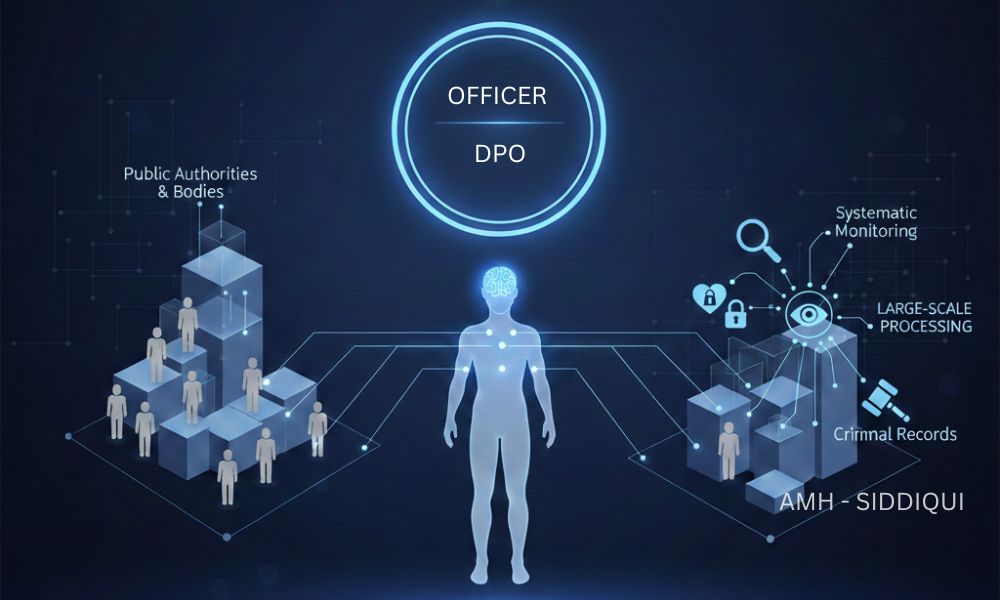
According to Article 37, a DPO must be designated when processing is carried out by a public authority or public body, except for courts acting in their judicial capacity. Additionally, private organizations must appoint a DPO if their core activitiesinvolve the regular and systematic monitoring of data subjects on a large scale. This includes activities such as behavioral tracking, profiling, or online monitoring.
Another key trigger is when the organization’s core activities consist of large-scale processing of special categories of personal dataunder Article9 (such as health data, biometric data, or religious beliefs) or data related to criminal convictions and offensesunder Article 10.
The DPO may be an internal employee or an external consultant, but they must possess expert knowledge of data protection law and practices. Importantly, Article 37 emphasizes the DPO’s independence, ensuring they can perform their tasks without conflicts of interest or undue influence.
Key Points
- Appointment of a DPO is mandatory, not optional, in specific scenarios defined by GDPRApplies to both controllers and processors
- Mandatory for public authorities and bodies(with limited exceptions)
- Required for systematic and large-scale monitoring of individuals
- Required for large-scale processing of sensitive dataor criminal records
- The DPO can be internal or external
- Must have expert knowledge of GDPR and data protection practices
- DPO must operate independently and report to top management
- Organizations must publish DPO contact detailsand notify supervisory authorities
General Activation Steps
To comply with Article 37, organizations should follow a structured approach:
- Assess Processing Activities: Review all data processing operations to determine whether they involve large-scale monitoring, sensitive data, or criminal records.
- Determine Applicability: Evaluate whether your organization qualifies as a public authority or whether data processing forms a core activity under GDPR definitions.
- Define the DPO Role: Clearly outline responsibilities, reporting lines, and independence requirements in line with GDPR Articles 37–39.
- Select a Qualified DPO: Appoint a candidate with demonstrable expertise in data protection law, risk management, and compliance practices.
- Ensure Independence: Avoid conflicts of interest by ensuring the DPO does not hold roles that determine processing purposes or means.
- Register and Publish Contact Details: Inform the supervisory authority and make DPO contact information easily accessible to data subjects.
- Integrate the DPO into Operations: Include the DPO in data protection impact assessments (DPIAs), policy development, and risk mitigation planning.
Use Cases
Article 37 applies across a wide range of industries and operational contexts:
- Healthcare Providers: Hospitals processing large volumes of patient health data must appoint a DPO due to the sensitivity and scale of processing.
- Financial Institutions: Banks and insurance companies handling financial profiles, credit histories, and identity data fall under mandatory DPO requirements.
- E-commerce and Digital Platforms: Businesses tracking user behavior, preferences, and purchasing patterns on a large scale require a DPO.
- Government Departments: Public authorities processing citizen records must designate a DPO to ensure lawful and transparent data handling.
- Security and Background Check Firms: Organizations processing criminal conviction data as a core activity must appoint a DPO.
- Educational Institutions: Universities and large schools processing extensive student data often meet the criteria for DPO designation.
Dependencies
Article 37 does not operate in isolation and is closely linked to other GDPR provisions:
- Article 5 (Principles of Processing)– Ensures lawful, fair, and transparent data handling
- Article 9 (Special Categories of Data)– Defines sensitive data requiring heightened protection
- Article 10 (Criminal Convictions Data)– Regulates processing of offense-related information
- Article 35 (DPIA)– DPO involvement is critical in high-risk processing assessments
- Article 38 & 39– Define the position, independence, and tasks of the DPO
Effective compliance with Article 37 depends on a broader GDPR governance framework, including policies, training, and risk assessments.
Tools and Technologies
Several tools and technologies can support DPOs and organizations in fulfilling Article 37 obligations:
- Data Mapping Tools– Identify and document personal data flows
- GDPR Compliance Platforms– Centralize policies, risk assessments, and compliance tracking
- DPIA Automation Tools– Support impact assessments with structured workflowsIncident
- Response Software– Manage data breaches and regulatory notifications
- Training and Awareness Platforms– Educate staff on data protection responsibilities
- Audit and Reporting Tools– Monitor compliance and provide management insights
These technologies empower DPOs to operate efficiently while maintaining independence and oversight.
Let’s Wrap
EU GDPR Article 37 plays a crucial role in strengthening organizational accountability by mandating the designation of a Data Protection Officer in high-risk data processing scenarios. The DPO serves as the cornerstone of GDPR compliance, bridging legal requirements, operational practices, and individual rights.
By appointing a qualified and independent DPO, organizations not only meet regulatory obligations but also build trust, reduce compliance risks, and demonstrate a strong commitment to data protection. In an increasingly data-driven world, Article 37 ensures that privacy governance remains proactive, professional, and effective.
For further reading:
- EU GDPR – Article 36 (Prior Consultation)
- EU GDPR – Article 35 (Data Protection Impact Assessment (DPIA))
- EU GDPR – Article 34 (Communication of a Personal Data Breach to the Data Subject)
- EU GDPR – Article 33 (Notification of a Personal Data Breach to the Supervisory Authority
- EU GDPR – Article 32 (Security of Processing)
- EU GDPR – Article 31 (Cooperation with the Supervisory Authority)
- EU GDPR – Article 30 (Records of Processing Activities)
- EU GDPR – Article 29 (Processing Under the Authority of the Controller or Processor)
- EU GDPR – Article 28 (Processor)
- EU GDPR – Article 27 (Representatives of Controllers or Processors Not Established in the Union)
- EU GDPR – Article 26 (Joint Controllers)
- EU GDPR – Article 25 (Data Protection by Design and by Default)
- EU GDPR – Article 24 (Responsibility of the Controller)
- EU GDPR – Article 23 (Restrictions on Data Subject Rights)
- EU GDPR – Article 22 (Automated Individual Decision-Making, Including Profiling)
- EU GDPR – Article 21 (Right to Object)
- EU GDPR – Article 20 (Right to Data Portability)
