










AI systems face several security threats that can affect their accuracy, confidentiality, and reliability. One major threat is Data Poisoning, where attackers intentionally insert malicious, false, or deceptive data into the training dataset of an AI model. Since AI learns patterns from data, poisoned data can teach the model incorrect behavior. For example, if an AI spam filter is trained with manipulated examples showing spam emails as “safe”, the AI may later allow harmful emails into users’ inboxes. Similarly, in a self-driving car system, attackers could manipulate training images so the AI misinterprets a stop sign as another traffic sign, creating serious safety risks. Data poisoning can lead to inaccurate predictions, biased decisions, financial loss, and even physical harm. Organizations reduce this risk by validating data sources, reviewing datasets carefully, and continuously monitoring model behavior.
Another important threat is Model Stealing, where attackers try to copy or recreate an AI model without authorization. AI models often require large investments of time, expertise, and money, making them valuable intellectual property. Attackers may repeatedly interact with a public AI service or API, sending thousands of queries and analyzing the responses to understand how the model works. Over time, they can build a similar model that imitates the original one. For example, if a company provides an AI image generation service online, an attacker may continuously test inputs and outputs until they develop a competing replica. This is similar to someone repeatedly tasting and analyzing a secret recipe until they can reproduce it independently. Model stealing can result in financial losses, loss of competitive advantage, and unauthorized use of proprietary AI technology. Companies protect against this threat through rate limiting, authentication controls, monitoring unusual query patterns, and watermarking AI models.
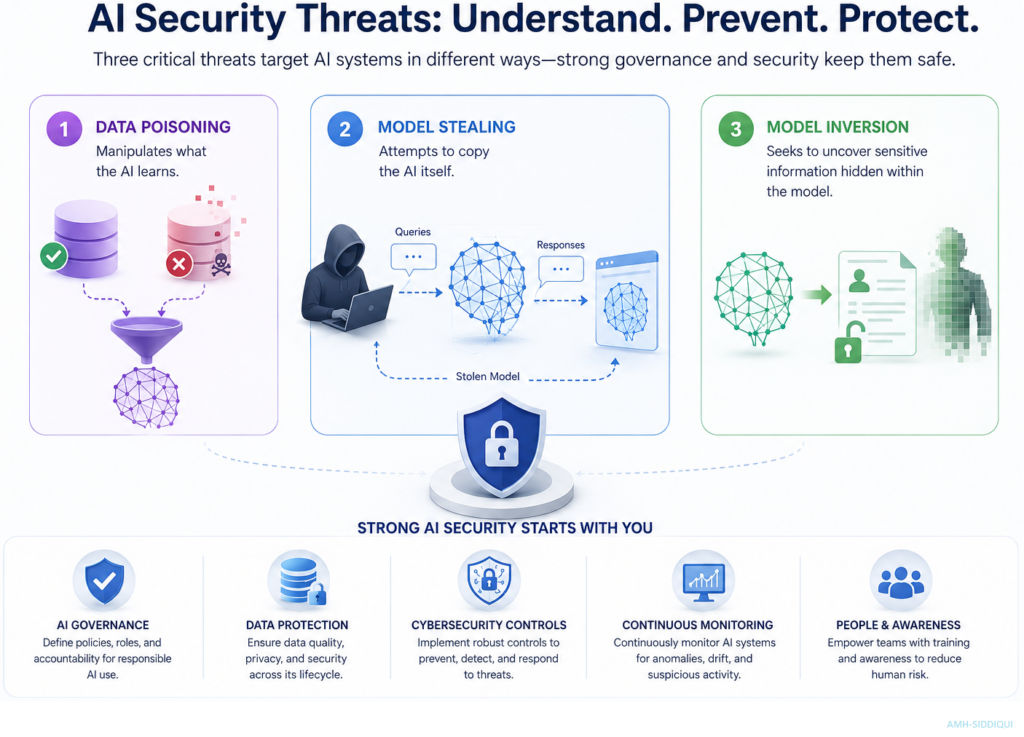
A third significant threat is the Model Inversion Attack, where attackers attempt to extract sensitive or private information from a trained AI model. Even though the model may not directly expose its training data, attackers can analyze outputs and responses to infer details about the data used during training. For example, if a facial recognition system was trained using employee photographs, an attacker might interact with the model repeatedly and eventually reconstruct approximate facial features of individuals from the training dataset. In healthcare AI systems, attackers may infer whether a person’s medical records were included in the training data or uncover sensitive health information. This type of attack is particularly dangerous because it threatens privacy and confidentiality by exposing personal, medical, financial, or biometric data. Organizations reduce the risk of model inversion by applying strong privacy controls, limiting unnecessary model outputs, and using privacy-preserving techniques such as differential privacy and secure model training methods.
In summary, Data Poisoning manipulates what the AI learns, Model Stealing attempts to copy the AI itself, and Model Inversion seeks to uncover sensitive information hidden within the model. These threats highlight the importance of strong AI governance, data protection, cybersecurity controls, and continuous monitoring to ensure AI systems remain secure, trustworthy, and reliable.
For your further reading:
- What is Integrated AI (Artificial Intelligence)?
- GDPR Aligned – Big Data Security Processes – Across the Data Lifecycle
- Six Essential Practices for Responsible AI Governance
- Zero-Knowledge Proof (ZKP) – A Professional Review
- Navigating the Big Data Lifecycle: From Collection to Insight
- Data Modeling – Identifiers / Keys
- Content Modeling – Controlled Vocabularies and Format
- Data Modeling – Arity of Relationships
