










AI (Artificial Intelligence) is the capability of computer systems, machines or software to perform tasks that normally require human intelligence, such as learning, reasoning, understanding language, recognizing patterns, and making decisions.
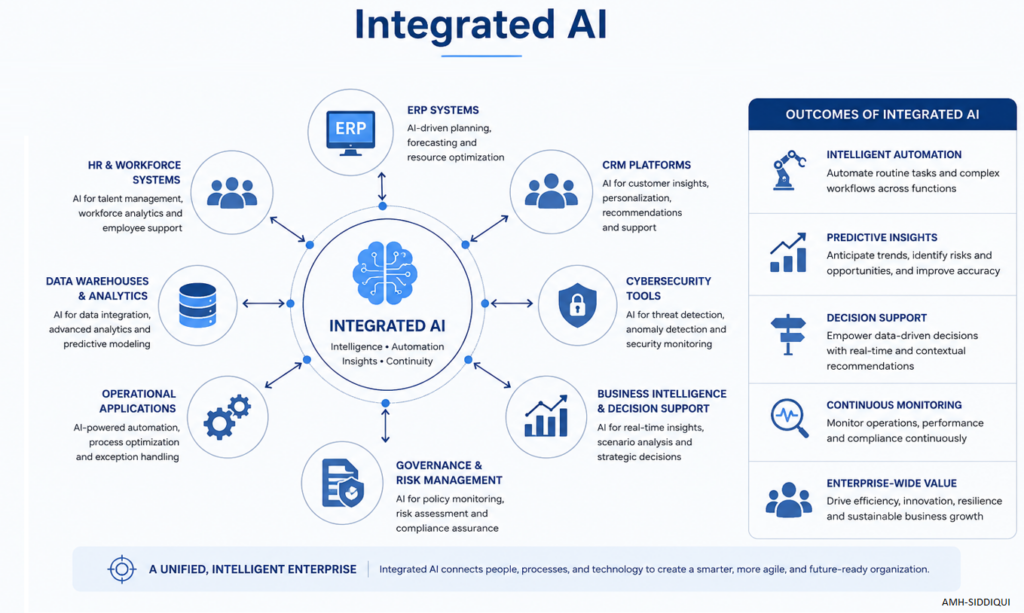
Integrated AI refers to the embedding and seamless incorporation of Artificial Intelligence capabilities into an organization’s business processes, systems, applications, and operational functions so that AI becomes a natural part of everyday activities rather than a standalone tool. Instead of operating independently, Integrated AI works across multiple departments and technologies such as ERP systems, CRM platforms, cybersecurity tools, data warehouses, governance frameworks, and operational applications to provide intelligent automation, predictive insights, decision support, and continuous monitoring. The concept emphasizes connectivity and collaboration between AI and enterprise systems. For example, Integrated AI may connect with finance systems to detect anomalies, with compliance platforms to monitor regulatory violations, with cybersecurity tools to identify threats, and with customer service systems to improve customer experience through intelligent recommendations or chatbots. By integrating AI into existing workflows, organizations can enhance efficiency, accuracy, speed, and strategic decision-making across all functions.
Integrated AI also supports enterprise-wide objectives such as governance, risk management, data protection, quality assurance, and business continuity. It enables organizations to analyze massive amounts of structured and unstructured data in real time, automate repetitive tasks, identify hidden patterns, predict risks, and generate actionable insights. In modern enterprises, Integrated AI is often combined with cloud platforms, analytics solutions, automation technologies, and data governance frameworks to create a unified intelligent ecosystem.
In a nutshell, Integrated AI means “AI Embedded Everywhere it Adds Value”, connected to people, processes, applications, and data to support smarter, faster, and more secure organizational operations.
Today’s AI Core Capabilities
- Continuous Learning: It means an AI system keeps improving by learning from new data and experiences over time. Instead of staying fixed after deployment, it becomes smarter as it processes more information. For example, a recommendation system on YouTube learns what videos/clips you like and improves future suggestions based on your watching habits.
- Contextual Understanding: This allows AI to understand the meaning behind information instead of just recognizing words or numbers. It helps the system respond more accurately according to the situation. For instance, when you type “Apple” AI can understand whether you mean the fruit or Apple depending on the conversation.
- Real-Time Adaptation: Real-time adaptation means AI can instantly adjust its actions based on changing conditions or new inputs. This helps organizations respond quickly to dynamic environments. Let’s say, a navigation app like Google Maps changes your route immediately when there is traffic or an accident on the road.
- Scalability Across Data Complexity: This means AI can handle both small and extremely large amounts of complex data efficiently. It can process structured and unstructured data from many different sources. For instance, a hospital AI system can analyze patient records, medical images, lab reports, and doctor notes together to support diagnosis and treatment decisions.
- Self-Driven Optimization: AI can automatically improve its own performance without constant human intervention. It identifies inefficiencies and adjusts processes for better results. For example, an e-commerce platform automatically changes product recommendations and pricing strategies to increase sales and customer satisfaction.
- Enhanced Explainability: AI can also clearly explain how and why it made a particular decision. This builds trust and helps users understand the reasoning behind outcomes. For example, a bank’s loan approval AI explains that a loan was rejected because of low-income level and high existing debt, instead of simply saying “Application Denied”.
Integrated AI – Use Cases (A Momentary Look)
- Fraud Detection: AI helps organizations detect suspicious activities by analyzing transaction patterns in real time. It can quickly identify unusual behavior, reduce financial losses, and strengthen overall security systems. Businesses use AI-powered fraud detection to improve trust, accuracy, and response speed.
- Cybersecurity: AI enhances cybersecurity by continuously monitoring networks, devices, and applications for potential threats. It can detect malware, phishing attempts, and unauthorized access faster than traditional methods. This allows organizations to respond quickly and minimize risks to sensitive data and systems.
- Predictive Maintenance: AI predicts equipment failures before they happen by analyzing machine performance and sensor data. This enables companies to schedule maintenance proactively, reduce downtime, and avoid costly breakdowns. Predictive maintenance improves operational efficiency and extends equipment lifespan.
- Supply Chain Optimization: AI improves supply chain operations by analyzing demand trends, logistics, and inventory data. It helps businesses optimize stock levels, reduce delivery delays, and improve resource planning. As a result, organizations can lower costs and provide faster, more reliable services.
- Customer Experience: AI enables businesses to deliver personalized experiences by analyzing customer preferences, behavior, and purchase history. It helps create targeted marketing campaigns, product recommendations, and customized services. This increases customer satisfaction, engagement, and loyalty.
- Business Processes: AI automates document processing by extracting, organizing, and validating information from invoices, contracts, and forms. This reduces manual effort, minimizes errors, and speeds up business workflows. Organizations benefit from improved accuracy, efficiency, and productivity.
Benefits from Adopting an Integrated AI Framework
- Operational Efficiency: Adopting an AI framework enables organizations to improve operational efficiency by streamlining AI development, governance, and deployment processes through standardized practices and automation. It helps reduce duplication of effort, accelerates decision-making, and optimizes the use of organizational resources.
- Trust: A well-defined AI framework also strengthens trust by promoting transparency, accountability, ethical AI practices, and regulatory compliance, thereby enhancing stakeholder confidence while protecting privacy and data integrity.
- Advantages: In addition, it provides significant competitive advantages by enabling faster innovation, improving customer experiences, enhancing operational intelligence, and supporting data-driven decision-making that increases organizational agility and market competitiveness.
- Resilience: The framework further enhances organizational resilience by supporting effective risk management, cybersecurity, compliance, and operational continuity, ensuring that AI systems remain adaptable and sustainable in a rapidly evolving environment.
- Improvement: Finally, it drives continuous improvement by encouraging ongoing monitoring, evaluation, and optimization of AI models, processes, and governance practices, fostering innovation, organizational learning, and long-term AI maturity aligned with strategic business objectives.
For your further reading:
- GDPR Aligned – Big Data Security Processes – Across the Data Lifecycle
- Six Essential Practices for Responsible AI Governance
- Zero-Knowledge Proof (ZKP) – A Professional Review
- Navigating the Big Data Lifecycle: From Collection to Insight
- Data Modeling – Identifiers / Keys
- Content Modeling – Controlled Vocabularies and Format
- Data Modeling – Arity of Relationships
