









Introduction
Digital transformation has shifted from a forward-looking strategy to an operational baseline. Today, the core drivers of this evolution are no longer isolated software applications, but rather the convergence of two massive technological forces: Artificial Intelligence (AI) and the Internet of Things (IoT).
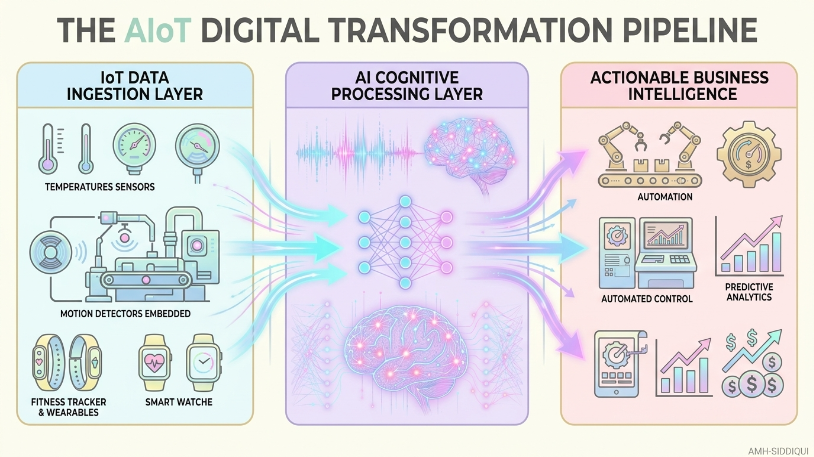
When deployed together, these technologies form a unified digital nervous system. IoT networks act as the sensory receptors, collecting vast streams of real-time environmental telemetry, while AI serves as the cognitive brain, instantly translating raw data into autonomous decisions. For modern enterprise architectures, executing a successful AI and IoT digital transformation strategy is the key to shifting business operations from reactive firefighting to predictive orchestration.
Deconstructing the AIoT Ecosystem
To fully leverage these technologies, enterprise leaders must look beyond the individual components and understand how they merge into a unified discipline known as the Artificial Intelligence of Things (AIoT).
IoT Sensor Layer (Captures Raw Data) Edge/Cloud Processing (Cleans & Routes Data) ➡ AI Cognitive Layer (Executes Autonomous Action)
The Internet of Things (IoT): A distributed network of physical endpoints—ranging from industrial vibration sensors and telemetry trackers to smart medical equipment—that continuously ingest environmental data.
Artificial Intelligence (AI): The algorithmic infrastructure (including machine learning models, neural networks, and computer vision tools) that ingests unstructured data streams to identify faint operational anomalies, extract features, and predict outcomes.
Raw IoT data alone has limited utility. Without an analytical engine, massive data streams create “data swamps” that strain storage infrastructure without delivering business value. AI transforms this raw noise into immediate, high-value business intelligence.
5 Ways AI and IoT Are Re-Engineering Modern Industries
1. Predictive Maintenance in Heavy Industry
In sectors like manufacturing, logistics, and aviation, unexpected equipment downtime can cost millions per hour. By affixing IoT acoustic and thermal sensors to critical machinery, AI models monitor equipment health in real-time. The system flags microscopic deviations from normal operation, scheduling maintenance before a catastrophic component failure occurs.
2. Next-Generation Smart Healthcare Systems
The integration of intelligent telemetry is redefining patient care pathways. Continuous monitoring systems and wearable medical devices track patient vitals autonomously. If an anomaly occurs, edge-AI models evaluate the severity instantly, alerting clinical teams before an emergency arises while compiling clean structured data for personalized long-term treatment models.
3. Intelligent Supply Chains and Logistics
Modern supply chain networks use connected fleets to track transit variables like precise geographic location, internal payload temperature, and humidity levels. Machine learning algorithms digest this multi-stream data to optimize delivery routes dynamically, minimize fuel consumption, and prevent the spoilage of sensitive goods.
4. Smart Infrastructure and Urban Environments
Municipalities utilize AIoT frameworks to build sustainable, efficient urban centers. Connected grids monitor real-time traffic density, public utility consumption, and waste management cycles. AI engines process this data to adjust municipal power grids dynamically, manage traffic light frequencies, and streamline public services.
5. Hyper-Personalized Customer Experiences
In physical retail and smart environments, AIoT bridges the gap between digital intent and physical spaces. Connected endpoints securely capture usage behaviors, allowing predictive engines to deliver contextual assistance, optimize inventory placement, and create frictionless self-service ecosystems.
Strategic Benefits of a Unified AIoT Architecture
| Operational Vector | Legacy Industrial Frameworks | AIoT-Driven Architecture |
| Decision Latency | Retrospective analysis (weeks/months) | Real-time automated execution |
| Resource Efficiency | Fixed, calendar-based allocation | Dynamic, demand-driven optimization |
| System Visibility | Fragmented, siloed data repositories | Unified, end-to-end data pipeline |
| Risk Management | Reactive response after incident | Proactive mitigation and anomaly fencing |
Critical Execution Challenges and Bottlenecks
Elevated Cybersecurity and Endpoint Vulnerabilities
Every connected IoT device expands an enterprise’s attack surface. Many edge endpoints lack the onboard compute capacity required for heavy cryptographic protocols, making them prime targets for botnets and unauthorized intrusion. Mitigating this risk requires a strict Zero-Trust Network Architecture (ZTNA) combined with robust authentication schemes.
Data Governance and Lifecycle Privacy
The comprehensive data collection required by AI and IoT strategies inevitably captures sensitive information. Organizations must maintain crystal-clear data lineage, enforce transparent governance policies, and ensure strict alignment with evolving international privacy frameworks like EU GDPR.
High Infrastructure and Edge-Compute Investments
Deploying thousands of sensors and training complex deep learning models demands substantial upfront capital. Enterprises must balance their processing workloads effectively between high-performance cloud environments and localized edge computing architectures to manage bandwidth expenses and latency demands.
Readers can further read:
What Is IoT (Internet of Things)?
Internet of Things (IoT) Security
The Horizon of Digital Transformation
The next phase of AI and IoT integration centers on ultra-low latency connectivity and localized intelligence. As enterprise 5G networks become global standards, the need to route massive data streams back to centralized data centers will drop significantly. Instead, sophisticated Edge AI models will execute complex inferencing right at the device level, enabling true split-second autonomy.
For enterprise tech teams and data professionals, the directive is clear: organizational value is no longer just about owning data—it is about the speed at which you can extract intelligence from it.
Readers can also explore:
- How Robots Are Assisting Modern Surgeries
- Bioinformatics: Where Biology Meets Artificial Intelligence
- NIST AI RMF – A Momentary Look
- Data Management – Key Components and Knowledge Areas
- EU GDPR – Article 25: Data Protection by Design and by Default
- Attribute-Based Access Control (ABAC) – A Modern Approach
- Big Data & Artificial Intelligence – MDM Team
- What is Integrated AI (Artificial Intelligence)?
- Big Data vs Traditional Data, Data Warehousing, AI, and Beyond
