










Introduction
The current paradigm of enterprise Artificial Intelligence has historically relied on a centralized cloud-centric model. Organizations collect massive volumes of raw data, transmit it to centralized data lakes, and process it using powerful, remote server farms. While this framework has driven significant innovation, it creates severe structural bottlenecks: high network latency, exorbitant bandwidth costs, and persistent privacy risks during data transit.
As the Internet of Things (IoT) expands to encompass billions of interconnected sensors, machines, and mobile devices, waiting for cloud-based round-trip processing is no longer viable for mission-critical operations. This technical constraint has accelerated the adoption of Edge AI. By moving machine learning models from the centralized cloud directly to the local device, Edge AI enables intelligent processing at the edge of the network. This shift allows for instantaneous, localized decision-making while significantly reducing the security surface area of corporate data.
What Is Edge AI?
Edge AI is the deployment of artificial intelligence algorithms and inference engines directly onto edge hardware—such as industrial sensors, surveillance cameras, mobile handsets, and factory robotics.
In a traditional AI architecture, the system relies on a continuous loop of Data Generation → Cloud Transmission → Cloud Processing → Decision Return. Edge AI shortens this loop significantly: Data Generation → Local AI Inference → Immediate Decision. By performing this processing in-situ, organizations can execute intelligent actions in milliseconds rather than seconds.
The Strategic Importance of Localized Intelligence
Modern enterprises generate massive, unstructured data streams that are physically impractical to centralize. Edge AI provides the architecture to address this complexity through three primary pillars:
1. Real-Time Operational Latency
In environments like autonomous vehicle navigation or high-speed manufacturing, a delay of even a few milliseconds caused by network congestion can be catastrophic. Edge AI eliminates the dependency on network stability by executing instructions locally.
2. Radical Data Privacy and Security
Transmitting raw data—especially sensitive video feeds, personal medical telemetry, or proprietary manufacturing logs—across open networks presents a significant risk of interception. Edge AI keeps the raw data contained within the local device boundary, transmitting only summarized, anonymized insights to the cloud.
3. Bandwidth and Infrastructure Cost Savings
Uploading massive, constant streams of raw sensory data creates massive cloud egress costs and bandwidth saturation. Edge AI acts as a sophisticated filter; it processes the raw data locally and transmits only the “event-based” intelligence to the enterprise data lake.
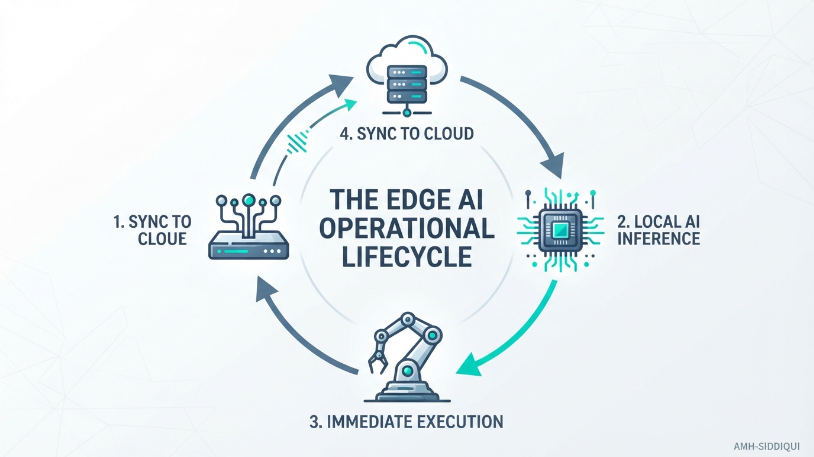
The Four-Stage Edge AI Operational Lifecycle
Edge AI requires a specialized orchestration pipeline that manages local hardware and centralized model management:
- Stage 1: Local Ingestion: Sensors or cameras continuously capture raw environment variables.
- Stage 2: On-Device Inference: Lightweight, optimized machine learning models analyze the data streams using local compute resources.
- Stage 3: Real-Time Execution: The device triggers an immediate automated response—such as slowing a robotic arm or alerting an administrator—without awaiting external cloud approval.
- Stage 4: Intelligent Synchronization: The system transmits compressed metadata summaries to the central cloud for long-term historical reporting and model performance auditing.
Enterprise Applications Across Industrial Verticals
| Industry Vertical | Legacy Cloud-Based Constraint | Edge AI Implementation |
| Smart Manufacturing | Slow response times to equipment vibration leads to unexpected downtime | Analyzes vibration data on-device to trigger immediate predictive maintenance shutdowns |
| Healthcare IoT | Transmitting sensitive heart rate data introduces patient privacy compliance risks | Monitors vitals on wearable devices locally, triggering alerts only if a medical anomaly occurs |
| Autonomous Systems | Self-driving cars cannot rely on cloud-connectivity to detect immediate road obstacles | Processes 360-degree LiDAR and camera feeds in real-time to execute emergency braking |
| Smart Surveillance | Monitoring thousands of cameras causes network saturation and privacy exposure | Identifies security threats at the camera edge, sending only incident-specific clips to security teams |
Navigating Engineering and Governance Hurdles
While Edge AI solves latency and privacy issues, it shifts the engineering burden to device management and security:
- Computing Constraints: Edge hardware typically possesses limited power and thermal envelopes compared to cloud clusters, requiring engineers to use highly compressed “quantized” AI models.
- Distributed Security: Protecting thousands of decentralized devices against physical and logical tampering requires strict, zero-trust hardware-level security protocols.
- Lifecycle Model Management: Updating thousands of remote AI models across global sites requires sophisticated MLOps (Machine Learning Operations) frameworks to ensure version consistency.
The Future of the Intelligent Edge
The trajectory of Edge AI is converging with 5G connectivity and specialized hardware acceleration (like Neural Processing Units). As these technologies mature, organizations will move toward “Swarm Intelligence,” where groups of decentralized edge devices communicate and learn from each other to solve complex problems without any centralized oversight. By embedding intelligence directly into the physical machinery of the modern enterprise, Edge AI is transforming the factory floor, the hospital ward, and the smart city into a single, cohesive, and hyper-responsive infrastructure.
Related Readings
- AI (Artificial Intelligence) – Key Concepts
- What Is IoT (Internet of Things)?
- How AI and IoT Are Driving Digital Transformation Across Industries
- IoT Security: Protecting Connected Devices in a Smart World
- Federated Learning: Training AI Without Sharing Sensitive Data
- Knowledge Graphs: The Hidden Foundation of Enterprise AI
- Data Governance Framework and Pillars
- Data Lineage: The Missing Link in Modern Data Governance
- Big Data Security, Privacy, and Protection
