









Introduction
Most enterprises do not face a single data problem; they manage dozens. A customer record lives in the CRM. Order history sits in an ERP. Support tickets reside in a separate SaaS tool. Nobody wants to copy all of that into one warehouse just to answer a basic question like, “What did this customer buy, and did they experience any issues?” Copying data everywhere creates its own mess—duplication, staleness, and a governance nightmare.
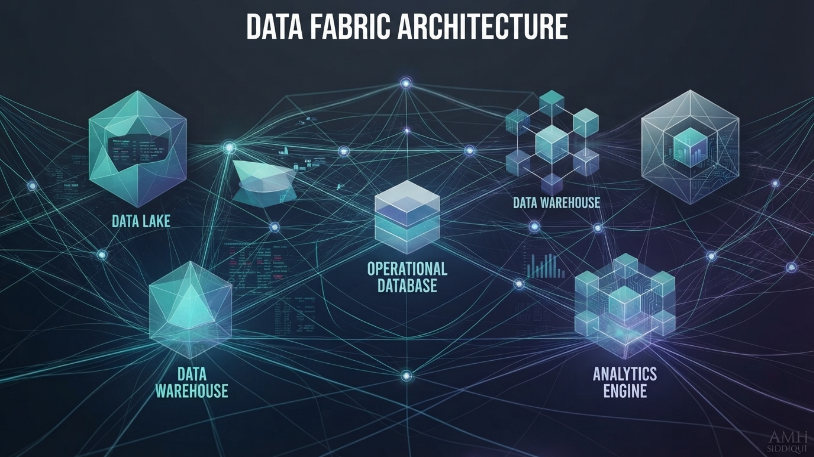
Data fabric solves this differently. Instead of moving data into one central repository, it connects data directly where it already lives.
What Data Fabric Actually Means
A data fabric is an architectural layer that sits across existing systems and makes them operate as a single connected entity. It does not replace databases, warehouses, or lakes; it rests on top of them, linking them together through metadata.
Metadata drives the entire approach. The fabric continuously scans systems, identifies existing data, maps relationships, tracks ownership, and monitors usage. It maintains a live map of the data landscape rather than relying on a static diagram created years ago.
Once active, the fabric answers queries by pulling from the right systems in real time. Users access a single interface while the underlying architectural complexity remains hidden.
The Core Components That Make It Work
A functional data fabric combines several key capabilities:
1. Active Metadata Management
Traditional metadata catalogs go stale quickly. Active metadata updates continuously, feeding machine learning models that spot patterns, suggest relationships, and flag data quality issues automatically.
2. Data Virtualization
This allows the fabric to pull data from multiple sources on demand without physically copying or moving files first. A user runs a query, and the fabric routes it to the correct underlying systems.
3. Knowledge Graphs
Knowledge graphs map the relationships between enterprise assets. They connect a “customer” in a CRM to a “customer” in a billing system, even when different IDs or field names are used.
4. Automated Governance
This component applies security and compliance rules consistently across every connected system so that access policies do not drift depending on the tool being used.
5. Self-Service Access
A simple interface allows business users and analysts to find and use data without filing a ticket with IT for every request.
Data Fabric vs. Data Mesh: The Confusion, Cleared Up
These two terms are frequently confused because both aim to make enterprise data easier to use at scale. However, they approach the problem from opposite directions:
- Data Mesh: An organizational model first and a technical pattern second. It assigns data ownership to domain teams and treats data as a product.
- Data Fabric: A technology layer first. It does not require team reorganization or ownership shifts. It focuses on connecting and governing data automatically through metadata and virtualization.
Many organizations combine both. An enterprise can run domain-oriented ownership under data mesh principles while using data fabric technology to power the metadata layer, discovery, and governance underneath.
Strategic Comparison
| Architecture Pattern | Core Focus | Primary Mechanism | Best Suited For |
|---|---|---|---|
| Data Fabric | Unified connectivity and active metadata | Virtualization and automated integration | Sprawling, multi-cloud, or hybrid systems |
| Data Mesh | Domain accountability and product thinking | Organizational restructuring and platform tooling | Large enterprises with distinct business verticals |
Where Data Fabric Tends to Make Sense
Data fabric earns its complexity in specific operational scenarios. It fits well when:
- Data spreads across disconnected systems, including legacy platforms that are expensive to migrate.
- Teams waste time building one-off pipelines for routine cross-system questions.
- Compliance policies require consistent enforcement across a hybrid or multi-cloud environment.
- Leadership demands faster self-service access without a full platform rebuild.
Smaller organizations with centralized systems usually do not need a data fabric. The metadata investment only pays off when managing genuine enterprise complexity.
Related Reading
