









Introduction
In the current data-driven economy, the most valuable insights often live at the intersection of two different datasets. A retailer may want to collaborate with a consumer brand to measure campaign effectiveness; a healthcare provider might partner with a research institution to advance patient outcomes; or a bank might work with a fraud-detection startup. However, the traditional barrier to these partnerships is the “data exposure trap.”
Sharing raw datasets between organizations is increasingly prohibited by stringent global regulations like GDPR and CCPA, and it carries the existential risk of catastrophic data breaches. To break this stalemate, data architecture teams are adopting Data Clean Rooms. These secure, isolated environments move the industry away from the high-risk practice of “data sharing” and toward the sustainable, compliant model of “insight sharing.”
What Is a Data Clean Room?
A Data Clean Room is a protected, private computing environment where multiple independent organizations can join, compare, and analyze their respective data assets without ever granting the other party access to their raw records.
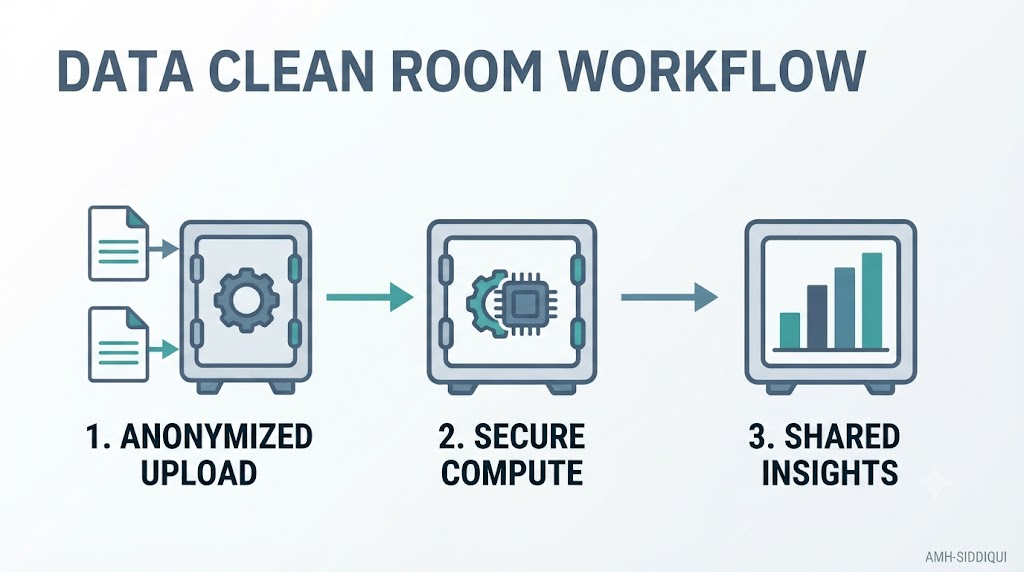
Instead of physically transferring files, each participant uploads their encrypted datasets into a neutral, governed cloud environment. The clean room software executes pre-approved analytical queries, returning only the aggregate results (such as conversion rates or customer overlaps) while keeping the granular, personally identifiable information (PII) locked and inaccessible to all parties.
How It Works
- Preparation: Data is anonymized or tokenized at the source.
- Secure Upload: Datasets are ingested into a neutral, controlled cloud vault.
- Privacy-Preserving Analysis: Algorithms execute queries (e.g., customer overlap) without revealing individual identities.
- Authorized Insights: Only aggregated, non-identifiable results are exported.
Strategic Benefits
| Benefit | Impact |
| Privacy Protection | Minimizes exposure of PII and sensitive records. |
| Regulatory Compliance | Supports GDPR and CCPA requirements for data handling. |
| Sovereignty | Organizations retain full control over their original data. |
| Actionable Insights | Enables high-value collaboration with partners and vendors. |
Core Technologies
- Access Control: Ensures only approved users can run specific analytical tasks.
- Differential Privacy: Adds statistical noise to prevent re-identification.
- Encryption: Protects data both at rest and in transit.
- Identity Resolution: Securely matches overlapping records without revealing PII.
Industry Applications
- Advertising: Measure campaign performance without third-party cookies.
- Healthcare: Collaborate on patient outcomes while keeping records private.
- Finance: Identify multi-bank fraud patterns via pooled, anonymous data.
- Retail: Optimize supply chains using shared cross-partner trends.
Implementing for Success
While Data Clean Rooms are highly effective, success requires:
- Standardization: Aligning data schemas across collaborating partners.
- Strong Governance: Clear policies on access, metadata, and auditability.
- Technical Investment: Dedicated infrastructure to manage secure compute environments.
Conclusion
Data Clean Rooms bridge the gap between privacy and innovation. By moving from raw data exchange to secure insight generation, organizations can build trusted partnerships while meeting rigorous regulatory standards. Companies that adopt privacy-first collaboration will lead in an increasingly data-conscious market.
Related Readings
- Navigating the Big Data Lifecycle: From Collection to Insight
- AI (Artificial Intelligence) – Key Concepts
- What Is Integrated AI (Artificial Intelligence)?
- Federated Learning: Training AI Without Sharing Sensitive Data
- AI Memory: How Intelligent Systems Remember, Retrieve, and Learn Over Time
- Knowledge Graphs: The Hidden Foundation of Enterprise AI
- Data Governance Framework and Pillars
- Data Governance – How to Set a Strong Foundation?
- Data Lineage: The Missing Link in Modern Data Governance
- Big Data Security, Privacy, and Protection
- Attribute-Based Access Control (ABAC): A Modern Approach to Dynamic and Granular Security
- Zero-Knowledge Proof (ZKP): A Professional Review
