










Artificial Intelligence and its related fields are rapidly transforming the way we live, work, and make decisions. From simple automation to advanced intelligent systems, these technologies are shaping the future of every industry. Understanding key concepts such as AI, Machine Learning, Neural Networks, and different AI frameworks is essential to grasp how modern intelligent systems operate and evolve. The following sections provide clear and simple explanations of the most important terms and categories in Artificial Intelligence, supported with practical examples for better understanding.
AI (Artificial Intelligence): AI is the ability of a computer or machine to perform tasks that normally require human intelligence, such as understanding language, recognizing images, or making decisions. For example, a chatbot that answers customer questions on a website is using AI to understand and respond like a human. You may consider AI as a student who can answer your questions.
NLP (Natural Language Processing) is a branch of Artificial Intelligence that enables computers to understand, interpret, and generate human language. For instance Chatbots like DeepSeek, Email spam filters, Voice assistants like Siri and Google Assistant, Sentiment analysis of customer reviews etc. When you type “Translate ‘Hello’ into Arabic”, an NLP system understands your sentence and replies as ‘مرحبا’.
Neural Networks: These are computing systems inspired by the human brain, designed to recognize patterns in data. For example, they help facial recognition systems identify a person in a photo by learning features like eyes, nose, and face shape. Neural Networks are advanced ML systems recognizes images, voices, handwriting and patterns. When Facebooks or your phones recognizes your face in photos “Is this Noman”, the system checks eyes, nose, face shape and distance between facial features. For further easy, you may consider Neural Network as the student’s brain recognizes patterns and connections quickly.
ML (Machine Learning): ML is a part of AI where systems learn from data and improve their performance without being explicitly programmed. For example, YouTube uses ML to recommend videos/clips based on what you have watched before. Because the system learned, what you like, what you click, and how long you watch. If you keep marking emails as “spam” the system learns, and automatically blocks similar emails later. In short, this is the student, who improves by studying many books and examples.
AIMS (Artificial Intelligence Management System): AIMS is a structured framework used to manage, govern, and control AI systems in an organization. For example, a company may use AIMS to ensure its AI tools follow ethical rules, security policies, and regulatory requirements.
AI RMF (Artificial Intelligence Risk Management Framework): AI RMF is a framework that helps organizations identify, assess, and manage risks related to AI systems. For example, it ensures an AI hiring system does not unfairly reject candidates due to bias.
AGI (Artificial General Intelligence): AGI refers to a type of AI that can understand, learn, and perform any intellectual task like a human. For example, an AGI system would be able to write a report, solve math problems, and plan a business strategy like a human expert.
ASI CV (Artificial Super Intelligence – Computer Vision): This refers to highly advanced AI systems in computer vision that can understand and interpret images and videos better than humans. For example, an ASI CV system could analyze medical scans and detect diseases more accurately than doctors.
ML Approaches
- Supervised learning uses labeled data to train models. For example, an email spam filter learns from emails already marked as “spam” or “not spam”.
- Semi-supervised learning uses a small amount of labeled data and a large amount of unlabeled data. For example, a system identifying objects in images using a few labeled pictures and many unlabeled ones.
- Unsupervised learning finds patterns in data without labels. For example, customer segmentation in marketing groups similar customers based on behavior.
- RL (Reinforcement Learning): Reinforcement Learning is a type of ML where an AI learns by trial and error, receiving rewards or penalties for its actions. For example, an AI playing chess improves its moves by learning which actions lead to winning or losing.
AI (Artificial Intelligence) Classifications
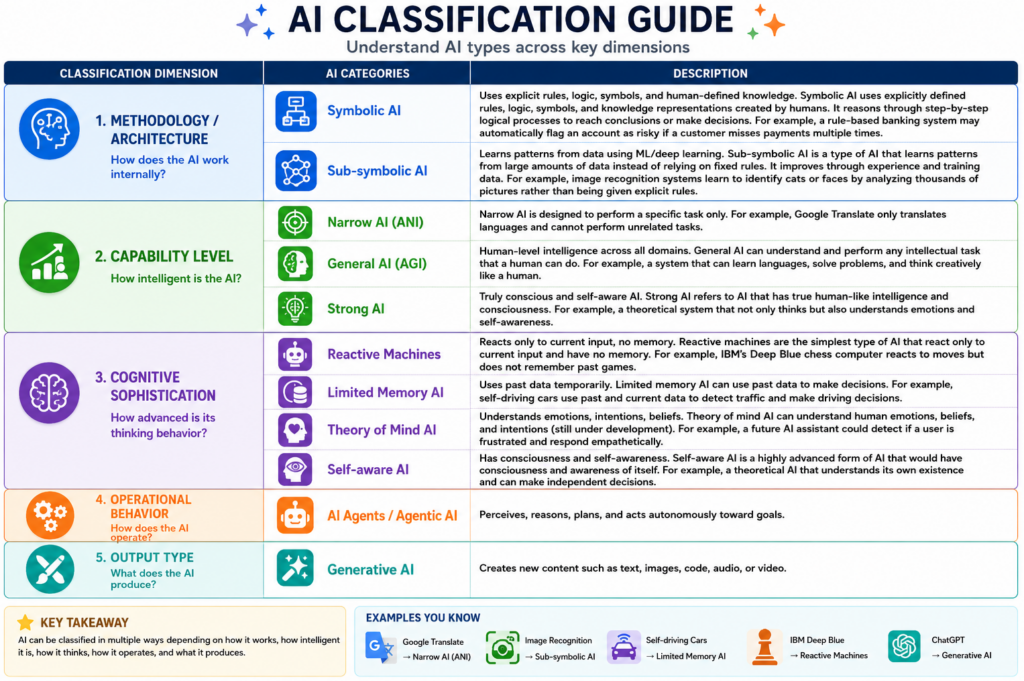
- AI Agent: An AI agent is a system that can perceive its environment, reason or make decisions, and take actions autonomously to achieve specific goals. For instance, virtual assistants such as Siri or Google Assistant respond to voice commands, retrieve information, and perform tasks.
- Symbolic AI (also called rule-based AI or classical AI) is a type of AI that uses explicitly defined rules, logic, symbols, and knowledge representations created by humans. It reasons through step-by-step logical processes to reach conclusions or make decisions. For example, a rule-based banking system may automatically flag an account as risky if a customer misses payments multiple times.
- Sub-symbolic AI is a type of AI that learns patterns from large amounts of data instead of relying on fixed rules. It improves through experience and training data. For example, image recognition systems learn to identify cats or faces by analyzing thousands of pictures rather than being given explicit rules.
AI Classification, according to the EU AI Act: The EU (European Union) Artificial Intelligence Act (AI Act) provides a comprehensive framework for regulating AI systems based on their potential risks and societal impact. It aims to ensure that AI systems within the EU are safe, transparent, ethical, and aligned with fundamental rights and values. The EU AI Act classifies AI systems into four categories based on the level of risk they may create for people and society.
- The first category is Minimal or No Risk, which includes AI systems that have very little impact on users and therefore do not require special legal obligations. For example spam filters and recommendation systems.
- The second category is Limited Risk, which covers AI systems that have low risk but must follow basic transparency requirements. In these cases, users should be informed that they are interacting with AI. Examples may include chatbots and AI-powered customer service tools.
- The third category is High Risk, which includes AI systems used in important areas such as employment, healthcare, education, transportation, and law enforcement. These systems are allowed under the EU AI Act, but they must comply with strict requirements to reduce risks and protect people’s rights and safety.
- The final category is Unacceptable Risk, which refers to AI systems that are considered harmful or dangerous to human rights and public safety. Such systems are prohibited under the EU AI Act. For instance social scoring systems and certain forms of manipulative or mass surveillance AI.
Types of AI Based on Capabilities
- Narrow AI is designed to perform a specific task only. For example, Google Translate only translates languages and cannot perform unrelated tasks.
- General AI can understand and perform any intellectual task that a human can do. For example, a system that can learn languages, solve problems, and think creatively like a human.
- Strong AI refers to AI that has true human-like intelligence and consciousness. For example, a theoretical system that not only thinks but also understands emotions and self-awareness.
Types of Strong AI Based on Cognitive Capabilities
- Reactive Machines are the simplest type of AI that react only to current input and have no memory. For example, IBM’s Deep Blue chess computer reacts to moves but does not remember past games.
- Limited Memory AI can use past data to make decisions. For example, self-driving cars use past and current data to detect traffic and make driving decisions.
- Theory of Mind AI can understand human emotions, beliefs, and intentions (still under development). For example, a future AI assistant could detect if a user is frustrated and respond empathetically.
- Self-Aware AI is a highly advanced form of AI that would have consciousness and awareness of itself. For example, a theoretical AI that understands its own existence and can make independent decisions.
A Social Scoring AI is a system used to evaluate and rank individuals or organizations based on their behavior, activities, trustworthiness, or compliance with certain rules. It usually works by collecting data from different sources and assigning a score or rating. For example, paying bills on time, following laws and regulations, financial history, traffic violations or criminal records etc.
Manipulative AI is artificial intelligence that tries to influence or control people’s decisions and behavior in unfair or harmful ways. It often studies people’s emotions, habits, or weaknesses and then uses that information to push them toward certain actions. For example, a shopping app may repeatedly target children with ads to make them buy unnecessary products, or a social media platform may continuously show emotional or shocking content just to keep users addicted and online for longer periods.
Mass Surveillance AI is artificial intelligence used to monitor, track, or observe large numbers of people continuously. It can use technologies such as facial recognition cameras, location tracking, voice recognition, or online activity monitoring. For example, cameras installed across a city may automatically identify and track people wherever they go, or an organization may monitor employees’ activities all day using AI systems. Many people are concerned that such systems may reduce privacy and personal freedom if they are used without proper controls and legal protections.
For your further reading:
- AI (Artificial Intelligence) Systems – Security Threats
- What is Integrated AI (Artificial Intelligence)?
- GDPR Aligned – Big Data Security Processes – Across the Data Lifecycle
- Six Essential Practices for Responsible AI Governance
- Zero-Knowledge Proof (ZKP) – A Professional Review
- Navigating the Big Data Lifecycle: From Collection to Insight
- Data Modeling – Identifiers / Keys
- Content Modeling – Controlled Vocabularies and Format
- Data Modeling – Arity of Relationships
