










Introduction
The healthcare industry is undergoing a massive computational shift. For decades, advancements like electronic health records and remote diagnostics laid the groundwork for connected medicine. Now, an incredible frontier is opening up. The medical community is moving rapidly toward remote robotic surgery.
Imagine an elite specialist executing a delicate neural or cardiac procedure on a patient located thousands of miles away. This concept once belonged entirely to science fiction. Today, it is an engineering reality. The convergence of surgical robotics, the Internet of Things (IoT), and high-speed telemetry networks has fundamentally changed clinical possibilities. As healthcare networks prioritize global accessibility and precision, telesurgery stands out as a transformative solution for modern medicine.
Deconstructing Telesurgery Architecture
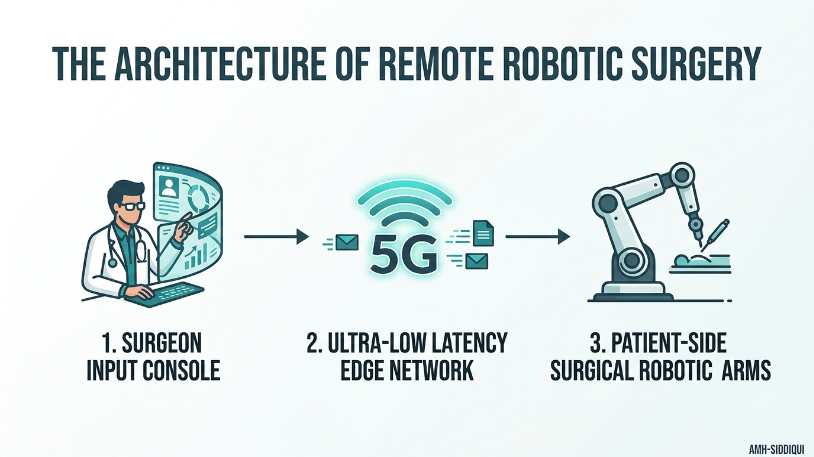
Remote robotic surgery allows a specialist to control sophisticated surgical instruments across great geographical distances. Instead of standing directly over the operating table, the physician sits at an advanced control console.
The system translates the surgeon’s physical hand movements into digital commands in real time. The patient-side robotic arms then mimic those gestures down to the millimeter. This setup eliminates minor human hand tremors completely. It allows for surgical execution that is smoother and more precise than traditional manual methods.
Technical Pillars of Remote Surgical Environments
Following are the Technical pillars for Remote Surgical Environment:
1. High-Speed, Low-Latency Networks
Telesurgery requires a practically instantaneous connection. Even a fraction of a second of network lag can create catastrophic clinical risks. Modern systems rely on dedicated fiber-optic lines and advanced 5G network slices. These pipelines deliver the ultra-low latency required to transmit commands without perceptible delay.
2. Magnified Three-Dimensional Vision Stacks
Surgeons cannot operate safely without perfect depth perception. Remote platforms solve this by using high-definition, stereoscopic camera arrays inserted directly into the patient. The console streams a magnified, lag-free 3D view of the surgical site. This visual clarity surpasses the capability of the naked human eye.
3. Integrated Edge-AI Diagnostics
Artificial Intelligence works as a silent, real-time co-pilot throughout the procedure. AI models analyze the incoming video feed instantly to map anatomical structures. The software flags hidden blood vessels, identifies tissue boundaries, and provides smart alerts to assist the surgeon’s navigation.
The Critical Role of IoT Telemetry
The Internet of Things functions as the nervous system of the modern operating room. It builds a fully connected, responsive environment around the patient.
- Real-Time Vital Streams: Medical sensors track the patient’s heart rate, blood pressure, oxygen saturation, and core temperature continuously. The system transmits this data instantly to both the local clinical team and the remote surgeon.
- System Integrity Monitoring: IoT diagnostics track the mechanical health of the robotic arms. The network monitors torque, power stability, and component calibrations every second.
- Interoperable Data Pipelines: Connected setups allow seamless information sharing between disparate hospital networks. This lets specialists access historical imaging, lab results, and patient charts instantly mid-operation.
Clear Strategic and Clinical Benefits
| Operational Vector | Traditional Open Surgery | Remote Robotic Surgery |
| Specialist Access | Limited by physical travel constraints | Instantly available globally |
| Incision Profile | Large openings; higher trauma | Minimally invasive micro-incisions |
| Patient Recovery | Extended hospital stays required | Accelerated healing; minimal blood loss |
| Precision Scale | Restricted by human hand stability | Sub-millimeter digital scaling |
Primary Structural and Cybersecurity Challenges
Despite its immense promise, widespread adoption faces critical infrastructure barriers. These bottlenecks require rigorous engineering solutions before telesurgery can become a global baseline.
1. System Vulnerability and Network Security
Every single connected medical device represents an active network endpoint. If a malicious actor disrupts a telesurgery session, the consequences are immediately life-threatening. Securing these architectures requires a strict Defense-in-Depth strategy. Networks must deploy Zero-Trust access controls, end-to-end data encryption, and robust firewalls to safeguard the telemetry pipeline.
2. Data Governance and Privacy Lifecycles
Telesurgery infrastructure generates massive amounts of sensitive personal health information (PHI). Organizations must ensure strict compliance with international privacy frameworks. This requires clear data governance policies, unalterable audit trails, and data minimization protocols to protect patient records from exploitation.
3. High Infrastructure Capital Costs
Deploying a reliable robotic surgery ecosystem requires a major capital investment. Hospitals must purchase expensive robotic platforms, maintain specialized hardware, and build dedicated high-speed network connections. Additionally, surgical teams need extensive technical training, which limits early adoption to well-funded medical centers.
Conclusion
The future of remote surgery is tied directly to the expansion of edge computing and intelligent automation. As 5G infrastructure matures worldwide, the reliance on centralized cloud servers will decrease. Localized edge nodes will process complex telemetry data right inside the operating room. This shift will drop latency to near-zero levels.
Further down the road, the integration of quantum computing and advanced machine learning will unlock true real-time predictive analytics. We will see global collaboration networks where specialists routinely consult on and execute complex procedures across continents simultaneously. For data professionals and healthcare engineers, building the secure, high-bandwidth pipelines to support this medical revolution is one of the most important frontiers in modern technology.
Related Readings:
- How AI and IoT Are Driving Digital Transformation Across Industries
- Bioinformatics and Artificial Intelligence
- How Robots Are Assisting Modern Surgeries
- Threat of AI in Healthcare
- Internet of Things (IoT) Security
- Wearable Health Technology
- Human Brain Vs Artificial Intelligence
- What Is Integrated AI (Artificial Intelligence)?
- NIST AI RMF – A Momentary Look
- Data Governance Framework and Pillars
- Data Governance – How to Set a Strong Foundation?
- What Is MDM (Master Data Management)?
