









Threat of AI in Healthcare: Security Risks, Privacy Concerns, and Ethical Challenges
Introduction
The threat of AI in healthcare is becoming a growing concern as healthcare organizations increasingly rely on artificial intelligence for automation, predictive analytics, patient monitoring, and healthcare data management. While AI technologies improve efficiency and medical decision-making, they also introduce serious risks related to cybersecurity, patient privacy, ethical responsibility, and data protection.
Today, hospitals, clinics, and healthcare providers rely heavily on digital systems to store and manage patient information. AI-powered technologies can analyze medical records, identify health patterns, support clinical decisions, and improve patient care. These advancements are helping modern healthcare systems become smarter and more data-driven.
However, despite its many advantages, the growing use of AI in healthcare data management also introduces serious risks and challenges. Healthcare systems store highly sensitive information, including medical records, financial details, insurance information, and personal patient data. If AI systems are not properly secured or managed, they can create cybersecurity vulnerabilities, privacy concerns, ethical issues, and operational risks.
Readers interested in artificial intelligence and intelligent systems can also explore:
Understanding AI in Healthcare Data Management
Artificial Intelligence in healthcare data management refers to the use of machine learning, predictive analytics, automation, and intelligent systems to collect, process, analyze, and manage healthcare information.
Healthcare organizations use AI technologies for:
- Electronic Health Records (EHRs)
- Medical diagnosis support
- Predictive healthcare analytics
- Healthcare automation
- Patient monitoring systems
- Clinical decision-making
- Medical research and reporting
Related reading:
- What is Data Management?
- Data Management – Key Components and Knowledge Areas
- What is MDM – Master Data Management
- Big Data vs Traditional Data, Data Warehousing, AI, and Beyond
Why Healthcare Data Requires Strong Protection
Healthcare data is considered one of the most sensitive forms of digital information. Medical records often contain highly confidential details such as:
- Patient identities
- Medical histories
- Financial records
- Insurance information
- Diagnostic reports
- Treatment plans
If healthcare data is compromised, it can lead to:
- Identity theft
- Financial fraud
- Medical fraud
- Privacy violations
- Loss of patient trust
- Legal and regulatory consequences
Strong healthcare data management systems are essential for protecting patient privacy and maintaining secure digital healthcare environments. Healthcare organizations must also comply with international privacy and data protection regulations to ensure responsible data processing.
Readers interested in healthcare privacy and compliance can also explore:
- EU GDPR – Article 22 (Automated Individual Decision-Making, Including Profiling)
- EU GDPR – Article 32 (Security of Processing)
- EU GDPR – Article 35 (Data Protection Impact Assessment – DPIA)
- KSA PDPL – Article 23 (Health Data Processing)
- KSA PDPL – Article 12 (Data Collection & Privacy Policies)
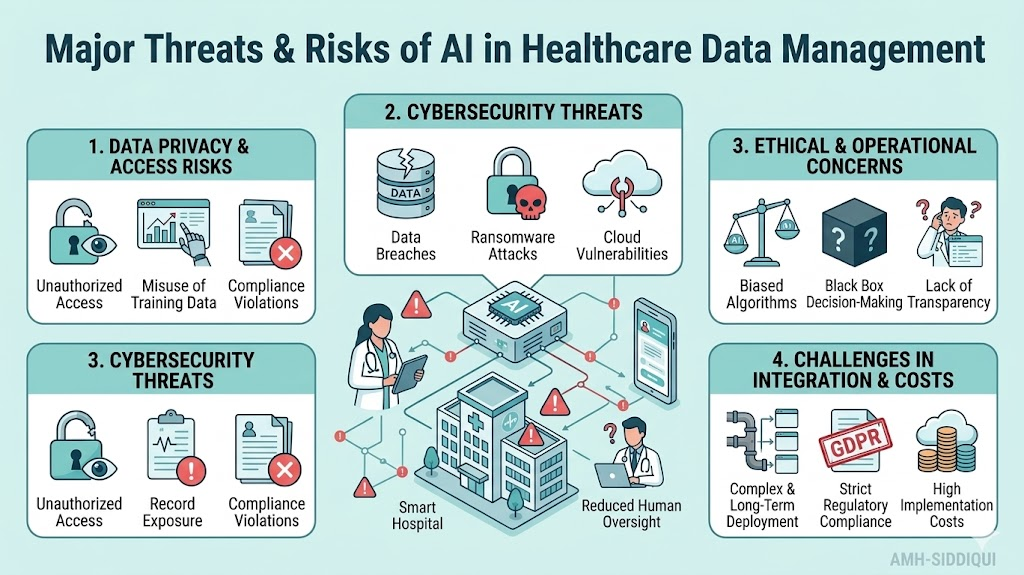
Understanding the Threat of AI in Healthcare
Although AI offers major benefits in healthcare, it also creates several risks that healthcare organizations cannot ignore.
1. Data Privacy Risks
AI systems require large amounts of healthcare data for training, analysis, and predictive modeling. This increases the risk of unauthorized access, data misuse, and privacy violations.
Poorly secured AI systems may expose:
- Patient medical records
- Personal identification information
- Financial details
- Treatment histories
- Healthcare insurance data
Protecting patient privacy remains one of the biggest challenges in AI-driven healthcare environments.
Related reading:
- The Far-Reaching Consequences of Personal Data Breaches
- KSA PDPL – Article 16 (Data Disclosure is Forbidden)
- KSA PDPL – Article 18 (Data Retention and Deletion)
2. Cybersecurity Threats
AI-powered healthcare systems are attractive targets for cybercriminals because they store valuable medical and personal information.
Hackers may attempt to steal patient records, manipulate healthcare systems, or disrupt hospital operations.
Common Cybersecurity Risks
- Data breaches
- Malware attacks
- Ransomware attacks
- Unauthorized system access
- Cloud security vulnerabilities
- Insider threats
As healthcare systems become more connected, stronger cybersecurity frameworks are becoming essential.
Readers interested in cybersecurity and connected technologies can also read:
3. Bias in AI Algorithms
AI systems learn from historical healthcare datasets. If the data contains bias, inaccuracies, or incomplete information, AI algorithms may generate unfair or misleading results.
Biased AI systems may affect:
- Disease diagnosis
- Treatment recommendations
- Healthcare accessibility
- Clinical decision-making
- Patient outcomes
This creates serious ethical and medical concerns, especially when patient safety is involved.
Healthcare organizations must ensure that AI systems are trained using diverse, accurate, and high-quality datasets.
4. Lack of Transparency in AI Systems
Some AI systems operate as “black box” models, where healthcare professionals cannot fully understand how AI-generated decisions are made.
Lack of transparency can reduce:
- Trust in AI systems
- Accountability
- Clinical reliability
- Decision accuracy
Healthcare organizations need explainable and transparent AI systems that support responsible healthcare decision-making.
5. Poor Data Quality
AI systems depend heavily on accurate and high-quality healthcare data. Incomplete or incorrect information can reduce the reliability of AI predictions and healthcare decisions.
Common Data Quality Problems
- Missing patient records
- Duplicate information
- Incorrect data entries
- Inconsistent healthcare datasets
- Outdated records
Poor healthcare data management can negatively affect patient care, operational efficiency, and AI performance.
Related reading:
Ethical Concerns of AI in Healthcare
The growing use of AI in healthcare also raises several ethical concerns that healthcare organizations must address carefully.
Patient Consent and Data Usage
Many patients may not fully understand how their personal medical information is collected, analyzed, or processed by AI systems.
Transparent privacy policies and proper consent mechanisms are essential for maintaining patient trust.
Reduced Human Oversight
Overdependence on AI technologies may reduce human involvement in medical decision-making. Howerver AI can support healthcare professionals, human expertise and judgment remain essential in healthcare services and patient treatment.
Risk of Misdiagnosis
AI systems may generate incorrect recommendations or predictions if they are trained using biased or incomplete healthcare data. This can negatively impact healthcare quality and patient safety.
Challenges in AI-Based Healthcare Data Management
Healthcare organizations face several operational and technical challenges when implementing AI-driven systems.
Integration Challenges
Integrating AI technologies with existing healthcare systems can be complex, time-consuming, and expensive.
Regulatory Compliance Challenges
Healthcare organizations must comply with strict privacy, cybersecurity, and data governance regulations when managing healthcare information.
High Implementation Costs
Advanced AI systems often require:
- Skilled professionals
- Cybersecurity infrastructure
- Cloud platforms
- Continuous monitoring systems
- AI governance frameworks
These requirements can significantly increase operational costs for healthcare organizations.
Related reading:
How to Reduce AI Risks in Healthcare Data Management
Healthcare organizations can reduce AI-related threats by:
Strengthen Cybersecurity Systems
Healthcare institutions should implement:
- Data encryption
- Multi-factor authentication
- Secure cloud systems
- Continuous security monitoring
- Regular security audits
Readers can further read:
Improve Data Governance
Healthcare organizations should establish clear policies for:
- Data storage
- Access management
- Data retention
- Privacy protection
- Data quality monitoring
Ensure Ethical AI Development
Organizations should develop transparent and responsible AI systems that reduce algorithm bias and improve accountability.
Maintain Human Supervision
AI should support healthcare professionals rather than replace human decision-making completely. Human oversight remains essential for safe and ethical healthcare services.
The Future of AI in Healthcare Data Management
Artificial AI-powered systems are expected to improve:
- Predictive healthcare analytics
- Medical research
- Patient monitoring
- Healthcare automation
- Personalized treatment systems
- Clinical decision support
As digital healthcare expands, organizations must prepare for the future threat of AI in healthcare technologies.
Readers interested in future healthcare technologies can also explore:
Conclusion
Artificial Intelligence is reshaping healthcare data management by improving automation, efficiency, and medical decision-making. Therefore, the increasing use of AI in healthcare also introduces serious risks related to cybersecurity, data privacy, ethics, and healthcare data quality.
Healthcare organizations must prioritize strong cybersecurity systems, responsible AI governance, and patient data protection to reduce these risks effectively. Meanwhile, maintaining transparency, ethical AI practices, and human oversight remains essential for building trustworthy healthcare systems.
As digital healthcare technologies continue evolving, balancing innovation with healthcare security and ethical responsibility will become one of the most important priorities in modern healthcare management.
“AI can improve healthcare systems, but protecting patient privacy, healthcare data, and digital trust must always remain the highest priority.”