









Introduction
Ask any data leader what slows their team down, and you will hear a familiar story. Business units need a new dataset. They file a request. The central data team—buried under a heavy backlog—eventually gets to it. By then, the business question has changed, or someone built a spreadsheet workaround. Multiply that across dozens of domains, and your data platform never quite keeps up.
This bottleneck is what data mesh solves. It is not a software product or a tool; it is an organizational shift in who owns enterprise data and how teams deliver it.
What Data Mesh Actually Means
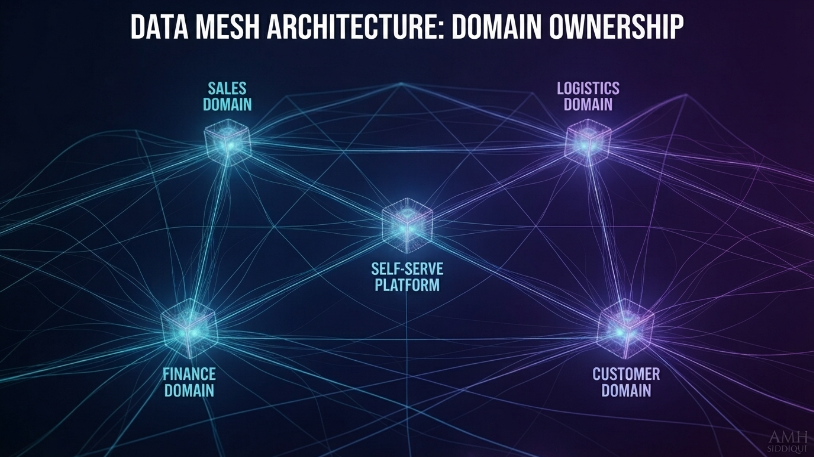
Data mesh introduces a clear premise: teams closest to a domain—sales, logistics, manufacturing—should own the data that their domain produces. They stop shipping raw data off to a central team with little business context.
Instead of one data engineering group trying to manage every vertical, ownership is distributed. Each domain team publishes clean, reliable, well-documented data as a product. Other teams consume it like any internal service.
Traditional data lakes force data into a single central repository. That model works at a small scale, but past a threshold, it limits how fast an enterprise can leverage its data assets.
The Four Principles Behind the Pattern
Practitioners describe data mesh through four interlocking principles:
1. Domain-Oriented Ownership
Data responsibility sits with the team closest to the source. These experts understand what a canceled order or a returned shipment represents in context.
2. Data as a Product
Domain teams treat datasets like customer-facing products. They provide clear documentation, defined SLAs, discoverability, and feedback loops. Unmanaged data is not a product.
3. Self-Serve Data Infrastructure
Domain teams rarely specialize in infrastructure. A shared platform handles storage, pipelines, access controls, and observability. This lets domains focus entirely on their data.
4. Federated Computational Governance
Decentralized ownership does not mean abandoning standards. Interoperability rules and security policies remain mandatory. However, the platform automates governance rather than relying on manual committee reviews.
Data Mesh vs. Data Lake vs. Data Warehouse
These three patterns serve entirely different architectural layers:
- Data Warehouse: Structures data for fast business reporting after heavy transformation.
- Data Lake: Stores raw, semi-structured data at scale before use cases are defined.
- Data Mesh: An ownership framework that dictates accountability, delivery, and governance.
Many organizations run a data lake or warehouse underneath a mesh approach. Mesh principles govern how that infrastructure is owned rather than replacing it outright.
Strategic Comparison
| Architecture Model | Primary Ownership | Scalability Bottleneck | Best Suited For |
| Centralized Data Lake | Central Data Team | Persistent pipeline backlogs | Smaller organizations with few data sources |
| Data Mesh | Distributed Domain Teams | Requires platform engineering investment | Large enterprises with complex business domains |
Where Data Mesh Makes Sense
Data mesh is not a universal upgrade. Smaller teams with few data sources benefit more from a centralized model. Data mesh pays off when:
- An enterprise operates multiple distinct business domains.
- A central data team has become a permanent delivery bottleneck.
- Domain expertise is scattered across the business.
- Executives invest in a shared self-serve platform.
Without platform investment, “decentralizing” data ownership just creates fragmented silos.
Related Readings
- Data Strategy vs. Data Platform Strategy
- Data Strategy, Architecture, & Models
- Knowledge Graphs: The Hidden Foundation of Enterprise AI
- Federated Learning: Training AI Safely Without Sharing Data
- Edge AI: Bringing Intelligence Closer to the Source of Data
- Data Clean Rooms: Secure Data Collaboration
- Machine Identity Management: Securing Non-Human Identities in Modern Enterprises
- Data Strategy Category
- Data Architecture Category
- Data Governance Category
- Data Engineering Category
- Data Lake Category
- Enterprise Architecture Category
