









The National Institute of Standards and Technology AI RMF stands for the AI Risk Management Framework. It was developed by National Institute of Standards and Technology to help organizations develop, use, and manage AI systems in a trustworthy, safe, secure, and responsible way. The framework is voluntary, meaning organizations are not legally forced to use it, but many companies, governments, and institutions use it as a best practice. You can think of the NIST AI RMF as a practical guidebook that helps companies answer questions like:
- Is our AI system fair?
- Is it secure from attacks?
- Can people trust its decisions?
- Are we protecting privacy?
- What happens if the AI makes mistakes?
Main Idea of NIST AI RMF: AI systems can create many benefits, but they also create risks. For example:
- A hiring AI may reject qualified candidates unfairly.
- A chatbot may give false medical advice.
- A facial recognition system may misidentify people.
- An AI fraud detection tool may block legitimate customers.
The NIST AI RMF helps organizations reduce these risks systematically by implementing the subsequent Four Core Functions of NIST AI RMF. The NIST AI Risk Management Framework is built around the following four major functions, and these functions work together continuously.
Govern means establishing the rules, policies, accountability, and culture for responsible AI. Without governance, AI projects may become uncontrolled and risky. This is the leadership and governance part, where organizations define:
- Who is responsible for AI decisions
- Ethical principles
- AI policies and standards
- Risk tolerance
- Compliance requirements
- Roles and responsibilities
Suppose an airline uses AI to analyze passenger behavior and offer promotions. Under “Govern” the airline would:
- Create AI usage policies
- Define who approves AI models
- Ensure compliance with privacy laws
- Train employees on responsible AI
- Establish review committees
Map means understanding the AI system, its purpose, environment, users, and possible risks. It is similar to creating a “risk picture” before deployment. This stage asks:
- What does the AI system do?
- Who will use it?
- What data does it use?
- What could go wrong?
- Who may be harmed?
The organization maps all possible impacts and stakeholders. For instance, a bank wants to use AI for loan approval. During “Map” the bank identifies:
- The AI uses customer income and credit history
- Customers from different backgrounds are affected
- Biased training data could create unfair decisions
- Incorrect approvals may create financial losses
- Privacy risks exist
Measure means testing and evaluating AI risks. Organizations assess whether the AI is Accurate, Fair, Reliable, Secure, Explainable and Privacy-preserving. This stage uses metrics, testing, audits, and validation. For instance, a hospital uses AI to detect diseases from X-rays. Under “Measure” the hospital checks:
- Accuracy percentage
- False positive rates
- False negative rates
- Performance across genders and age groups
- Security vulnerabilities
- Reliability under different conditions
If the AI performs poorly for certain patient groups, the issue is identified here.
Manage means continuously responding to and reducing AI risks over time. AI risks change constantly because Data changes, threats evolve, users behave differently and regulations change. Organizations must continuously monitor and improve AI systems. This creates ongoing AI risk control. For instance, an e-commerce company uses AI for fraud detection. Under “Manage” the company:
- Monitors AI decisions daily
- Investigates unusual outputs
- Updates models regularly
- Handles customer complaints
- Corrects biases
- Responds to security incidents
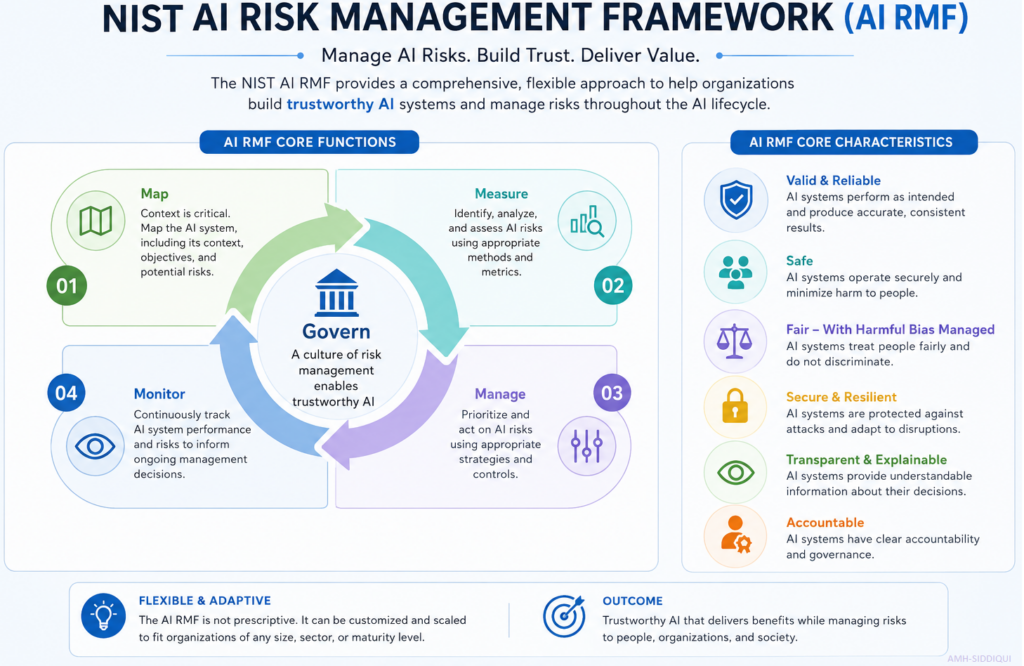
As a real-life analogy just imagine AI is like driving a car:
- Govern = traffic laws, driving policies, and licenses
- Map = checking the route, weather, and road conditions
- Measure = checking brakes, speed, fuel, and sensors
- Manage = adjusting driving continuously during the journey
All four are needed for safe travel. Right?
NIST AI RMF Official Reference: For your further understanding, you may also explore the official framework by visiting website NIST AI Risk Management Framework (AI RMF 1.0)
For your further reading:
- AI (Artificial Intelligence) – Key Concepts
- AI (Artificial Intelligence) Systems – Security Threats
- What is Integrated AI (Artificial Intelligence)?
- GDPR Aligned – Big Data Security Processes – Across the Data Lifecycle
- Six Essential Practices for Responsible AI Governance
- Zero-Knowledge Proof (ZKP) – A Professional Review
- Navigating the Big Data Lifecycle: From Collection to Insight
- Data Modeling – Identifiers / Keys
- Content Modeling – Controlled Vocabularies and Format
- Data Modeling – Arity of Relationships
