










Bioinformatics and Artificial Intelligence: Transforming Modern Healthcare
Introduction
The intersection of biological sciences and digital technology is driving a massive paradigm shift in clinical research and modern patient care. At the absolute forefront of this movement is the convergence of bioinformatics and Artificial Intelligence. Together, these disciplines allow researchers to decode complex biological mechanisms at a scale and speed that was completely unimaginable a decade ago.
From mapping massive genomic arrays to engineering highly specific therapeutic compounds, AI-driven bioinformatics is moving modern medicine away from generalized treatments and toward targeted, data-backed interventions. For platforms like the MDM Team that focus on the cutting edge of enterprise data and emerging tech, understanding this computational biology pipeline is essential.
As healthcare transitions into a purely data-driven industry, managing, processing, and securing biological big data requires the exact same foundational architecture used in advanced enterprise AI systems.
What Is Bioinformatics?
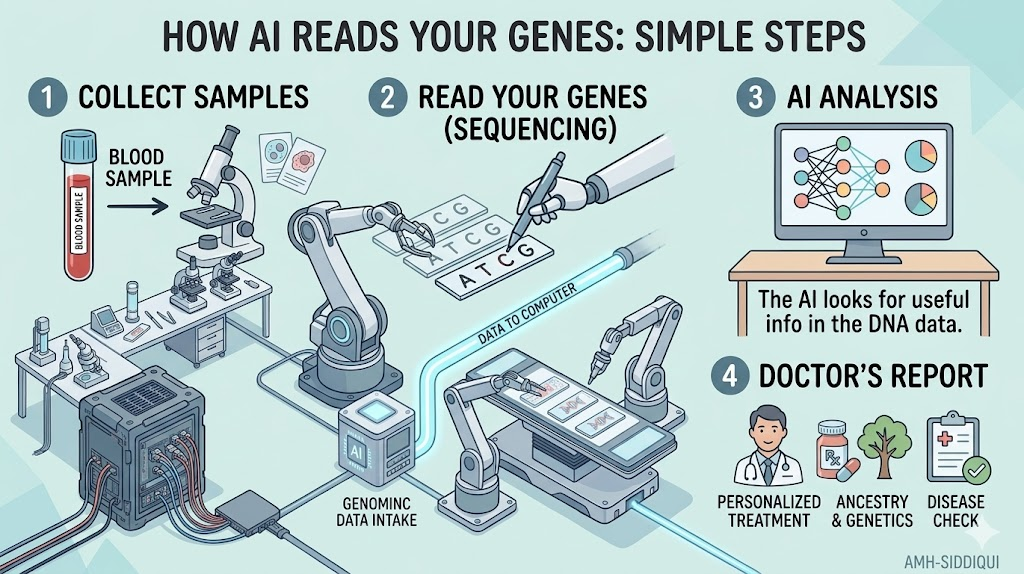
Bioinformatics is a multidisciplinary field that blends biology, computer science, mathematics, and information engineering to analyze and interpret complex biological data. Instead of analyzing test tubes manually, molecular biologists use computational software to parse billions of data points.
Inputs (DNA, RNA, Proteins) Processing (Algorithms & Modeling) Outcomes (Targeted Therapies & Vaccines)
The core architecture of bioinformatics centers on a few highly critical biological components:
- Genomic Sequencing: Mapping and analyzing complete DNA and RNA structures.
- Proteomics: Understanding protein folding, molecular configurations, and structural changes.
- Phylogenetics: Tracing the evolutionary tracks and mutations of viruses and bacteria.
- Systems Biology: Modeling entire cellular ecosystems to predict how human tissue reacts to external variables.
The Role of Artificial Intelligence in Bioinformatics
Traditional bioinformatics relied heavily on static, hard-coded statistical algorithms. While effective for small datasets, these tools struggle under the weight of modern high-throughput sequencing. This is where Artificial Intelligence—specifically deep learning and neural networks—fundamentally changes the equation.
AI excels at parsing unstructured data and isolating faint biological signals within massive, noisy environments. When deployed alongside biological databases, machine learning algorithms can predict molecular interactions, classify pathogenic mutations, and automate complex pattern recognition tasks in fractions of a second.
| Computational Attribute | Traditional Bioinformatics | AI-Enhanced Bioinformatics |
| Data Processing Speed | Hours to weeks per genome | Real-time pattern recognition |
| Pattern Discovery | User-defined parameters only | Autonomous feature extraction |
| Predictive Capabilities | Limited to historical data points | Simulates unseen molecular bonds |
| Scale Capacity | Struggles with multi-omic data | Seamlessly aggregates deep datasets |
Key Clinical Applications of AI-Driven Bioinformatics
1. Accelerated Genome Sequencing
Next-generation sequencing (NGS) generates multi-gigabyte data files for a single human genome. Deep learning models process these sequences to identify single nucleotide polymorphisms (SNPs) and structural variants that indicate a high risk for genetic disorders, hereditary diseases, or oncological mutations.
2. High-Velocity Drug Discovery
Developing a new pharmaceutical drug traditionally takes over a decade and billions of dollars in capital. AI engines bypass years of physical laboratory trials by simulating how millions of chemical compounds interact with target disease proteins in a virtual sandbox. This slashes early-stage drug discovery phases down from years to mere days.
3. Precision Medicine and Targeted Therapies
The historic “one-size-fits-all” approach to medicine is fading. By matching a patient’s unique genetic profile against a deep library of clinical outcomes, AI helps physicians design highly personalized treatment protocols. This maximizes the therapeutic impact while reducing adverse drug reactions.
4. Advanced Protein Structure Analysis
Proteins dictate nearly every critical function within living organisms. For decades, mapping a single protein’s 3D structure required months of arduous lab work using X-ray crystallography. Today, advanced deep learning models predict highly complex protein structures down to atomic accuracy using only their amino acid sequences.
Major Technical and Operational Benefits
Integrating neural networks into biological research unlocks massive operational efficiencies across scientific ecosystems:
- Drastic Cost Reduction: Eliminating thousands of physical, wet-lab trials lowers the overhead associated with pharmaceutical R&D and genomic analysis.
- Elimination of Analytical Errors: Automated pipeline processing standardizes data cleaning and removes human bias or oversight from data interpretation.
- Early Intervention Strategies: Predictive algorithms flag clinical vulnerabilities long before physical pathology manifests in a patient, changing medicine from reactive to proactive.
Crucial Challenges Facing the Industry
Massive Biological Data Storage
A single human genome sequence creates roughly 100 gigabytes of raw data. As population-scale sequencing accelerates, healthcare networks face severe infrastructure bottlenecks. Solving this requires resilient cloud setups, localized high-performance computing (HPC) nodes, and sophisticated data deduplication protocols.
Data Privacy and Lifecycle Cybersecurity
Genetic data is the most sensitive form of personally identifiable information (PII) in existence. Unlike a password or credit card number, a compromised DNA profile cannot be reset. Protecting this data requires strict alignment with global compliance frameworks, zero-trust architectures, and robust access controls.
High-Compute Infrastructure Dependencies
Training deep neural networks to process three-dimensional molecular structures demands massive GPU clusters. Organizations must invest heavily in high-performance hardware or cloud engineering to keep up with the processing footprints of modern bio-models.
Conclusion
The convergence of biology and computing power will only deepen over the next several years. As deep learning techniques mature, we are moving closer to real-time molecular modeling and fully automated pathogen tracking systems. Emerging technologies like quantum computing also stand to completely break through our current computational limits, allowing us to simulate entire biological systems at an atomic layer.
For technology teams and data professionals, the takeaway is clear: the future of medical science is being written in code. Building scalable, highly secure data pipelines to handle this biological revolution remains one of the most vital frontiers in modern engineering.
Further readers can read:
Internet of Things (IoT) Security
EU GDPR – Article 25: Data Protection by Design and by Default
What is Integrated AI (Artificial Intelligence)?
Big Data vs Traditional Data, Data Warehousing, AI, and Beyond
Big Data & Artificial Intelligence – MDM Team
Human Brain vs Artificial Intelligence
