










Introduction
The rapid expansion of enterprise Artificial Intelligence has exposed a critical bottleneck in modern engineering: standard silicon computer chips are hitting their physical limits. Training deep learning architectures containing hundreds of billions of parameters strains modern data centers. It consumes massive amounts of power and requires weeks of high-compute clustering.
To overcome these roadblocks, the tech sector is turning to a revolutionary new processing paradigm. The convergence of Quantum Computing and Artificial Intelligence represents the next major leap in computational power. By moving away from legacy binary constraints, quantum architectures provide the specialized processing power required to run the next generation of machine learning workloads.
The Shift from Binary Bits to Qubits
To understand how quantum mechanics accelerates AI, we must first look at how these systems handle information differently than conventional servers.
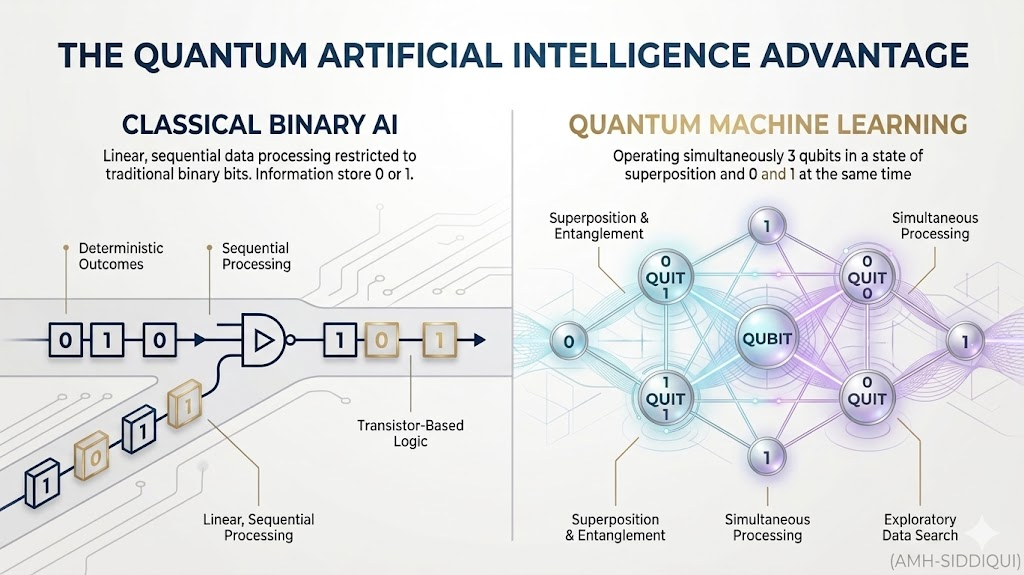
Classical computers process data sequentially using standard bits. A traditional bit is strictly deterministic, meaning it can only exist as a 0 or a 1 at any given moment, limiting processing to linear tracks.
Quantum systems break this linear limitation by using qubits (quantum bits). Qubits leverage two advanced principles of quantum physics to process highly complex variables simultaneously:
- Superposition: The ability of a qubit to exist in multiple states at once. Instead of testing solutions one by one, a quantum system evaluates millions of possibilities at the exact same time.
- Entanglement: A unique state where qubits become deeply interconnected. Changing the state of one qubit instantly influences its entangled partner, allowing computational power to scale exponentially rather than linearly.
Why Modern AI Urgently Needs Quantum Architecture
Modern machine learning models are growing faster than classical hardware can keep up. Advanced enterprise AI networks face major computational constraints across four core areas:
Processing Unstructured Data at Scale
Every day, global enterprises generate massive amounts of unstructured data. Sorting through these sprawling datasets using traditional relational databases creates heavy pipeline latency.
The Math Behind Complex Model Training
Training an advanced deep learning model involves adjusting billions of weights and parameters. On standard silicon chips, this optimization process requires massive, expensive graphic processing unit (GPU) clusters running continuously for months.
The Demand for Split-Second Decisions
In high-stakes environments like fraud detection and algorithmic trading, AI models must deliver automated decisions within milliseconds. Standard networks often experience computational lag when parsing multi-stream variables in real time.
Resolving Multi-Variable Optimization Problems
Classical machines struggle when calculated choices involve millions of fluid dependencies. Tasks like dynamic supply chain routing require evaluating near-infinite variables, often timing out standard processing systems.
How Quantum Mechanisms Enhance Machine Learning
Integrating quantum mechanics into artificial intelligence creates a highly advanced field known as Quantum Machine Learning (QML). This discipline upgrades standard algorithmic performance across three primary computational vectors:
1. Slashing Model Training Windows
Because quantum processors can calculate multiple data paths simultaneously, they compress the time required to train complex machine learning models. Workloads that currently take weeks on high-end server farms can be resolved in minutes.
2. High-Dimensional Pattern Recognition
Standard computer vision and pattern matching models struggle to find relationships in highly fragmented data. Quantum algorithms map information into vast, multi-dimensional mathematical spaces. This lets the system isolate subtle, complex patterns that classical algorithms miss entirely.
3. Sub-Second Combinatorial Optimization
Quantum computing excels at solving optimization challenges. By using algorithms like Quantum Annealing, the system scans through countless resource allocations simultaneously to find the absolute most efficient path instantly.
Real-World Industry Deployments
| Industry Domain | Legacy Classical AI Constraints | Quantum-Enhanced AI Potential |
| Biomedical Research | Takes years to simulate molecular bonds | Models atomic protein folding in seconds |
| Quantitative Finance | Portfolio risk modeling lags in volatile markets | Simulates complex global market shifts instantly |
| Enterprise Security | Vulnerable to advanced decryption attacks | Powers unhackable Quantum Key Distribution (QKD) |
| Global Logistics | Route optimization degrades during disruptions | Recalculates massive supply chains in real time |
Primary Structural Hurdles to Enterprise Adoption
While the mathematical potential of Quantum AI is revolutionary, building practical, commercial-scale hardware remains an uphill battle. The core challenge stems from a cascading physical vulnerability: ambient heat or minimal environmental vibrations generate quantum noise, which quickly destabilizes the fragile qubits. This process is known as decoherence, and it immediately introduces severe calculation errors into the AI workload.
Severe Infrastructure Cooling Demands
To keep qubits stable and fight off decoherence, quantum computers require highly specialized environments. Most systems must operate inside dilution refrigerators cooled to near absolute zero (roughly -273° Celsius), making them far colder than deep space.
Significant Capital Requirements and Talent Shortages
Building, maintaining, and programming quantum hardware requires immense capital. Furthermore, writing code for these architectures demands rare expertise at the intersection of advanced quantum physics, data science, and computer science.
Conclusion
The future of enterprise technology relies on hybrid processing networks. In the coming years, organizations will not replace their local systems entirely. Instead, companies will route traditional data management tasks through standard cloud architectures while offloading dense machine learning algorithms to quantum co-processors.
As technology providers stabilize hardware and expand Quantum Big Data as-a-Service (BDaaS), access to these advanced systems will democratize. Prioritizing clean data governance and modern pipeline architecture today ensures your business is ready to plug directly into the upcoming quantum ecosystem.
Related Readings:
- AI (Artificial Intelligence) – Key Concepts
- What Is Integrated AI (Artificial Intelligence)?
- NIST AI RMF – A Momentary Look
- Six Essential Practices for Responsible AI Governance
- How AI and IoT Are Driving Digital Transformation Across Industries
- Bioinformatics and Artificial Intelligence
- Human Brain Vs Artificial Intelligence
- How Robots Are Assisting Modern Surgeries
- Threat of AI in Healthcare
- Internet of Things (IoT) Security
- Wearable Health Technology
