









Introduction
Artificial Intelligence (AI) is no longer a speculative line item on a technology roadmap; it is the core engine driving modern enterprise innovation. From predictive market modeling and automated logistics to real-time customer behavior analytics, companies are aggressively deploying machine learning workloads to capture competitive advantages.
Yet, a glaring operational reality remains: an AI model is only as sophisticated as the data pipeline feeding it.
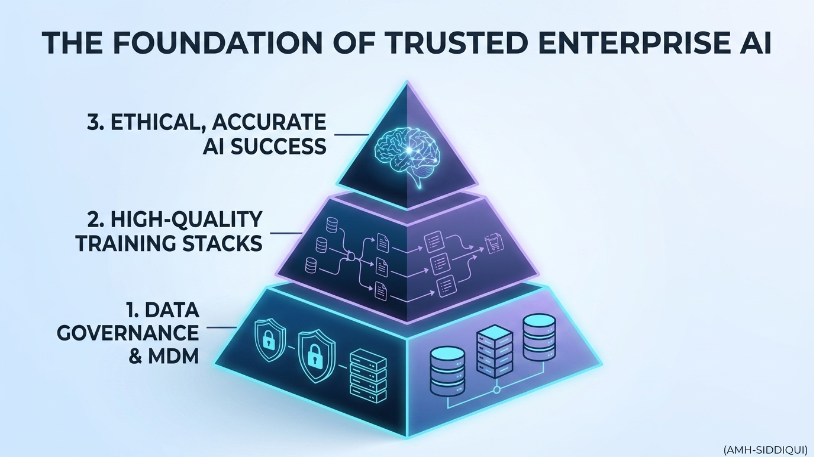
Without a rigorous framework governing that data, even the most advanced neural networks will fail, generating flawed insights that introduce severe financial, legal, and operational risks. For data leaders and enterprise architects, executing an effective Data Governance in AI success strategy is not just a compliance checkbox—it is an absolute architectural requirement.
The Anatomy of Modern Data Governance
Data governance is the comprehensive architectural framework of structural policies, data lineages, distinct roles, and technical standards that dictate how an enterprise ingests, secures, stores, and utilizes its information assets.
Raw Data Sources (Siloed, Unstructured) Governance Framework (Quality, Lineage, Security) AI Ready Data Stack (Unbiased, High-Fidelity)
A mature, high-functioning data governance program moves beyond basic data cleaning, establishing explicit parameters around several core operational vertices:
- Data Lineage Tracking: Mapping the end-to-end journey of a data point from its initial ingest source to its ultimate AI model consumption point.
- Stewardship & Ownership: Assigning clear, non-overlapping operational accountability to data stewards across specific business units.
- Dynamic Access Controls: Safeguarding infrastructure using modern, context-aware frameworks like Attribute-Based Access Control (ABAC).
- Lifecycle Lifecycle Auditing: Continuous tracking of how data ages out, updates, or undergoes transformation across production environments.
Why Machine Learning Models Fail Without Governance
The foundational engineering rule of computing remains undefeated in the machine learning era: garbage in, garbage out. Because AI engines are built to identify patterns autonomously, they cannot inherently distinguish between clean, high-fidelity signals and toxic, corrupted noise.
The Downstream Risks of Ungoverned Data:
- Cascading Algorithmic Bias: If historical training datasets lack proper diversity or reflect systemic human bias, the AI model will simply codify and accelerate those exact biases at scale.
- Model Drift and Degradation: Without continuous governance over incoming data streams, changes in real-world environments cause model performance to decay rapidly over time.
- The “Black Box” Problem: If an enterprise cannot map its data lineage, it becomes mathematically impossible to audatably explain why a deep learning model arrived at a specific decision.
Harmonizing Master Data Management (MDM) with AI Strategies
To feed an enterprise AI engine reliably, information must be clean, unique, and synchronized across every department. This is where the overlap between Master Data Management (MDM) and AI becomes critical.
MDM creates a single, immutable “golden record” for core business entities (such as customers, products, or suppliers). When paired with data governance, it provides the clean, deduplicated, and unified data foundation that allows predictive algorithms to run accurately without getting tripped up by duplicate entries or fragmented data silos.
| Data Attribute | Ungoverned Enterprise Stack | Governed, MDM-Enhanced Stack |
| Data Integrity | Fragmented, duplicate profiles across systems | Single, reconciled “Golden Record” |
| Lineage Visibility | Opaque; source origins are untraceable | Crystal clear end-to-end traceability |
| Ingest Pipeline | Ad-hoc, unvalidated data streams | Automated quality checks and schemas |
| Security Layer | Siloed, inconsistent security policies | Unified Zero-Trust access control |
Architectural Pillars of an AI-Ready Governance Framework
1. Unified Metadata Management
Organizations must invest heavily in metadata management. This keeps training data highly contextual. Properly cataloged assets allow machine learning pipelines to parse files easily. This drastically reduces manual data engineering overhead.
2. Automated Bias Mitigation and Auditing
Mitigating algorithmic bias requires strict data governance standards. These standards must apply directly during the source selection phase. Data stewards must conduct rigorous data profiling. This confirms that training arrays are genuinely representative. Stewards must also run continuous validation loops to detect skewed model behaviors early.
3. Structural Privacy Engineering
Modern AI architectures frequently process sensitive personally identifiable information (PII). A robust governance framework protects this sensitive footprint. It embeds privacy directly into the system design. Engineers achieve this by utilizing techniques like data anonymization, tokenization, and strict cryptographic protections.
Mitigating Regulatory and Compliance Risks
Deploying automated decision engines exposes organizations to aggressive legal frameworks. Regulations like the EU GDPR impose strict mandates. These rules govern automated profiling, data security, and the definitive “right to explanation.”
Data governance shields an enterprise from severe regulatory penalties. It enforces precise data lineage tracking and unambiguous consent management. It also maintains immutable audit trails. More importantly, it builds crucial customer trust in the safety, ethics, and transparency of AI deployments.
Conclusion
Generative AI, large language models (LLMs), and autonomous agents are becoming foundational enterprise tools. The sheer volume of unstructured data will soon test the limits of human teams.
Consequently, the future of data management relies on AI-driven autonomous governance. Moving forward, intelligent metadata engines will catalog assets automatically. Self-healing data pipelines will isolate anomalous entries, patch compliance gaps, and enforce security policies in real-time. Organizations that prioritize clean data engineering today will capture the full economic potential of this next intelligent era.
Related Readings:
What Is MDM – Master Data Management
Data Management – Key Components and Knowledge Areas
EU GDPR – Article 25: Data Protection by Design and by Default
NIST AI RMF – A Momentary Look
Six Essential Practices for Responsible AI Governance
What is Integrated AI (Artificial Intelligence)?
