









ISO/IEC 42001 is the international standard for establishing, implementing, maintaining, and continuously improving an AIMS (Artificial Intelligence Management System). It provides organizations with a structured framework to manage artificial intelligence responsibly, ethically, securely, and effectively. The standard helps organizations ensure that AI systems are trustworthy, transparent, compliant with legal and regulatory requirements, and aligned with business objectives while minimizing risks related to privacy, bias, security, and misuse of AI technologies. ISO/IEC 42001 follows the PDCA (Plan–Do–Check–Act) model, which is a continuous improvement approach commonly used in management systems standards. The PDCA cycle helps organizations systematically plan AI activities, implement them effectively, evaluate their performance, and continuously improve the AI Management System over time. This approach ensures that AI governance is not a one-time activity but an ongoing process of monitoring, learning, and enhancement.
In the “Plan” phase, the organization identifies its AI objectives, understands business and regulatory requirements, assesses risks and opportunities, and establishes policies, processes, and controls for responsible AI management. This phase mainly includes understanding the organizational context, leadership commitment, and planning activities. For example, before deploying an AI-based customer support chatbot, the organization plans how the AI will operate, what risks may exist, and what controls are needed to ensure accurate and fair responses.
In the “Do” phase, the organization implements and operates the planned AI processes and controls. This includes providing resources, training employees, managing data, developing or deploying AI systems, and ensuring operational controls are functioning properly. For example, the company deploys the chatbot, trains employees to monitor it, and ensures customer data is handled securely.
In the “Check” phase, the organization monitors, measures, evaluates, and audits the performance of the AI Management System. The purpose is to verify whether the AI systems are achieving objectives, complying with policies, and operating effectively without introducing unacceptable risks. For example, the organization reviews chatbot performance reports, customer complaints, accuracy levels, and compliance with privacy requirements.
In the “Act” phase, the organization takes corrective actions and continuously improves the AI Management System based on monitoring results, audits, incidents, feedback, and changing business or regulatory needs. This ensures long-term effectiveness and maturity of AI governance practices. For example, if the chatbot produces biased or incorrect responses, the organization updates the AI model, improves training data, and strengthens review processes to prevent recurrence.
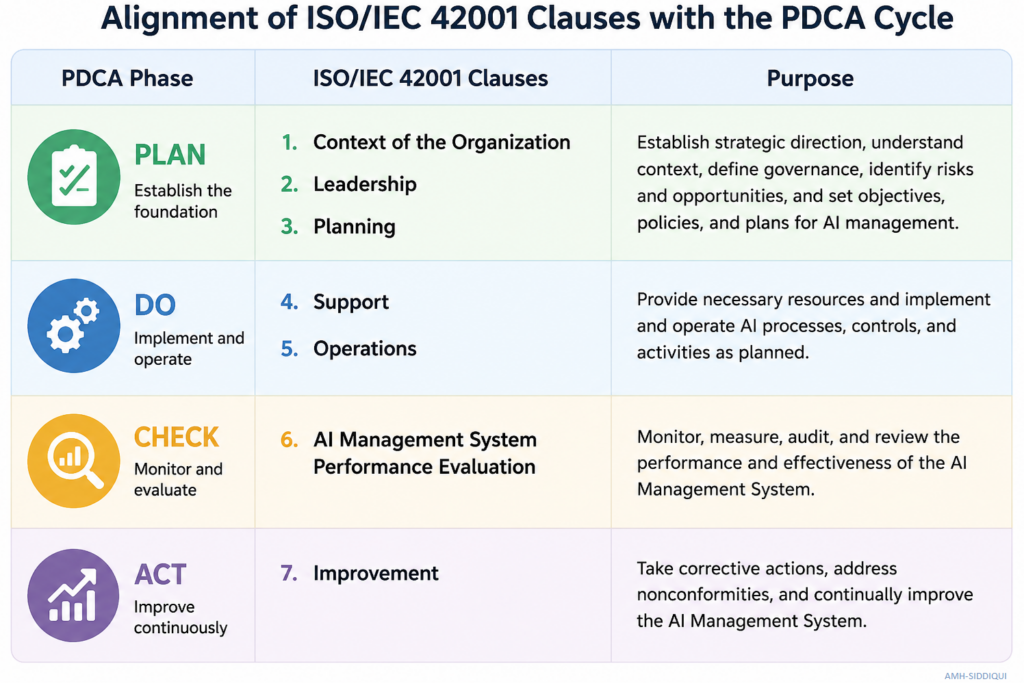
- Context of the Organization (PDCA Phase -> Plan): In ISO/IEC 42001, the context of the organization refers to understanding how artificial intelligence is used within the organization and identifying the internal and external factors that may influence its success, risks, and compliance obligations. This includes understanding business objectives, legal and regulatory requirements, customer expectations, ethical considerations, available technologies, organizational culture, and the potential impact of AI on individuals and operations. The organization must also clearly define the scope of its AIMS (AI Management System) and determine where AI technologies are being applied and for what purpose. Within the PDCA (Plan–Do–Check–Act) cycle, this activity belongs to the Plan phase because it establishes the foundation for AI governance, risk assessment, and strategic direction before implementation begins. For example, an airline using AI for ticket pricing must consider fairness to customers, aviation regulations, market competition, cybersecurity risks, and data privacy requirements before deploying the AI solution.
- Leadership (PDCA Phase -> Plan): Leadership in ISO/IEC 42001 means that top management must actively direct, support, and promote the effective implementation of the AI Management System. Senior leadership is responsible for establishing AI-related policies, assigning roles and responsibilities, ensuring accountability, promoting ethical and trustworthy AI practices, and aligning AI initiatives with organizational objectives. Leadership also plays a critical role in creating a culture of transparency, responsibility, and continual improvement. In the PDCA model, leadership primarily aligns with the Plan phase because management establishes the strategic direction, governance framework, and commitment required for successful AI management. For example, if an organization uses AI for recruitment and hiring, top management must ensure the system operates fairly, avoids discriminatory outcomes, complies with employment regulations, and is subject to proper human oversight and governance controls.
- Planning (PDCA Phase -> Plan): Planning in ISO/IEC 42001 involves identifying AI-related risks, opportunities, objectives, and necessary actions before implementing or modifying AI systems. Organizations are expected to assess how AI may affect individuals, operations, compliance obligations, and business continuity while also determining how identified risks can be mitigated or controlled. Planning includes establishing measurable AI objectives, defining risk treatment strategies, allocating resources, and determining monitoring criteria. Within the PDCA cycle, this clause directly corresponds to the Plan phase because it focuses on preparing and designing the activities needed for responsible and effective AI management. For example, before deploying an AI-powered customer service chatbot, an organization may identify risks such as inaccurate responses, biased outputs, privacy concerns, or reputational impact and then establish controls, testing procedures, and monitoring mechanisms to address these risks proactively.
- Support (PDCA Phase -> Do): Support refers to providing and managing the necessary resources required for the effective operation of the AI Management System. This includes competent personnel, employee training, awareness programs, communication processes, documented information, technological infrastructure, data management capabilities, and operational tools. Organizations must ensure that employees understand how to use AI systems responsibly, securely, and in accordance with organizational policies and ethical requirements. In the PDCA cycle, support aligns with the Do phase because it enables the practical execution and operation of planned AI activities. For example, if a hospital implements AI for medical diagnosis, doctors, healthcare professionals, and IT staff should receive proper training on how the AI system functions, its limitations, potential risks, and the need for human validation before relying on AI-generated recommendations for patient care.
- Operations (PDCA Phase -> Do): Operations involve the actual implementation, execution, monitoring, and control of AI systems within the organization’s day-to-day activities. Organizations must ensure that AI systems are designed, deployed, and managed according to established governance processes, ethical principles, security requirements, and risk controls. Operational activities include managing data quality, validating AI models, controlling system changes, monitoring outputs, addressing incidents, and ensuring ongoing compliance with organizational requirements. Within the PDCA framework, operations correspond to the Do phase because they represent the execution of planned AI processes and controls. For example, an e-commerce organization using AI for personalized product recommendations should continuously monitor whether the AI system provides accurate, unbiased, and reliable recommendations and should promptly address issues if misleading or unfair suggestions are identified.
- AIMS – AI Management System Performance Evaluation (PDCA Phase -> Check): Performance evaluation refers to assessing whether the AI Management System is functioning effectively and achieving its intended objectives. Organizations are expected to monitor AI performance, measure results, conduct internal audits, review risks, assess regulatory compliance, and evaluate the effectiveness of implemented controls. Management reviews are also conducted to determine whether improvements, corrective actions, or strategic adjustments are necessary. In the PDCA cycle, this activity belongs to the Check phase because it focuses on reviewing, measuring, and evaluating organizational performance against planned objectives and requirements. For example, a bank using AI for fraud detection may regularly assess how accurately fraudulent transactions are identified, evaluate the number of false positives, review operational effectiveness, and confirm compliance with financial regulations and internal policies.
- Improvement (PDCA Phase -> Act): Improvement in ISO/IEC 42001 means continuously enhancing the effectiveness, reliability, governance, and performance of the AI Management System. Organizations are required to identify nonconformities, investigate incidents, implement corrective actions, address weaknesses, and continually improve AI-related processes and controls. Continuous improvement ensures that AI systems remain trustworthy, compliant, secure, and aligned with evolving business, legal, and ethical requirements. Within the PDCA framework, improvement aligns with the Act phase because it focuses on taking corrective and preventive actions based on performance evaluation findings and lessons learned. For example, if customers report that an AI chatbot is providing misleading or inaccurate information, the organization should investigate the root cause, improve the AI model, retrain it using better-quality data, strengthen oversight processes, and implement measures to prevent recurrence of similar issues in the future.
For your further reading:
- NIST AI RMF – A Momentary Look
- AI (Artificial Intelligence) – Key Concepts
- AI (Artificial Intelligence) Systems – Security Threats
- What is Integrated AI (Artificial Intelligence)?
- GDPR Aligned – Big Data Security Processes – Across the Data Lifecycle
- Six Essential Practices for Responsible AI Governance
- Zero-Knowledge Proof (ZKP) – A Professional Review
- Navigating the Big Data Lifecycle: From Collection to Insight
- Data Modeling – Identifiers / Keys
- Content Modeling – Controlled Vocabularies and Format
- Data Modeling – Arity of Relationships
