










Abstract
The General Data Protection Regulation (GDPR) establishes a consistent data protection framework across the European Union. To maintain uniform application of the law, supervisory authorities must cooperate when decisions may affect more than one Member State. Under Article 64, the European Data Protection Board (EDPB) plays a key role by issuing opinions on certain draft decisions or new measures proposed by national supervisory authorities.This process ensures that interpretations of the GDPR remain aligned throughout the Union. Instead of allowing fragmented approaches, Article 64 introduces a structured review mechanism. Whenever a supervisory authority intends to adopt specific measures with cross-border impact, it must consult the Board. The Board then evaluates the matter and issues a formal opinion, guiding authorities toward harmonized enforcement.
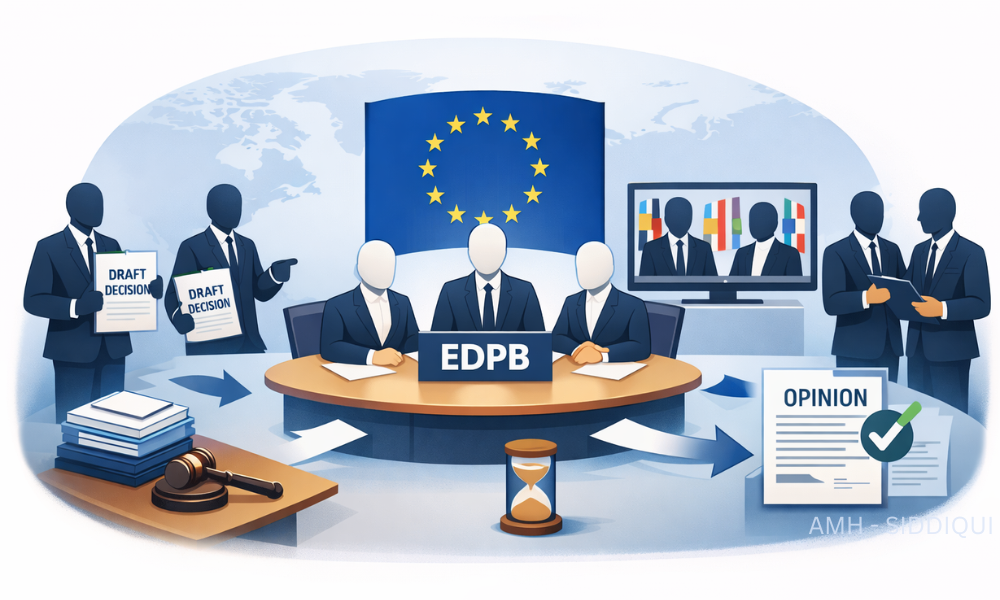
Explanation
Article 64 is part of the GDPR’s broader consistency mechanism. Its primary purpose is to prevent conflicting regulatory decisions across Member States. When a supervisory authority plans to adopt measures that may significantly affect data protection practices beyond its borders, it must submit the draft to the European Data Protection Board.
The Board, composed of representatives from all national supervisory authorities and the European Data Protection Supervisor, reviews the proposal. Within a defined timeframe, it issues an opinion assessing whether the proposed measure aligns with GDPR principles and established interpretations.
Although the Board’s opinion is not always legally binding in the strictest sense, it carries substantial authority. Supervisory authorities are expected to take the opinion into account. If they choose to depart from it, further procedural steps under the consistency mechanism may be triggered.
In practice, Article 64 strengthens cooperation, transparency, and legal certainty. It reassures businesses and individuals that data protection standards are applied consistently across the European Union rather than being subject to varying national interpretations.
Key Points
- The Article applies when supervisory authorities intend to adopt specific measures listed under the consistency mechanism.
- The European Data Protection Board must issue an opinion on qualifying draft decisions.
- The mechanism promotes harmonized interpretation of the GDPR.
- The opinion must be delivered within a set timeframe (generally eight weeks, extendable in complex cases).
- Supervisory authorities are required to consider the Board’s opinion before finalizing their decisions.
- The Article supports cross-border cooperation and prevents regulatory fragmentation.
- It enhances legal certainty for controllers, processors, and data subjects.
General Activation Steps
- Identification of Relevant Measure: A supervisory authority determines that it intends to adopt a measure falling within the categories requiring consultation under the consistency mechanism.
- Submission to the Board: The draft decision or measure is formally submitted to the European Data Protection Board for review. Relevant documentation and reasoning are included.
- Circulation Among Members: The Board distributes the draft to all members for assessment and discussion.
- Evaluation and Deliberation: Members analyze legal consistency, alignment with GDPR principles, and potential cross-border effects.
- Issuance of Opinion: The Bord adopts an opinion within the prescribed timeframe and communicates it to the supervisory authority concerned.
- Consideration and Final Decision: The supervisory authority must take the opinion into account before adopting the final measure. If disagreement persists, additional procedures may follow under the GDPR framework.
Use Cases
- Approval of Binding Corporate Rules (BCRs): When multinational companies propose Binding Corporate Rules to govern intra-group data transfers, supervisory authorities may seek the Board’s opinion to ensure EU-wide consistency.
- Standard Contractual Clauses or Certification Criteria: If a supervisory authority develops draft standard clauses or accreditation requirements for certification bodies, the Board’s opinion helps confirm compliance with GDPR standards.
- Cross-Border Investigations: In cases where a company operates in multiple Member States, and enforcement decisions could impact several jurisdictions, consultation under Article 64 ensures uniformity.
- Sector-Specific Guidelines: When new sector-focused measures are introduced, such as for healthcare, finance, or digital platforms, the Board’s opinion prevents inconsistent national approaches.
- High-Impact Regulatory Interpretations: If a supervisory authority adopts a novel interpretation of GDPR provisions that may influence enforcement across the Union, the Board’s involvement ensures alignment.
Dependencies
- Consistency Mechanism Framework: Article 64 operates within the broader GDPR consistency mechanism, particularly alongside Articles governing cooperation and dispute resolution.
- Cooperation Between Supervisory Authorities: Effective operation depends on transparent communication among national authorities. Without active cooperation, the process cannot function smoothly.
- Timely Information Sharing: Accurate and comprehensive documentation must accompany draft measures. Incomplete submissions may delay the Board’s opinion.
- Legal Expertise and Interpretation: The Board’s ability to provide meaningful opinions relies on expert legal analysis and collective experience from all Member States.
- Administrative Infrastructure: Efficient workflows, secure communication systems, and procedural clarity are essential to manage cross-border consultations.
- Good Faith Compliance: Supervisory authorities must genuinely consider the Board’s opinion. If authorities systematically disregard guidance, the purpose of Article 64 would be undermined.
Tools and Technologies
- Internal Case Management Systems: Supervisory authorities use digital case management tools to prepare and transmit draft decisions securely.
- Secure Communication Platforms: Encrypted communication channels facilitate safe exchange of sensitive regulatory documents among Board members.
- Document Collaboration Software: Shared digital workspaces enable collaborative drafting, commentary, and revisions of opinions.
- Legal Research Databases: Comprehensive access to case law, prior EDPB opinions, and guidance documents supports consistent analysis.
- Data Protection Impact Assessment (DPIA) Tools: When draft measures relate to high-risk processing activities, DPIA frameworks assist in evaluating compliance implications.
- Regulatory Tracking Systems: Authorities rely on monitoring tools to track deadlines and ensure opinions are issued within the mandated timeframe.
Let’s Wrap
Article 64 of the GDPR reinforces the principle that data protection within the European Union should not vary depending on national borders. By requiring supervisory authorities to consult the European Data Protection Board before adopting certain measures, it introduces a safeguard against inconsistent enforcement.
For organizations operating across multiple Member States, this mechanism offers reassurance. Decisions affecting them are not made in isolation but are reviewed through a collective European lens. For supervisory authorities, it promotes accountability and structured cooperation.
Ultimately, Article 64 strengthens trust in the GDPR framework. It balances national regulatory independence with Union-wide coherence, ensuring that data protection standards remain unified, predictable, and fair across the European Union.
For further reading:
- EU GDPR – Article 63 (Consistency Mechanism)
- EU GDPR – Article 62 (Joint Operations of Supervisory Authorities)
- EU GDPR – Article 61(Mutual assistance)
- EU GDPR – Article 60 (Cooperation Between Supervisory Authorities)
- EU GDPR – Article 59 (Activity Reports)
- EU GDPR – Article 58 (Powers of Supervisory Authorities)
- EU GDPR – Article 57 (Tasks of the Supervisory Authority)
- EU GDPR – Article 56 (Competence of the Lead Supervisory Authority)
- EU GDPR – Article 55 (Competence)
- EU GDPR – Article 54 (Rules on the Establishment of the Supervisory Authority)
- EU GDPR – Article 53 (General Conditions for the Members of the Supervisory Authority)
- EU GDPR – Article 52 (Independence)
- EU GDPR – Article 51 (Supervisory Authority)
- EU GDPR – Article 50 (International Cooperation for the Protection of Personal Data)
- EU GDPR – Article 49 (Derogations for Specific Situations)
- EU GDPR – Article 48 (Transfers or Disclosures Not Authorized by Union Law)
- EU GDPR – Article 47 (Binding corporate rules)
