










Abstract
Article 59 of the General Data Protection Regulation (GDPR) requires every supervisory authority within the European Union to prepare and publish an annual report describing its activities. This obligation strengthens transparency and public accountability. The report typically outlines investigations conducted, enforcement actions taken, guidance issued, cooperation with other authorities, and trends in data protection compliance.
By mandating yearly public reporting, Article 59 ensures that supervisory authorities remain open about how they exercise their powers. It also provides organizations, policymakers, and individuals with insight into regulatory priorities and enforcement patterns. In simple terms, this article turns regulatory oversight into something visible and measurable rather than hidden behind institutional walls.
Explanation
Supervisory authorities are independent public bodies established under GDPR to monitor and enforce data protection law in each EU Member State. Article 59 requires these authorities to document their yearly work and make it publicly available.
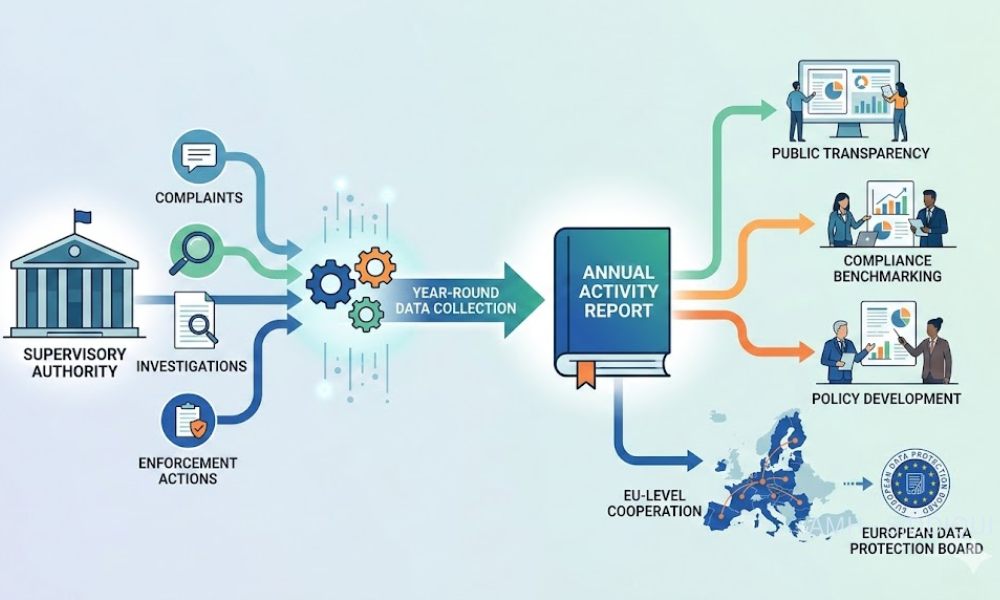
The annual activity report usually includes statistics on complaints received from individuals, investigations launched, administrative fines imposed, corrective measures ordered, and advisory opinions delivered. It may also describe cross-border cooperation, participation in consistency mechanisms, and engagement with public awareness campaigns.
The goal is not only administrative recordkeeping. Article 59 supports democratic oversight. When supervisory authorities disclose how many cases they handled, what sectors faced enforcement actions, or which compliance gaps were common, the public can evaluate regulatory effectiveness.
The European Data Protection Board (EDPB) may also compile EU-wide summaries based on national reports. This promotes harmonization and allows comparison across Member States. Ultimately, Article 59 reinforces trust by ensuring that enforcement bodies are themselves subject to transparency standards.
Key Points
- Each supervisory authority must produce an annual activity report.
- The report must cover the authority’s tasks, investigations, and enforcement measures.
- Reports are made public to promote transparency and accountability.
- The obligation applies to every EU Member State’s supervisory authority.
- Activity reports often include statistics on complaints, audits, fines, and corrective actions.
- They may also describe cooperation with other supervisory authorities and participation in EU-wide mechanisms.
- The European Data Protection Board can use these reports for broader EU analysis.
General Activation Steps
Although Article 59 is directed at supervisory authorities rather than private organizations, its practical activation follows a structured process:
- Data Collection Throughout the Year: Authorities gather data on complaints, investigations, enforcement measures, and consultations.
- Compilation of Enforcement Statistics: This includes the number of administrative fines, warnings, reprimands, and corrective orders issued.
- Assessment of Regulatory Trends: Authorities analyze recurring compliance failures, sector-specific risks, and cross-border issues.
- Drafting the Annual Report: The authority prepares a structured document summarizing its yearly activities and outcomes.
- Publication and Public Access: The report is made publicly available, usually through the authority’s official website.
- Submission for EU-Level Cooperation: Information may be shared with the European Data Protection Board for broader coordination.
Use Cases
- Regulatory Transparency for the Public: Individuals who file complaints can see how actively their supervisory authority processes cases. For example, if a report shows a high volume of complaints about digital marketing practices, it signals public concern in that area.
- Compliance Benchmarking for Organizations: Businesses review activity reports to understand enforcement trends. If multiple fines were issued for insufficient data security measures, organizations can reassess their technical safeguards.
- Policy Development and Reform: Lawmakers may rely on annual reports to evaluate whether current data protection frameworks require amendments or additional guidance.
- Academic and Legal Research: Researchers use activity reports to study enforcement consistency across Member States, patterns in administrative fines, and emerging privacy risks.
- Cross-Border Cooperation Insights: Reports often describe cooperation between supervisory authorities in cross-border cases. This is particularly relevant for multinational companies operating in several EU countries.
- Risk Management Strategy: Compliance teams analyze reported cases to identify high-risk processing activities and adjust internal policies accordingly.
Dependencies
Article 59 does not operate in isolation. Its effectiveness depends on several structural and regulatory elements:
- Article 51 – Establishment of Supervisory Authorities: Without properly established and independent supervisory authorities, annual reporting cannot function effectively.
- Article 57 – Tasks of Supervisory Authorities: The scope of the annual report depends on the tasks assigned under Article 57, including complaint handling and awareness promotion.
- Article 58 – Powers of Supervisory Authorities: Enforcement statistics in activity reports are directly linked to investigative and corrective powers granted under Article 58.
- Article 60 – Cooperation and Consistency: Cross-border case summaries rely on cooperation frameworks defined elsewhere in GDPR.
- Administrative Infrastructure: Authorities must maintain reliable case management systems to track complaints and enforcement actions accurately.
- Transparency Obligations Under EU Law: Broader principles of openness in EU governance support and reinforce Article 59’s reporting duty.
Tools and Technologies
Supervisory authorities rely on various systems and technologies to fulfill Article 59 obligations effectively:
- Case Management Systems: Digital platforms track complaints, investigations, deadlines, and enforcement outcomes. These systems allow accurate statistical reporting.
- Data Analytics Tools: Authorities use analytical software to identify trends in complaint categories, breach notifications, or sector-specific violations.
- Document Management Systems: Secure storage solutions ensure proper documentation of enforcement decisions and legal opinions.
- Public Reporting Portals: Web publishing platforms make annual reports accessible to the public in downloadable formats.
- Cybersecurity Monitoring Tools: Given the sensitive nature of regulatory data, authorities use advanced security controls to protect internal systems.
- Collaboration Platforms: Secure communication tools facilitate coordination with other EU supervisory authorities and the European Data Protection Board.
Let’s Wrap
Article 59 of the GDPR may seem procedural at first glance, but it plays a vital role in strengthening accountability within the data protection ecosystem. By requiring supervisory authorities to publish annual activity reports, the regulation ensures that enforcement is not only carried out but also openly documented.
For organizations, these reports offer valuable insight into regulatory focus areas, common compliance failures, and enforcement intensity. However, for individuals, they provide reassurance that complaints are processed and privacy rights are actively protected. For policymakers and researchers, they offer measurable data to evaluate the effectiveness of GDPR enforcement.
In short, Article 59 transforms regulatory oversight into a transparent process. It supports trust in data protection institutions and reinforces the broader goal of the GDPR: protecting personal data through consistent, accountable, and visible enforcement across the European Union.
For further reading:
- EU GDPR – Article 58 (Powers of Supervisory Authorities)
- EU GDPR – Article 57 (Tasks of the Supervisory Authority)
- EU GDPR – Article 56 (Competence of the Lead Supervisory Authority)
- EU GDPR – Article 55 (Competence)
- EU GDPR – Article 54 (Rules on the Establishment of the Supervisory Authority)
- EU GDPR – Article 53 (General Conditions for the Members of the Supervisory Authority)
- EU GDPR – Article 52 (Independence)
- EU GDPR – Article 51 (Supervisory Authority)
- EU GDPR – Article 50 (International Cooperation for the Protection of Personal Data)
- EU GDPR – Article 49 (Derogations for Specific Situations)
- EU GDPR – Article 48 (Transfers or Disclosures Not Authorized by Union Law)
- EU GDPR – Article 47 (Binding corporate rules)
- EU GDPR – Article 46 (Transfers Subject to Appropriate Safeguards)
- EU GDPR – Article 45 (Transfers on the Basis of an Adequacy Decision)
- EU GDPR – Article 44 (General Principle for Transfers)
- EU GDPR – Article 43 (Certification Bodies)
- EU GDPR – Article 42 (Certification)
