










Abstract
In a digital world where data moves across borders every second, protecting personal information doesn’t stop at the EU’s borders. EU GDPR Article 45 plays a key role in making sure personal data stays protected even when it’s transferred to a third country or an international organization. This article allows such transfers when the European Commission decides that the destination ensures an adequate level of data protection. Simply put, if the protection “over there” matches EU standards, the transfer can happen without extra safeguards. This article helps businesses operate globally while keeping individuals’ rights safe.
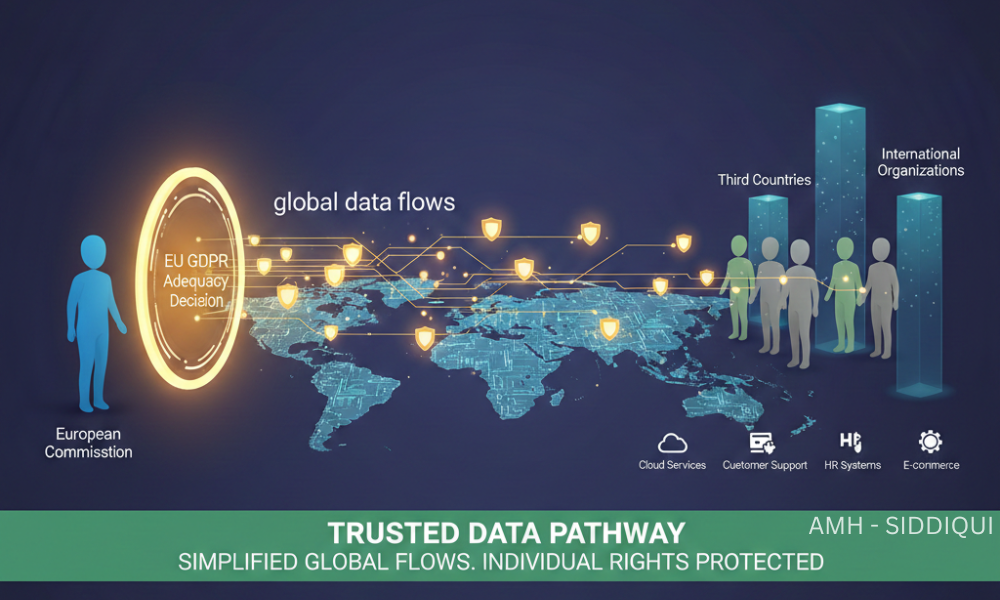
Explanation
Article 45 focuses on international data transfers based on what’s called an adequacy decision. An adequacy decision is made by the European Commission after carefully assessing a country’s data protection laws, enforcement mechanisms, and respect for fundamental rights.If a country or international organization is found to offer protection comparable to the GDPR, personal data can be transferred there freely. No additional legal tools like Standard Contractual Clauses or Binding Corporate Rules are required.
This article reduces complexity for businesses and public bodies while maintaining a high level of data protection. It also encourages non-EU countries to improve their data protection frameworks to meet EU expectations.
Adequacy decisions aren’t permanent. They are reviewed regularly and can be updated, suspended, or revoked if the level of protection changes.
Key Points
- Article 45 allows data transfers to third countries or international organizations approved by the European Commission
- The approval comes in the form of an adequacy decision
- Adequacy means the level of data protection is essentially equivalent to the GDPR
- No extra safeguards or authorizations are required once adequacy is granted
- Decisions are based on laws, oversight authorities, international commitments, and enforcement practices
- Adequacy decisions are monitored and reviewed over timeIf protection standards drop, the decision can be withdrawn
General Activation Steps
- Identify whether personal data is being transferred outside the EU or EEA
- Check if the destination country or organization has an active adequacy decision
- Confirm the scope of the adequacy decision covers your type of data and processing
- Ensure internal records reflect reliance on Article 45 for the transferInform data subjects through privacy notices about international transfers
- Monitor updates from the European Commission regarding adequacy status
- Prepare alternative safeguards in case the adequacy decision changes
Use Cases
- Cloud services hosted outside the EU: If a cloud provider operates in a country with an adequacy decision, EU businesses can store and process personal data there without additional legal contracts, making operations smoother and faster.
- Global customer support teams: Companies using customer service centers in adequate countries can share customer data safely while staying compliant with GDPR requirements.
- International payroll and HR systems: Employee data can be transferred to global HR platforms located in adequate jurisdictions without extra compliance layers.
- Cross-border research collaborations: Universities and research institutions can exchange personal data with international partners where adequacy is recognized, supporting innovation while respecting privacy.
- E-commerce and digital platforms: Online businesses operating internationally can handle customer data across borders without constant legal checks when adequacy applies.
Dependencies
- European Commission assessments: Transfers depend entirely on the Commission’s evaluation of a country’s data protection framework.
- Independent supervisory authorities: The presence of strong, independent data protection authorities in the third country is a key factor.
- Legal remedies for individuals: Data subjects must have enforceable rights and access to effective legal remedies.
- International commitments: Participation in global privacy agreements and conventions strengthens adequacy status.
- Ongoing compliance monitoring: Continued adherence to data protection principles is required to maintain adequacy.
Tools and Technologies
- Data transfer mapping tools: Help organizations track where personal data is stored and processed globally.
- Compliance management platforms: Used to document reliance on adequacy decisions and maintain audit-ready records.
- Privacy notice management systems: Ensure transparency by clearly informing users about international data transfers.
- Regulatory monitoring tools: Track updates, reviews, or changes in adequacy decisions issued by the Commission.
- Risk assessment software: Supports contingency planning if an adequacy decision is suspended or revoked.
Let’s Wrap
EU GDPR Article 45 simplifies international data transfers by creating a trusted pathway based on adequacy decisions. It balances global data flows with strong privacy protections, making life easier for organizations while keeping individuals’ rights front and center. If you’re transferring data outside the EU, checking for an adequacy decision should always be your first step. It’s the most straightforward and reliable option under GDPR, as long as the protection stays up to the mark.
For further reading:
- EU GDPR – Article 44 (General Principle for Transfers)
- EU GDPR – Article 43 (Certification Bodies)
- EU GDPR – Article 42 (Certification)
- EU GDPR – Article 41 (Monitoring of Approved Codes of Conduct
- EU GDPR – Article 40 (Codes of Conduct)
- EU GDPR – Article 39 (Tasks of the Data Protection Officer)
- EU GDPR – Article 38 (Position of the Data Protection Officer (DPO))
- EU GDPR – Article 37 (Designation of the Data Protection Officer (DPO))
- EU GDPR – Article 36 (Prior Consultation)
- EU GDPR – Article 35 (Data Protection Impact Assessment (DPIA))
- EU GDPR – Article 34 (Communication of a Personal Data Breach to the Data Subject)
- EU GDPR – Article 33 (Notification of a Personal Data Breach to the Supervisory Authority
- EU GDPR – Article 32 (Security of Processing)
- EU GDPR – Article 31 (Cooperation with the Supervisory Authority)
- EU GDPR – Article 30 (Records of Processing Activities)
- EU GDPR – Article 29 (Processing Under the Authority of the Controller or Processor)
- EU GDPR – Article 28 (Processor)
