










Abstract
The General Data Protection Regulation (GDPR) created a unified legal framework for protecting personal data across the European Union. To support transparency and accountability within this system, the European Data Protection Board (EDPB) is responsible for monitoring how data protection rules are applied across member states. One of its key responsibilities is publishing an annual report that provides a public overview of developments in data protection.
This responsibility is defined in EU GDPR Article 71, which requires the Board to prepare and publish a yearly report on the protection of natural persons with regard to the processing of personal data. The report highlights major regulatory activities, cooperation between supervisory authorities, guidance issued by the Board, and significant trends affecting privacy and data protection. By making this information public, the report helps maintain transparency and strengthens trust in the data protection framework within the European Union.
Explanation
The purpose of EU GDPR Article 71 is to ensure transparency in the functioning of the European Data Protection Board and to keep both institutions and the public informed about developments in data protection across the EU.
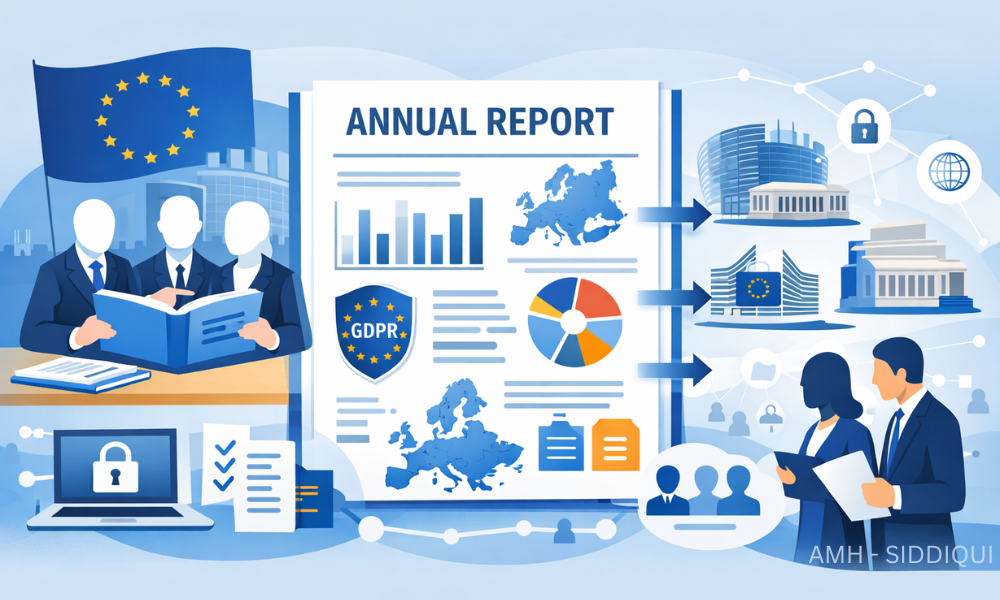
Each year, the Board prepares a comprehensive report describing how personal data protection rules are implemented and enforced. The report includes information about important decisions, cooperation between supervisory authorities, and guidance documents issued by the Board. It also outlines challenges faced during the year, including technological developments, cross-border cases, and new privacy risks.
The annual report is submitted to several important EU institutions, including the European Parliament, the Council of the European Union, and the European Commission. These institutions review the report to understand how GDPR rules are working in practice and whether additional policy actions may be required.
Another important feature of the report is that it is publicly accessible. By publishing the report openly, the Board ensures that organizations, researchers, and individuals can see how data protection rules are being applied and enforced. This transparency supports trust in the system and encourages organizations to comply with privacy regulations.
In addition to describing past activities, the report often highlights trends and emerging issues in data protection, such as artificial intelligence, online tracking technologies, cross-border data transfers, and new digital services. This helps policymakers and organizations prepare for future regulatory challenges.
Overall, the annual report serves as both an accountability tool and an informative resource. It allows stakeholders to understand the progress of GDPR implementation and helps maintain consistency in data protection practices throughout the European Union.
Key Points
- EU GDPR Article 71 requires the European Data Protection Board to publish an annual public report.
- The report focuses on the protection of natural persons regarding the processing of personal data.
- It summarizes major regulatory developments and enforcement actions.
- The report highlights cooperation between supervisory authorities across EU member states.
- It is submitted to EU institutions including the European Parliament, the Council of the European Union, and the European Commission.
- The document is publicly accessible to promote transparency and accountability.
- It often includes trends, challenges, and future considerations in data protection.
General Activation Steps
- Data Collection from Authorities: National supervisory authorities gather information about enforcement actions, investigations, cooperation activities, and regulatory developments throughout the year.
- Compilation by the European Data Protection Board: The European Data Protection Board collects and compiles this information to create a comprehensive overview of data protection activities across the EU.
- Analysis of Trends and Issues: The Board analyzes trends related to privacy risks, technological developments, cross-border cases, and compliance challenges.
- Preparation of the Annual Report: A detailed report is drafted that summarizes the Board’s activities, guidelines, decisions, and cooperation efforts.
- Submission to EU Institution: The report is formally submitted to the European Parliament, the Council of the European Union, and the European Commission.
- Public Publication: The final report is published for public access, allowing organizations and individuals to review the findings and developments.
Use Cases
- Transparency for Policy Makers: The annual report helps policymakers understand how GDPR is functioning across the European Union. By reviewing enforcement statistics and cooperation outcomes, institutions can evaluate whether current laws are effective or require adjustments.
- Guidance for Organizations and Businesses: Companies that process personal data often review the annual report to understand enforcement priorities and emerging privacy risks. This information helps them improve internal compliance programs and reduce regulatory risks.
- Resource for Researchers and Academics: Researchers studying data protection law frequently use the report as a source of reliable information. It provides detailed insights into real enforcement actions, regulatory trends, and technological challenges affecting privacy.
- Public Awareness and Trust: The report helps individuals understand how their personal data is protected within the European Union. Public access to the document demonstrates that supervisory authorities actively monitor compliance and address privacy concerns.
- Support for Cross-Border Cooperation: Because many digital services operate across multiple countries, the report highlights cooperation between national data protection authorities. This encourages consistent enforcement of GDPR rules across all EU member states.
Dependencies
- National Supervisory Authorities: The preparation of the annual report relies heavily on information provided by national data protection authorities in each EU member state. These authorities contribute data on investigations, complaints, enforcement decisions, and regulatory actions taken throughout the year.
- Cooperation Mechanisms under GDPR: The report reflects activities carried out through GDPR cooperation mechanisms such as consistency procedures and cross-border case handling. Without these mechanisms, the Board would not be able to present a complete overview of regulatory actions.
- Regulatory Guidance and Decisions: The report also depends on guidelines, opinions, and recommendations issued by the European Data Protection Board during the year. These documents demonstrate how the Board interprets GDPR provisions and provides practical direction to organizations.
- Institutional Collaboration: Collaboration with EU institutions such as the European Commission and the European Parliament supports the reporting process. Their feedback and policy initiatives may influence the analysis included in the annual report.
Tools and Technologies
- Data Reporting Systems: Supervisory authorities often rely on internal reporting systems and case management tools to record investigations, complaints, and enforcement decisions. These systems help organize information that will later be included in the annual report.
- Regulatory Collaboration Platforms: Digital collaboration platforms allow national authorities and the European Data Protection Board to share information efficiently. These platforms support communication and coordination between regulators across different countries.
- Data Analysis and Monitoring Tools: Analytical tools help regulators examine patterns in complaints, enforcement actions, and compliance issues. These insights contribute to the trends and statistics presented in the annual report.
- Publication and Transparency Platforms: Once finalized, the report is published through official EU websites and documentation portals. These platforms ensure public access and allow organizations, researchers, and citizens to review the report easily.
Let’s Wrap
EU GDPR Article 71 plays an important role in maintaining transparency and accountability within the European data protection framework. By requiring the European Data Protection Board to publish an annual report, the regulation ensures that regulatory activities and developments remain visible to both policymakers and the public.
The report provides valuable insights into enforcement trends, cooperation between authorities, and emerging challenges in data protection. It also strengthens trust in the GDPR framework by demonstrating that supervisory authorities actively monitor compliance and protect the rights of individuals.
In a digital world where personal data is constantly processed and shared, the annual reporting requirement serves as an important mechanism for oversight and awareness. Through clear reporting and public accessibility, the European Union continues to reinforce its commitment to strong data protection and transparency.
For further reading:
- EU GDPR – Article 70 (Tasks of the Board)
- EU GDPR – Article 69 (Independence)
- EU GDPR – Article 68 (European Data Protection Board)
- EU GDPR – Article 67 (Exchange of Information)
- EU GDPR – Article 66 (Urgency Procedure)
- EU GDPR – Article 65 (Dispute resolution by the Board)
- EU GDPR – Article 64 (Opinion of the Board)
- EU GDPR – Article 63 (Consistency Mechanism)
- EU GDPR – Article 62 (Joint Operations of Supervisory Authorities)
- EU GDPR – Article 61(Mutual assistance)
- EU GDPR – Article 60 (Cooperation Between Supervisory Authorities)
- EU GDPR – Article 59 (Activity Reports)
- EU GDPR – Article 58 (Powers of Supervisory Authorities)
- EU GDPR – Article 57 (Tasks of the Supervisory Authority)
- EU GDPR – Article 56 (Competence of the Lead Supervisory Authority)
- EU GDPR – Article 55 (Competence)
- EU GDPR – Article 54 (Rules on the Establishment of the Supervisory Authority)
