










Abstract
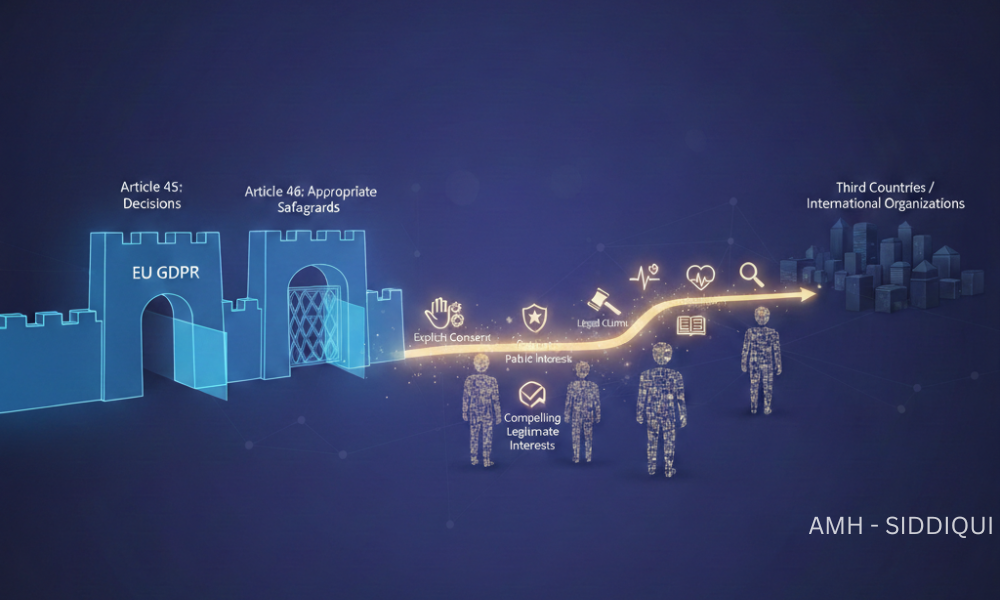
Under the General Data Protection Regulation (GDPR), personal data transfers outside the European Union are tightly controlled. While Articles 45 and 46 outline adequacy decisions and appropriate safeguards, Article 49 provides limited exceptions, known as derogations, for specific situations. EU GDPR Article 49 applies when there is no adequacy decision under Article 45 and no appropriate safeguards under Article 46. In such cases, a transfer to a third country or international organization may only occur if one of seven clearly defined conditions is met. These derogations are not meant to be routine solutions but rather exceptional mechanisms used under strict circumstances. Article 49 ensures that even when standard protection mechanisms are unavailable, transfers remain lawful, transparent, and respectful of data subjects’ rights.
Explanation
Article 49 acts as a safety valve within the GDPR framework. It recognizes that in rare or urgent scenarios, organizations may need to transfer personal data even when neither adequacy decisions nor safeguards such as Standard Contractual Clauses are in place.
However, these exceptions must be interpreted restrictively. They are not alternative long-term compliance strategies. Supervisory authorities expect organizations to rely on adequacy decisions or safeguards whenever possible. Article 49 should only be used when transfers are occasional, necessary, and justified under one of the permitted grounds.
The seven derogations include explicit consent, necessity for contract performance, important reasons of public interest, legal claims, protection of vital interests, transfers from public registers, and compelling legitimate interests (subject to strict conditions).
Organizations must carefully assess and document their reliance on any of these conditions. Misuse can result in regulatory scrutiny and penalties.
Key Points
- Article 49 applies only when Article 45 (adequacy decision) and Article 46 (appropriate safeguards) cannot be used.
- Derogations are exceptions, not standard transfer mechanisms.
- Transfers must be occasional and necessary.
- Data subjects must be informed of potential risks where applicable.
- Explicit consent must be specific, informed, and freely given.
- Public interest grounds must be recognized under EU or Member State law.
- Legitimate interest transfers require documented balancing tests and supervisory authority notification in some cases.
General Activation Steps
- Confirm that no adequacy decision exists for the destination country.
- Verify that appropriate safeguards (e.g., Standard Contractual Clauses or Binding Corporate Rules) are not applicable.
- Identify which Article 49 derogation applies.
- Assess whether the transfer is truly occasional and necessary.
- Inform the data subject about potential risks if relying on consent.
- Document the legal assessment and justification.
- Maintain internal records for accountability and possible supervisory authority review.
Use Cases
- Explicit Consent for a One-Time Transfer: If a customer requests services in a country without an adequacy decision, the organization may transfer personal data after obtaining explicit, informed consent. The individual must understand the risks involved due to the absence of safeguards.
- Performance of a Contract with the Data Subject: A travel agency transferring booking details to a hotel in a non-adequate country may rely on this derogation if the transfer is necessary to fulfill the contract. The transfer must be directly connected to contractual performance.
- Public Interest Grounds: Government agencies may transfer data to foreign authorities for cooperation in taxation, anti-money laundering, or public health investigations when recognized under EU or Member State law.
- Legal Claims: Data transfers may occur when necessary to establish, exercise, or defend legal claims. For example, sharing relevant employee data with foreign legal representatives in litigation.
- Protection of Vital Interests: In medical emergencies, personal data may be transferred to hospitals abroad if necessary to protect someone’s life or physical integrity and the individual cannot give consent.
- Public Register Transfers: Information from official public registers, such as company registries, may be transferred if access conditions under EU law are respected.
- Compelling Legitimate Interests: In rare cases, an organization may rely on its compelling legitimate interests when the transfer is not repetitive, affects a limited number of data subjects, and safeguards are implemented. This requires careful documentation and notification to supervisory authorities.
Dependencies
- Legal Assessment: A clear understanding of Articles 45 and 46 is essential before relying on Article 49. The derogations only activate when other mechanisms are unavailable.
- Risk Evaluation: Organizations must evaluate risks associated with transferring data to countries lacking equivalent data protection standards.
- Transparency Obligations: Privacy notices must reflect potential reliance on derogations where applicable. Data subjects should understand when their data may be transferred under exceptional circumstances.
- Supervisory Authority Oversight: Data protection authorities across EU Member States monitor misuse of Article 49. Organizations must be prepared to justify their decisions.
- Internal Governance Framework: Strong internal compliance structures, including Data Protection Officers where required, support lawful decision-making around cross-border transfers.
Tools and Technologies
- Transfer Impact Assessments (TIAs): Used to document risk evaluations when transferring data internationally. Even under Article 49, risk analysis supports accountability.
- Consent Management Platforms: Digital tools that capture explicit consent records, ensuring traceability and proof of informed agreement.
- Data Mapping Software: Helps organizations identify where personal data flows internationally and determine when derogations might apply.
- Encryption and Security Controls: Technical safeguards such as encryption, pseudonymization, and secure transmission channels help reduce risks during exceptional transfers.
- Contract Management Systems: While Article 49 is not safeguard-based, documentation tools help store legal assessments, approvals, and related compliance records.
- Compliance Monitoring Platforms: Centralized dashboards allow tracking of cross-border transfers and ensure they remain occasional rather than systematic.
Let’s Wrap
EU GDPR Article 49 provides narrowly defined exceptions for international data transfers when neither adequacy decisions nor safeguards are available. These derogations exist to address exceptional, necessary situations, not to replace structured compliance mechanisms.
Organizations must approach Article 49 with caution. Transfers should be limited, justified, transparent, and well-documented. Supervisory authorities expect controllers and processors to treat these exceptions as last-resort solutions.
When applied carefully, Article 49 allows operational flexibility without compromising the GDPR’s core objective: protecting individuals’ fundamental rights and freedoms in the digital age.
For further reading:
- EU GDPR – Article 48 (Transfers or Disclosures Not Authorized by Union Law)
- EU GDPR – Article 47 (Binding corporate rules)
- EU GDPR – Article 46 (Transfers Subject to Appropriate Safeguards)
- EU GDPR – Article 45 (Transfers on the Basis of an Adequacy Decision)
- EU GDPR – Article 44 (General Principle for Transfers)
- EU GDPR – Article 43 (Certification Bodies)
- EU GDPR – Article 42 (Certification)
- EU GDPR – Article 41 (Monitoring of Approved Codes of Conduct
- EU GDPR – Article 40 (Codes of Conduct)
- EU GDPR – Article 39 (Tasks of the Data Protection Officer)
- EU GDPR – Article 38 (Position of the Data Protection Officer (DPO))
- EU GDPR – Article 37 (Designation of the Data Protection Officer (DPO))
- EU GDPR – Article 36 (Prior Consultation)
- EU GDPR – Article 35 (Data Protection Impact Assessment (DPIA))
- EU GDPR – Article 34 (Communication of a Personal Data Breach to the Data Subject)
- EU GDPR – Article 33 (Notification of a Personal Data Breach to the Supervisory Authority
- EU GDPR – Article 32 (Security of Processing)
