










Introduction
Cybersecurity strategies traditionally focus on human users—securing passwords, multi-factor authentication, and user access controls. However, modern digital enterprises rely overwhelmingly on non-human entities. Applications, cloud workloads, APIs, containers, IoT devices, and AI agents communicate continuously, each requiring a trusted identity to operate securely.
In many organizations, these non-human identities now drastically outnumber human users. Without structured oversight, they become prime targets for cyberattacks. Machine Identity Management (MIM) provides a robust framework for securing these digital assets, ensuring that every machine and application can authenticate safely and communicate without exposure.
What Is Machine Identity Management?
Machine Identity Management is the comprehensive process of creating, issuing, tracking, renewing, and revoking digital identities for non-human entities. Unlike human user accounts, machine identities rely on cryptographic tools rather than passwords:
- SSL/TLS Certificates: Secures web traffic and server communication.
- Cryptographic & SSH Keys: Validates administrative access across virtual machines.
- API Keys & OAuth Tokens: Authorizes machine-to-machine application calls.
- Workload Identities: Authenticates dynamic microservices in cloud environments.
Why Machine Identities Matter
Enterprise operations span hybrid clouds, automated pipelines, and distributed IoT networks. Every digital interaction requires absolute trust. For example, when an AI model queries a centralized database or a cloud application communicates with a payment gateway, both endpoints must verify each other’s legitimacy. Without verified machine identities, malicious actors can intercept transmissions, spoof trusted systems, or execute unauthorized lateral movements.
The Machine Identity Lifecycle
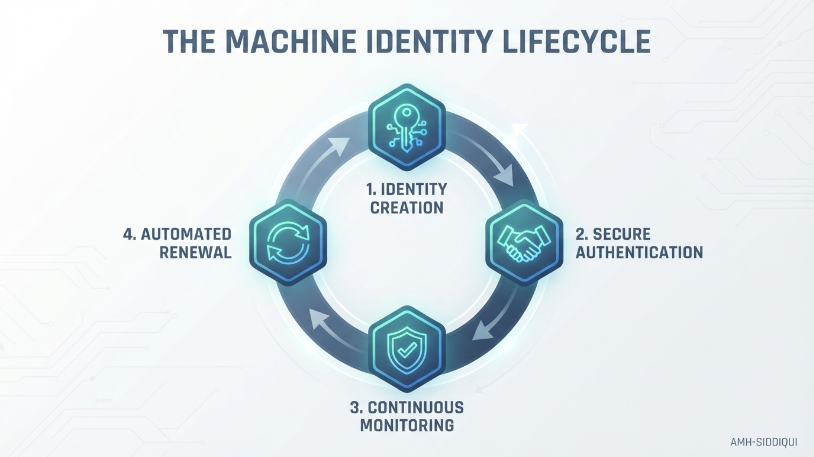
Managing hundreds of thousands of non-human identities manually is impossible. A secure MIM pipeline operates through four automated phases:
- Creation: Generating a unique digital certificate or cryptographic key during deployment.
- Authentication: Validating credentials instantly before network communication begins.
- Continuous Monitoring: Tracking usage metrics, anomalous behavior, and expiration timelines.
- Renewal & Revocation: Automatically rotating keys before expiration and instantly revoking compromised credentials.
Core Benefits of Machine Identity Management
| Security Pillar | Enterprise Impact |
|---|---|
| Impersonation Defense | Cryptographic verification stops attackers from spoofing trusted APIs or servers. |
| Operational Stability | Automated certificate lifecycle management prevents unexpected service outages caused by expired credentials. |
| Comprehensive Visibility | Centralized inventories eliminate blind spots across shadow IT and hybrid clouds. |
| Compliance Support | Aligns machine security standards with rigorous data protection mandates. |
Enterprise Applications Across Sectors
- Cloud Computing: Secures dynamic microservices and internal server communication.
- Artificial Intelligence: Protects AI agents and LLMs as they pull data from enterprise repositories.
- Internet of Things (IoT): Authenticates millions of edge sensors before telemetry transmission.
- Financial Services: Secures automated payment gateways, high-frequency trading, and backend ledgers.
Best Practices for Enterprise Implementation
- Centralized Inventory: Maintain a single source of truth for all active certificates and keys.
- Full Automation: Eliminate manual certificate tracking to prevent expiration outages.
- Least Privilege Access: Restrict machine identities to only the specific resources required for their function.
- Continuous Cryptographic Rotation: Regularly update keys and tokens to minimize blast radiuses during a breach.
Conclusion
As organizations scale cloud adoption, IoT networks, and AI-driven automation, non-human entities form the backbone of daily operations. Machine Identity Management ensures that these digital workers remain secure, trusted, and fully compliant. By shifting from manual tracking to automated cryptographic lifecycle management, enterprises can innovate rapidly without expanding their security attack surface.
Related Readings
- Attribute-Based Access Control (ABAC): A Modern Approach to Dynamic and Granular Security
- Zero-Knowledge Proof (ZKP): A Professional Review
- Big Data Security, Privacy, and Protection
- NIST AI RMF – A Momentary Look
- What Is IoT (Internet of Things)?
- How AI and IoT Are Driving Digital Transformation Across Industries
- Data Governance Framework and Pillars
- Knowledge Graphs: The Hidden Foundation of Enterprise AI
- Federated Learning: Training AI Without Sharing Sensitive Data
- AI Memory: How Intelligent Systems Remember, Retrieve, and Learn Over Time
