










Introduction
The comparison between the human brain and artificial intelligence (AI) has become one of the most mesmerizing discussions in modern technology. As AI continues to grow rapidly, many people wonder whether machines can ever match or even replace human intelligence.
We are comparing the ultimate “organic supercomputer” (the brain) with the ultimate “logic engine” (AI). One runs on caffeine and lived experience; the other runs on electricity and massive datasets. But as AI continues to weave itself into our lives, the question isn’t just who’s faster, it’s about what makes us human in the first place.
Today, AI is transforming industries such as healthcare, education, cybersecurity, finance, and business analytics. According to MDM Team, artificial intelligence and big data are restructuring the digital world by improving automation, analytics, and operational proficiency. (MDM Team)
Understanding the Human Brain
The human brain is one of the most powerful and complex systems in existence. It controls memory, learning, emotions, communication, and physical movement.
Key Functions of the Human Brain
- Problem Solving
- Emotional understanding
- Creativity and Critical Thinking
- Learning from experiences
- Decision making
- Communication and Social interaction
- Adaptability (Humans can learn from mistakes, emotions, and life experiences without requiring programming or datasets.)
What is AI?
Artificial Intelligence refers to computer systems that can perform tasks that usually require human intelligence. AI uses machine learning, algorithms, neural networks, and large datasets to identify patterns and make decisions.
AI is widely used in:
- Chatbots
- Smart devices
- Recommendation systems
- Self driving vehicles
- Healthcare systems or Devices
- Cybersecurity
- Virtual assistants
- Data analytics
The growth of AI technologies and Big Data platforms has significantly improved business intelligence and digital transformation processes. (MDM Team)
For more understandings on AI and data technologies, readers can explore the Big Data & Artificial Intelligence category on MDM Team.
Human Brain vs Artificial Intelligence
1. Knowledge and Adaptability
The human brain learns naturally through observation, emotions, and practices. Humans can adapt quickly even in unpredictable situations.
AI learns through training data and machine learning models. It improves based on the quality and quantity of data provided.
| Human Brain | Artificial Intelligence |
| Learns emotionally and socially | Learns through datasets |
| Adapts naturally | Requires programming and training |
| Understands context | Depends on algorithms |
2. Creativity and Innovation
Creativity represents one of the most remarkable capabilities of the human mind. People have the power to imagine new possibilities, produce art, compose music, and think beyond established frameworks.
While artificial intelligence can generate content and identify patterns, it lacks genuine imagination and emotional depth. This distinction continues to be one of the fundamental limitations of AI.
3. Speed and Accuracy
Artificial intelligence can handle huge amounts of calculations in just a few seconds with impressive accuracy.
On the other hand, the human brain may be slower when solving calculations, but it naturally understands emotions, moral values, and complicated social interactions far better.
AI Vs Human Brain Strengths
| Artificial Intelligence | Human Brain |
| Fast processing speed | Emotional intelligence |
| High accuracy | Contextual understanding |
| Handles repetitive tasks efficiently | Ethical reasoning |
4. Emotional Intelligence
Humans are naturally capable of feeling emotions such as empathy, happiness, sadness, excitement, and compassion. This emotional understanding helps people create strong relationships and make thoughtful, responsible decisions.
However, AI cannot truly feel emotions. It can only imitate emotional responses through programmed data and patterns. Because of this limitation, AI still relies greatly on human guidance and supervision.
5. Decision-Making Ability
Human decisions involves emotions, morality, experiences, cultural understanding and Ethics.
Whereas AI decisions rely mainly on algorithms, historical data, predictive models and Machine learning systems.
The importance of responsible AI governance and transparency is also discussed in EU GDPR – Article 22, which highlights risks linked to automated decision-making and profiling. (MDM Team)
Readers who want to learn more about ethical AI and intelligent automated systems can also explore:
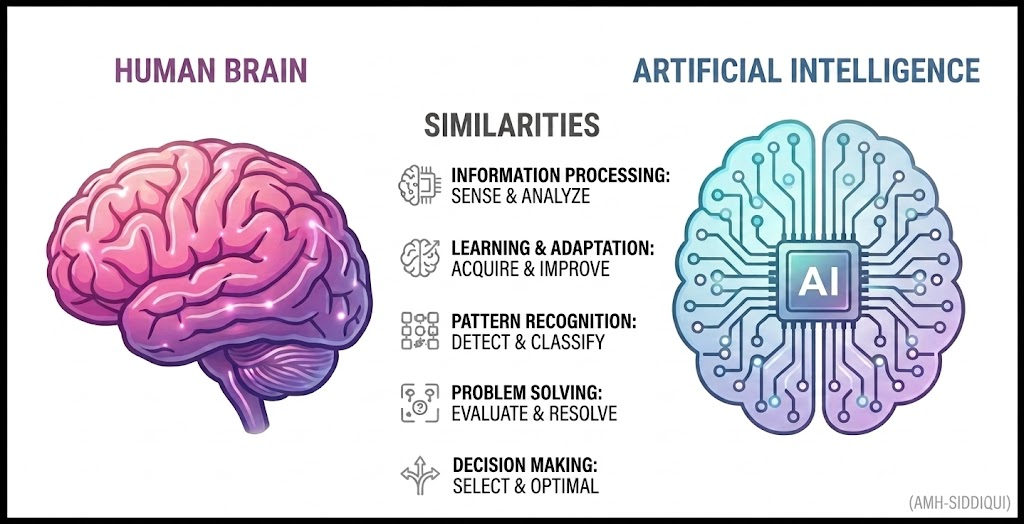
Similarities Between Human Brain and AI
Advantages of Artificial Intelligence
Artificial intelligence offers several benefits in the modern world such as:
- Faster data processing
- Reduced human errors
- Automation of repetitive tasks
- 24 hours system availability
- Improved business analytics
- Better operational efficiency
Technologies such as predictive analytics and machine learning are helping organizations improve performance and decision-making. (MDM Team)
You can also read:
Advantages of the Human Brain
Despite technological advancements, the human brain remains irreplaceable in many areas like:
- Emotional intelligence
- Creativity and imagination
- Ethical decision-making
- Social communication
- Adaptability
- Independent thinking
Humans can understand emotions, relationships, and moral responsibilities in ways machines cannot.
Can Artificial Intelligence Replace Humans?
The rapid evolution of technology often sparks a fundamental debate:
Will Artificial Intelligence eventually render human professionals obsolete?
While AI is increasingly capable of automating repetitive, high-volume, and data-driven tasks, it remains a tool of augmentation rather than a total replacement for human intelligence.
The limitation of AI lies in the qualities that define the human experience. Current systems lack:
- Consciousness: The ability to subjectively experience and understand the world.
- Emotions: The capacity for genuine empathy and emotional resonance.
- Moral Values: The ethical framework required to make nuanced, value-based decisions.
- Self-awareness: An understanding of one’s own existence and impact.
- Human Creativity: The “out-of-the-box” thinking that stems from personal history and intuition.
Ultimately, the future of the workforce is not a competition between man and machine, but a partnership. Instead of replacing humans, AI is expected to work alongside humans to improve productivity and innovation.
The Future of Human Intelligence and AI
The future of AI is closely connected with healthcare, robotics, cybersecurity, education, and automation.
AI technologies are expected to continue improving through:
- Machine learning
- Big Data
- Predictive analytics
- Cloud computing
- Automation systems
The role of AI in secure systems, data privacy, and intelligent automation is continuously expanding. (MDM Team)
Related reads from MDM Team:
Conclusion
The debate between the human brain and artificial intelligence highlights the strengths of both humans and machines. Artificial intelligence excels in speed, automation, and data analysis, while the human brain remains unmatched in creativity, emotions, ethics, and imagination.
AI is not likely to completely replace humans. Instead, it will continue to support and enhance human capabilities in different industries. The future depends on how responsibly humans develop and use artificial intelligence technologies.
The combination of human intelligence and AI innovation has the potential to transform the world positively while maintaining the importance of human values and creativity.
“When human intelligence and artificial intelligence work together, innovation becomes limitless and the future becomes brighter.”
