










Abstract
The General Data Protection Regulation (GDPR) was created to give people stronger control over how their personal data is collected, used, stored, and shared. While many GDPR provisions focus on compliance duties for organizations, the regulation also gives individuals clear legal rights when those duties are ignored. One of the most important protections in this area is Article 79, which gives data subjects the right to take legal action against a controller or processor if their data protection rights have been violated because of unlawful or non-compliant processing.
This article matters because it moves data protection from being only a policy issue to being a legal right that can be enforced in court. If a person believes an organization has mishandled their personal data, ignored a lawful request, exposed sensitive information, or processed data without a proper legal basis, Article 79 provides a direct path to seek justice through judicial remedy. In simple terms, it allows individuals to challenge organizations in court when their privacy rights have been infringed.
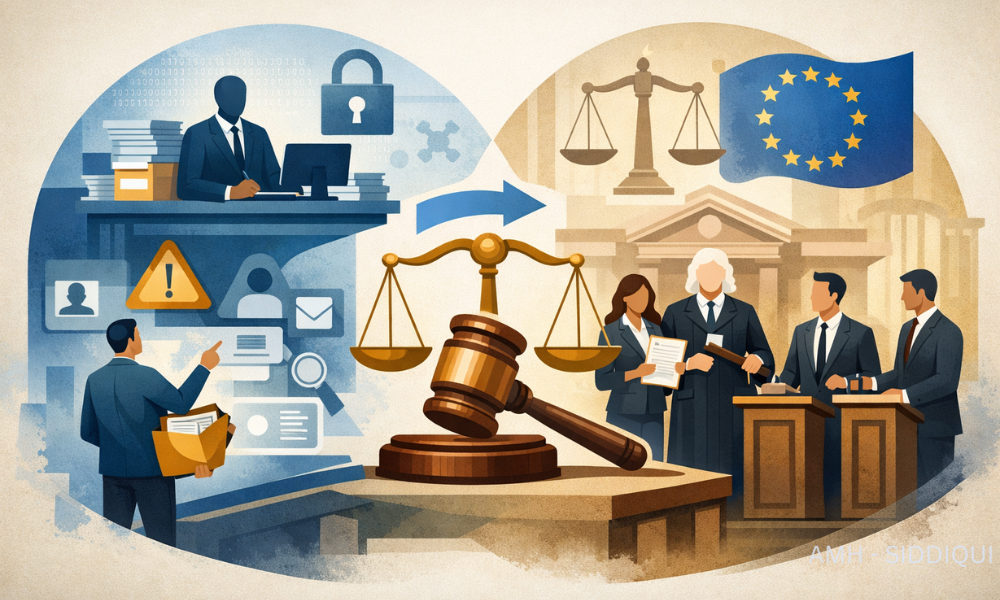
Explanation
Article 79 of the GDPR ensures that every data subject has the right to an effective judicial remedy against a controller or processor where they believe their rights under the GDPR have been violated. A controller is the organization or person that decides why and how personal data is processed, while a processor handles that data on behalf of the controller.
This right becomes important when a person feels that an organization has not followed GDPR requirements. For example, a company may collect personal data without consent, fail to respond to a subject access request, retain data longer than necessary, use information for a purpose not originally disclosed, or fail to protect personal data from unauthorized access. In such situations, Article 79 allows the affected individual to seek a legal remedy before a court.
One important thing to understand is that Article 79 works independently of other GDPR complaint routes. A data subject may first complain to a supervisory authority, but they are not always limited to that route. They can also go directly to court if they believe their rights were violated by the actions of a controller or processor.
This article strengthens accountability. It reminds businesses, employers, online platforms, service providers, and data processors that GDPR is not just a set of guidelines. It is a legal framework with real consequences. If an organization fails to comply, individuals are not powerless. They have the legal standing to challenge that conduct.The article also supports access to justice by allowing proceedings to be brought in the courts of the Member State where the controller or processor has an establishment, or where the data subject habitually resides. This makes enforcement more practical and accessible for individuals.
Key Points
- Article 79 gives every data subject the right to go to court if their GDPR rights are violated.
- It applies when the violation results from processing that does not comply with GDPR.
- The legal action can be taken against a controller or a processor.
- This right exists whether or not a complaint has already been filed with a supervisory authority.
- It supports real legal enforcement of privacy rights, not just administrative review.
- Individuals may seek remedies for issues such as unlawful collection, misuse, over-retention, lack of transparency, or poor security of personal data.
- The case can generally be brought in the courts of the Member State where the organization is established or where the individual lives.
- Article 79 often works closely with Article 77 (complaints to supervisory authorities) and Article 82 (right to compensation).
General Activation Steps
- Identify the suspected GDPR violation: The first step is to clearly understand what went wrong. The issue may involve unauthorized data sharing, ignored deletion requests, excessive tracking, failure to provide access, unlawful profiling, or a data breach that affected personal information.
- Gather supporting evidence: The individual should collect all relevant records, such as emails, privacy notices, screenshots, consent forms, account logs, data access requests, rejection messages, contracts, or breach notifications. These documents can help show how the rights were infringed.
- Contact the controller or processor: Before going to court, it is often practical to raise the issue directly with the organization. This may include contacting the privacy team or data protection officer and requesting correction, deletion, restriction, explanation, or compliance.
- Assess whether the response was sufficient: If the organization ignores the request, delays excessively, gives an incomplete answer, or continues the unlawful processing, the matter may require escalation.
- Consider legal or regulatory support: The individual may seek help from a legal professional, privacy advisor, consumer rights body, or representative organization to understand the available options and the likely strength of the claim.
- Initiate judicial proceedings: If the rights infringement remains unresolved, the data subject may bring the matter before a competent court under Article 79.
Use Cases
- Unlawful collection of personal data: A mobile app collects location, contacts, and usage behavior without a valid legal basis or clear notice. The user later discovers that this information was gathered in a way that was not transparent or lawful. Article 79 may allow the person to challenge the organization in court.
- Ignoring a subject access request: A customer asks a company for a copy of all personal data held about them, but the company never replies or gives only partial information. If the response fails to meet GDPR standards, the individual may seek judicial remedy.
- Refusal to delete personal data without valid reason: A former user requests deletion of their account data, but the company continues to store and use the information for internal profiling or marketing. If there is no lawful basis for continued retention, legal action may be justified.
- Data shared with third parties without proper notice: A website shares user information with advertisers, analytics providers, or business partners without informing users properly or obtaining lawful consent where needed. This can lead to a rights-based legal challenge.
- Inadequate data security leading to harm: A business fails to secure customer records, resulting in unauthorized exposure of names, addresses, financial details, or identification data. If poor security practices caused the violation, Article 79 may support legal proceedings.
- Automated decision-making without safeguards: A person is denied a service, job opportunity, or account approval because of automated profiling, but they were never given meaningful information or a chance to challenge the outcome. This may trigger judicial action under GDPR rights.
- Employee data misuse: An employer monitors staff emails, devices, or attendance systems in a way that goes beyond what is lawful, necessary, or transparent. Workers may rely on Article 79 if their privacy rights are infringed.
Dependencies
- Existence of personal data processing: Article 79 applies where personal data is being processed. If no personal data is involved, the article would not usually be triggered.
- A rights infringement under GDPR: The person must believe that one or more GDPR rights were violated. This could include rights related to access, deletion, rectification, restriction, objection, transparency, lawful basis, or security.
- Non-compliance by a controller or processor: There must be some form of failure by the organization to meet GDPR obligations. The legal claim usually depends on showing that the processing was unlawful, unfair, excessive, insecure, or otherwise non-compliant.
- Jurisdiction and legal procedure: The judicial remedy must be brought before a competent court in the appropriate Member State. National procedural rules will influence how the case is filed and handled.
- Supporting evidence and documentation: While not every case needs a huge evidence file, documentation helps establish the facts and strengthens the individual’s legal position.
- Connection with other GDPR rights and remedies: Article 79 often interacts with other GDPR mechanisms. In many real-world cases, the issue may also involve complaints to supervisory authorities, compensation claims, or enforcement decisions.
Tools and Technologies
- Data Subject Request Management Platforms: These tools help organizations receive, track, and respond to access, deletion, correction, and objection requests. If poorly managed, failures in these systems can become part of an Article 79 dispute.
- Consent Management Platforms (CMPs): These technologies record whether users gave valid consent for cookies, tracking, marketing, or profiling. Missing or misleading consent logs may become relevant in judicial claims.
- Privacy Notice and Policy Management Tools: These systems help maintain accurate privacy notices and disclosures. If the organization processed data in ways not properly disclosed, these records may be important.
- Audit Logging and Activity Monitoring Tools: Logs showing when data was accessed, changed, transferred, or deleted can be valuable evidence in proving or defending against a GDPR violation claim.
- Identity and Access Management (IAM) Systems: These systems control who can access personal data. Weak access controls can contribute to unlawful internal access or exposure.
- Data Mapping and Records of Processing Tools: Organizations use these to understand what personal data they hold, where it is stored, and why it is processed. Poor data mapping can lead to compliance failures that later become legal disputes.
- Incident Response and Breach Management Solutions: If a data breach led to the rights infringement, breach logs, response timelines, and internal investigations may play a major role in legal review.
- Encryption and Security Infrastructure: Security technologies such as encryption, access controls, backup systems, and endpoint protection help reduce risk. Their absence or poor implementation can support claims of non-compliance.
Let’s Wrap
Article 79 of the GDPR is one of the strongest legal protections available to individuals when organizations misuse personal data. It gives people the right to go beyond complaints and seek a real judicial remedy when a controller or processor fails to comply with GDPR rules. That makes it a powerful accountability tool in the data protection framework.
For businesses, Article 79 is a reminder that privacy compliance is not just about having a policy on paper. It requires lawful processing, clear communication, strong security, and proper respect for individual rights. For data subjects, it offers something equally important: the ability to challenge unfair or unlawful data handling through the courts when necessary.In short, Article 79 helps ensure that data protection rights are not just promised, they can also be enforced.
For further reading:
- EU GDPR – Article 78 (Right to an effective judicial remedy against a supervisory authority)
- EU GDPR – Article 77 (Right to lodge a complaint with a supervisory authority)
- EU GDPR – Article 76 (Confidentiality)
- EU GDPR – Article 75 (Secretariat)
- EU GDPR – Article 74 (Tasks of the Chair)
- EU GDPR – Article 73 (Chair)
- EU GDPR – Article 72 (Procedure)
- EU GDPR – Article 71 (Reports)
- EU GDPR – Article 70 (Tasks of the Board)
- EU GDPR – Article 69 (Independence)
- EU GDPR – Article 68 (European Data Protection Board)
- EU GDPR – Article 67 (Exchange of Information)
- EU GDPR – Article 66 (Urgency Procedure)
- EU GDPR – Article 65 (Dispute resolution by the Board)
- EU GDPR – Article 64 (Opinion of the Board)
- EU GDPR – Article 63 (Consistency Mechanism)
- EU GDPR – Article 62 (Joint Operations of Supervisory Authorities)
