










Introduction
The explosive rise of Large Language Models (LLMs) has transformed how modern enterprises process information, automate complex workflows, and interface with data. Yet, beneath the seamless conversational capabilities of these tools lies a persistent, fundamental challenge: AI models are naturally amnesic. A base neural network possesses no inherent historical memory of its past interactions with a user, nor does it dynamically update its core internal weights when it encounters new information during a chat session.
To build artificial intelligence systems capable of managing sustained enterprise workflows, engineers must design external cognitive layers. This architectural field is known as AI memory. By combining local context processing with long-term semantic retrieval systems, developers are shifting AI away from isolated, one-off interactions and toward continuous, hyper-contextual learning platforms that securely retain corporate knowledge.
The Core Mechanisms of AI Memory
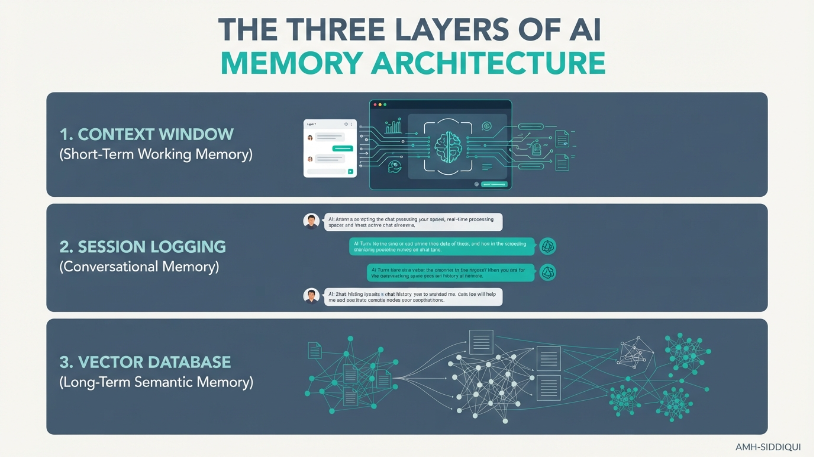
AI memory does not function like a human brain, nor does it mimic the standard hard-drive storage used by traditional software applications. Instead, intelligent systems split data retention into three distinct computational layers:
1. Short-Term Working Memory (The Context Window)
The context window represents the total volume of text an AI model can process and look at during a single active conversation. Measured in tokens (fractional words), this workspace functions exactly like a human’s active working memory. While modern models boast massive context windows capable of processing entire technical manuals simultaneously, this storage is strictly ephemeral—the moment a user closes the session, that working memory completely clears.
2. Conversational Memory (Session State Logging)
To maintain the illusion of a continuous conversation, application developers build session logging frameworks. Every time a user submits a new prompt, the system secretly appends the history of the previous questions and answers to the backend of the query. This ensures the model retains full visibility of what was discussed five minutes prior, though this approach consumes increasing amounts of computational bandwidth as the conversation grows.
3. Long-Term Semantic Memory (Vector Databases)
To retain knowledge across days, weeks, or entire quarters without overloading the context window, enterprise systems deploy external vector databases. These tools convert unstructured text documents, emails, and transaction logs into high-dimensional numerical coordinates called vector embeddings. This allows the AI to store, index, and retrieve relevant historical facts instantly based on conceptual meaning rather than literal keyword matches.
The Engine of AI Memory: Retrieval-Augmented Generation (RAG)
Rather than executing the incredibly slow and cost-prohibitive process of continuously retraining or fine-tuning an entire foundational AI model on new corporate data, modern enterprise systems rely on an architecture called Retrieval-Augmented Generation (RAG).
RAG functions as the functional bridge between an AI’s internal reasoning capabilities and its external long-term memory vault. When a user submits a complex operational query, the RAG framework acts as an intelligent assistant that runs ahead of the request:
User Query ---> Vector Database Search ---> Relevant Context Extracted ---> Combined Prompt into LLM
The system converts the query into a vector embedding, searches the organization’s secure vector database for matching concepts, extracts the exact paragraphs needed, and injects that retrieved context directly into the model’s short-term context window. As a result, the AI outputs an answer grounded in verified, up-to-date corporate memory, entirely eliminating historical hallucinations.
Strategic Applications Across Enterprise Architectures
| Business Domain | Legacy Context Bottleneck | Memory-Enabled AI Implementation |
| Enterprise Knowledge Management | Employee knowledge sits buried in thousands of disconnected PDFs and internal wikis | Serves as a centralized semantic knowledge base that remembers and searches corporate history instantly |
| Customer Support Operations | Chatbots treat every single customer interaction as a completely isolated event | Retains full multi-session historical context to deliver personalized support without repeating questions |
| Legal & Compliance Auditing | Regulatory compliance teams must manually cross-reference thousands of shifting policies | Long-term vector memory automatically surfaces conflicting clauses and historical precedents across massive archives |
Critical Challenges: The Cost and Risk of Remembering
Building a highly advanced corporate AI memory system introduces serious technical, operational, and financial hurdles that enterprise data science teams must prepare to manage:
The Burden of Context Drift
As an AI system continuously pulls historical notes, user preferences, and old conversation logs into its active context window, it runs the risk of experiencing “context drift.” Too much non-essential information clutches the model’s analytical focus, causing it to overlook the primary task or deliver unfocused, low-quality outputs.
Managing High Compute Overhead
Operating large-scale vector databases and running continuous semantic similarity searches across millions of corporate documents requires substantial computing power. Organizations must optimize their indexing structures and deployment frameworks to prevent these memory retrieval loops from inflating cloud infrastructure costs.
Data Governance and Privacy Boundaries
The moment an AI system is given the ability to remember, data governance becomes the top priority. Storing conversational histories and user interactions in a centralized vector repository creates severe compliance risks under frameworks like GDPR and CCPA, particularly regarding a user’s right to be forgotten.
If a customer requests that their personal profile be permanently deleted from corporate records, data engineers cannot easily scrub that information if it has been mathematically woven into an AI’s long-term vector embeddings. Enterprises must build rigid metadata filtering layers, attribute-based access controls, and automated compliance pipelines to ensure that long-term AI memory remains secure, auditable, and legally compliant at every stage of operation.
Related Readings:
- AI (Artificial Intelligence) – Key Concepts
- What Is Integrated AI (Artificial Intelligence)?
- Knowledge Graphs: The Hidden Foundation of Enterprise AI
- Quantum Computing and Artificial Intelligence: The Next Technological Revolution
- Synthetic Data: The Future of AI Training Without Privacy Risks
- NIST AI RMF – A Momentary Look
- Six Essential Practices for Responsible AI Governance
- Federated Learning: Training AI Without Sharing Sensitive Data
- Data Governance Framework and Pillars
- Data Governance – How to Set a Strong Foundation?
- Data Governance Readiness Assessment
- Data Lineage: The Missing Link in Modern Data Governance
- Navigating the Big Data Lifecycle: From Collection to Insight
- Big Data vs. Traditional Data, Data Warehousing, AI and Beyond
- Big Data Security, Privacy, and Protection
- Zero-Knowledge Proof (ZKP) – A Professional Review
- Attribute-Based Access Control (ABAC) – A Modern Approach to Dynamic and Granular Security
- Bioinformatics and Artificial Intelligence
