










Introduction
For decades, the digital revolution has driven global innovation by using silicon chips and binary code to process complex information. Today, a similar computational shift is occurring inside the field of life sciences. Instead of viewing biological entities purely as organic mysteries, engineers are treating living cells as programmable execution environments.
This rapidly advancing discipline is known as synthetic biology. By merging molecular genetics, software engineering, and advanced machine learning, researchers can design, manufacture, and optimize organisms from the ground up. Just as software engineers compile source code to instruct a computer, synthetic biologists are writing digital genetic code to program living cells to perform highly specialized corporate and medical functions.
The Concept of Living Software
To understand how synthetic biology functions, we must look at how the fundamental infrastructure of life mimics computer systems. Every living organism runs on an internal instruction set called DNA. This chemical language stores the precise data sequences that dictate how cells metabolize, grow, adapt, and respond to external inputs.
By approaching DNA as a biological programming language, developers can bypass the limitations of traditional breeding or basic gene splicing. A traditional computer functions by taking input data, processing it through machine code, and generating an output. Synthetic biology applies this exact logical sequence to living structures: chemical inputs trigger engineered DNA pathways, which execute precise cellular processes to deliver a specific biological output.
The Core Engineering Building Blocks
Synthetic biology separates complex cellular biology into standardized, predictable modules to make bioengineering scale exactly like traditional manufacturing. This structural approach relies on four primary layers:
1. BioParts (Standard Biological Parts)
BioParts are individual, well-characterized DNA sequences that perform specific, predictable functions. These function like open-source software code repositories, allowing researchers to pick and place defined biological instructions without rebuilding the code from scratch.
2. Standardized Genes
Genes function as full software modules within the cell. Each gene contains the blueprint required to assemble a specific protein or activate a precise metabolic engine.
3. Logic-Driven Genetic Circuits
Genetic circuits mimic electronic circuits. By combining genetic components, engineers build biological logic gates (AND, OR, NOT) inside living cells. These circuits allow an engineered cell to assess its surroundings—such as detecting a toxic chemical—and trigger a pre-programmed response only when specific criteria are met.
The AI and Data Analytics Accelerator
Modern biological systems generate massive, complex datasets that overwhelm traditional analysis tools. To scale these operations, data science teams are deploying specialized machine learning algorithms, turning bioengineering into a highly predictable digital pipeline across four major fronts:
Automated Design and Synthesis
Advanced software algorithms automate the design of complex genetic sequences. Instead of relying on manual testing, machine learning models analyze intended cellular paths and recommend optimized DNA scripts before a single physical sample is created in the lab.
High-Velocity Predictive Modeling
Biological systems are highly dynamic and prone to unexpected cellular reactions. Data scientists use neural networks to run large-scale simulations, predicting exactly how engineered cells will behave under different environmental stressors. This step minimizes real-world laboratory trial-and-error.
Streamlining Genomic Analysis
Machine learning algorithms parse vast genomic datasets within seconds, identifying useful patterns, mutations, and structural rules that would take human researchers years to uncover.
Real-World Cross-Industry Applications
| Industry Vertical | Legacy Production Bottleneck | Synthetic Biology Implementation |
| Healthcare & Pharma | Vaccine and cell therapy manufacturing is slow, rigid, and expensive | Programs immune cells to actively target tumors and custom-manufacture vaccines on demand |
| Sustainable Agriculture | Crops depend heavily on chemical fertilizers and suffer from climate volatility | Engineers plants to fix their own nitrogen and survive extreme drought conditions |
| Environmental Management | Eliminating persistent industrial toxins requires invasive physical cleanup | Deploys specialized microorganisms designed to digest microplastics and capture carbon |
| Industrial Chemicals | Petroleum-based plastics and fuel production drives heavy carbon emissions | Harnesses engineered yeast strains to ferment agricultural waste into bio-based plastics |
Critical Challenges and Governance Bottlenecks
While programming life offers incredible strategic value, building a reliable bio-economy requires addressing serious safety, compliance, and architectural risks. The foundational challenge begins with biosafety: releasing an engineered organism into an open ecosystem carries the risk of unpredictable mutations or unintended cross-contamination with native species.
Engineered Biological Asset ---> Environmental Release ---> Genetic Mutation ---> Ecological Disruption
Navigating Strict Biosecurity and Dual-Use Risks
As genetic design software becomes cloud-accessible, global security frameworks must evolve to prevent malicious actors from engineering dangerous pathogens. Implementing rigid access controls and screening digital DNA orders is crucial for defending global digital health networks.
Overcoming High Production Costs
Scaling a biological process from a controlled laboratory Petri dish to a massive industrial fermentation tank presents difficult structural hurdles. Managing living software across large production lines requires significant capital and specialized bioreactor monitoring.
The Rise of Automated Bio-Foundries
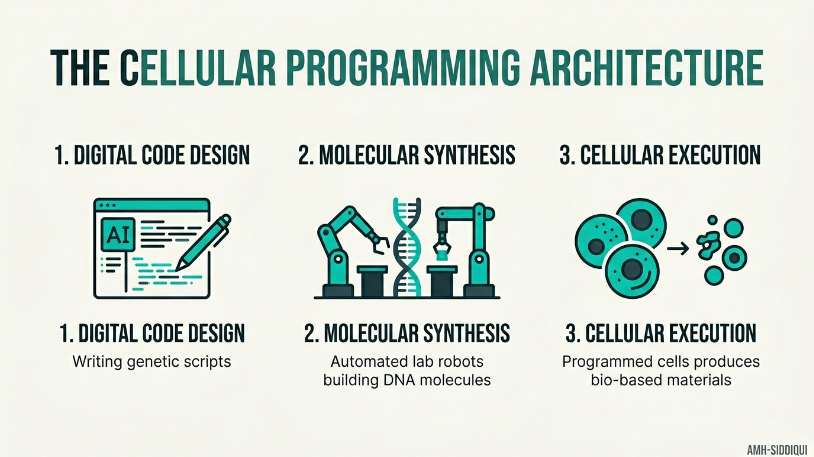
The future of technology lies in the complete integration of artificial intelligence, cloud computing, and automated laboratory robotics. The industry is moving rapidly toward fully autonomous bio-foundries—specialized data facilities where AI models design genetic code, robotic arms assemble the physical molecules, and automated sensors analyze the cellular outputs in real time.
By scaling biological production with the exact same speed and predictability as software development, synthetic biology is transforming life itself into an efficient manufacturing platform for future-ready enterprises.
Related Readings:
- Bioinformatics and Artificial Intelligence
- Human Brain Vs Artificial Intelligence
- Quantum Computing and Artificial Intelligence: The Next Technological Revolution
- Synthetic Data: The Future of AI Training Without Privacy Risks
- How AI and IoT Are Driving Digital Transformation Across Industries
- AI (Artificial Intelligence) – Key Concepts
- What Is Integrated AI (Artificial Intelligence)?
- NIST AI RMF – A Momentary Look
- Six Essential Practices for Responsible AI Governance
- Data Governance Framework and Pillars
- Data Governance – How to Set a Strong Foundation?
- Data Governance Readiness Assessment
- Navigating the Big Data Lifecycle: From Collection to Insight
- Big Data vs. Traditional Data, Data Warehousing, AI and Beyond
- Big Data Security, Privacy, and Protection
- Threat of AI in Healthcare
- How Robots Are Assisting Modern Surgeries
- The Future of Remote Robotic Surgery
- Wearable Health Technology
- Internet of Things (IoT) Security
