










Introduction
The pharmaceutical industry faces a trillion-dollar bottleneck: over 90% of therapeutic compounds that succeed in traditional laboratory testing fail when advanced to human clinical trials. For decades, biomedical research has relied on a combination of flat, two-dimensional cell cultures and animal models to evaluate drug safety and efficacy. While these models have historically advanced medicine, they fundamentally fail to replicate the complex, three-dimensional cellular architecture, genetic diversity, and metabolic pathways of actual human organs.
This structural gap results in billions of dollars wasted on clinical trial failures and delays the deployment of life-saving therapies. To overcome these limitations, biotechnology and data science teams are utilizing organoids. These miniature, three-dimensional, lab-grown tissues function as physiological mirrors of human organs, providing the highly accurate biological data required to fuel the next generation of automated drug discovery and personalized healthcare.
What Are Organoids?
An organoid is a simplified, miniature version of a human organ grown in a laboratory environment that replicates the realistic three-dimensional anatomy and functional micro-anatomy of its real-world counterpart. Instead of forcing cells to grow in unnatural, flat layers on plastic petri dishes, organoid technology allows specialized cells to cluster, interact, and self-organize.
Though typically no larger than a grain of rice, these structures contain a realistic mix of tissue-specific cell types. Scientists can successfully cultivate organoids that replicate the core functional profiles of the human brain, liver, kidneys, lungs, intestines, and heart. This architectural accuracy shifts medical research away from approximate animal models and toward direct human cellular data.
The Biological Engineering Process
The cultivation of highly specialized organoids relies on advanced stem cell engineering and biochemical modeling. The production pipeline generally follows three key stages:
1. Cellular Sourcing
Engineers extract stem cells from one of three primary origins: embryonic stem cells, adult tissue-resident stem cells, or Induced Pluripotent Stem Cells (iPSCs). iPSCs are particularly valuable because they allow scientists to take standard adult skin or blood cells and genetically reprogram them back into an embryonic-like state, ready to become any tissue type.
2. Extracellular Matrix Scaffolding
The selected stem cells are embedded within a nutrient-rich, three-dimensional hydrogel scaffold. This matrix mimics the natural structural support system found within the human body, providing the spatial cues necessary for cells to expand in three dimensions.
3. Biochemical Signaling
Researchers introduce precise mixtures of growth factors, proteins, and chemical inhibitors to the cellular environment. These biochemical instructions guide the stem cells to differentiate and self-organize into complex organ structures exactly as they would during human embryonic development.
Why Legacy Pre-Clinical Models Fail Modern Pharma
Traditional pre-clinical testing frameworks struggle to meet the speed and data requirements of modern machine learning-driven drug discovery due to three severe limitations:
Inaccurate In Vivo Translation
Animal physiology differs significantly from human biology. A compound that treats a disease effectively in a mouse model often proves completely ineffective or highly toxic when administered to a human patient, leading to costly late-stage clinical trial failures.
Structural Over-Simplification of 2D Cultures
Growing human cells on flat, two-dimensional surfaces alters their natural behavior, gene expression, and signaling pathways. Flat cell lines cannot replicate the complex fluid dynamics, tissue layers, and cellular interactions that dictate real-world drug absorption and resistance.
Lack of Patient-Specific Diversity
Traditional cell lines are often derived from highly modified, uniform cellular stock that has been cultivated for decades. These lines completely lack the unique genetic profiles, ancestral variations, and underlying comorbidities found across real-world patient populations.
How Organoids and Artificial Intelligence Unify Bio-Data Pipelines
Integrating 3D biological models into enterprise data and AI infrastructure addresses these scaling bottlenecks across three major operational layers:
Accelerating Automated High-Throughput Screening
Using automated robotic platforms, data engineers can scale organoid production to test thousands of chemical compounds simultaneously. High-definition imaging systems capture real-time cellular responses, providing high-volume datasets that train predictive machine learning models to identify top drug candidates in days rather than years.
Unlocking Omic Data Integration
Organoid cultures allow research teams to run deep multi-omic analyses—including genomics, transcriptomics, and metabolomics—on live human tissue samples. This rich biological data can be fed directly into enterprise knowledge graphs and data lakes to map complex disease pathways with complete accuracy.
Perfecting Patient-Specific Clinical Simulations
In personalized oncology, doctors can harvest cells from a patient’s tumor, grow matching “tumoroids” in the lab, and expose those models to a wide array of chemotherapy regimens. Computer vision algorithms track the rate of cellular decay, allowing oncology teams to identify the exact treatment plan before the patient receives their first dose.
Cross-Domain Therapeutic Applications
| Medical Domain | Legacy Research Hurdle | Organoid Solution Implementation |
| Oncology & Cancer Care | Uniform cell lines fail to replicate the complex, multi-layered defense mechanisms of real tumors | Patient-derived tumor models allow teams to test multi-drug combinations against specific genetic mutations |
| Neurological Disorders | Accessing live human brain tissue to study progressive degradation is impossible | Brain organoids mimic cortical layer structures to safely track the cellular mechanics of Alzheimer’s and Parkinson’s |
| Virology & Infectious Disease | Many human-specific pathogens cannot effectively infect or replicate inside standard animal models | Lung and intestinal organoids allow researchers to track active viral replication and test antiviral drugs safely |
| Regenerative Medicine | Severe organ failure lacks viable treatment options beyond long, competitive transplant waiting lists | Scaled tissue organoids serve as functional patches to repair localized liver, skin, or cardiac tissue damage |
Key Challenges to Scaled Implementation
While the potential of 3D biology is immense, scaling organoid infrastructure requires overcoming significant engineering and logistical boundaries. The primary technical hurdle involves production standardization: because organoids rely on natural cellular self-organization, minor changes in laboratory temperature, hydrogel batches, or fluid dynamics can cause wide variations between samples, introducing unwanted noise into data pipelines.
[Cellular Self-Organization] ---> [Batch Variability] ---> [Inconsistent Data Outputs] ---> [Pipeline Noise]
Addressing High Operational Costs
Cultivating, maintaining, and analyzing 3D organoid structures requires highly specialized equipment, sterile cleanroom facilities, and expensive growth factor cocktails. Lowering these financial barriers is essential before organoids can become a standardized part of routine clinical pathology.
Navigating the Ethics of Complex Neural Models
As brain organoids become structurally advanced, incorporating vascular networks and processing localized electrical signals, global bioethics committees must establish rigid governance boundaries. Developing clear regulatory frameworks is critical to guide cellular research safely and transparently without stifling clinical innovation.
The Next Era of Unified Digital Bio-Foundries
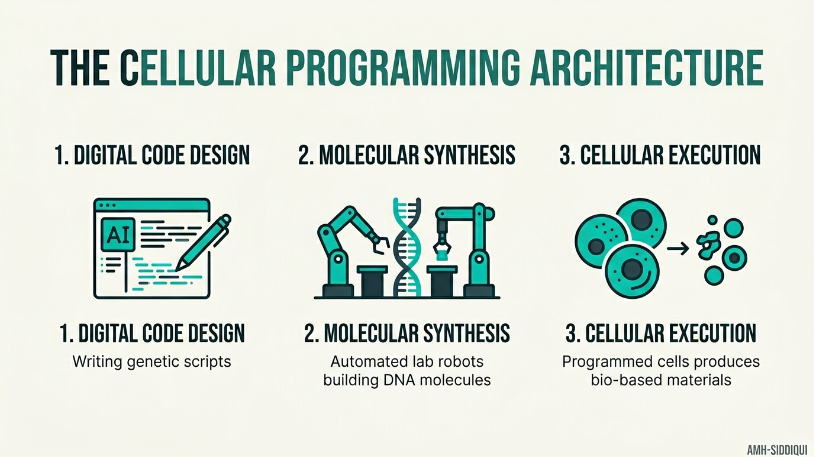
The long-term trajectory of life sciences points toward an architecture where organoid arrays and generative AI platforms operate in a continuous, automated feedback loop. Rather than relying on human speculation, advanced AI systems will analyze real-time phenotypic data from organoid arrays, automatically design optimized synthetic molecules, and direct lab robotics to test the new configurations. Grounding enterprise pharmaceutical pipelines in automated human tissue testing allows digital bio-foundries to eliminate developmental guesswork, lowering drug development costs and bringing true precision medicine to the global market.
Related Readings:
- Bioinformatics and Artificial Intelligence
- Human Brain Vs Artificial Intelligence
- Synthetic Biology: How Scientists Are Programming Living Cells Like Computers
- Quantum Computing and Artificial Intelligence: The Next Technological Revolution
- Synthetic Data: The Future of AI Training Without Privacy Risks
- AI (Artificial Intelligence) – Key Concepts
- What Is Integrated AI (Artificial Intelligence)?
- NIST AI RMF – A Momentary Look
- Six Essential Practices for Responsible AI Governance
- How Robots Are Assisting Modern Surgeries
- The Future of Remote Robotic Surgery: Can Surgeons Operate from Miles Away?
- Threats of AI in Healthcare Data Management
- How AI and IoT Are Driving Digital Transformation Across Industries
- Data Governance Framework and Pillars
- Data Lineage: The Missing Link in Modern Data Governance
- Knowledge Graphs: The Hidden Foundation of Enterprise AI
- Big Data Security, Privacy, and Protection
- Navigating the Big Data Lifecycle: From Collection to Insight
