










Introduction
Modern medicine is undergoing a profound structural shift, moving away from treating chronic symptoms and toward permanently correcting root-cause genetic mutations. At the center of this biological revolution is CRISPR, a groundbreaking gene-editing system that grants molecular biologists the power to modify DNA with incredible precision.
However, translating raw genomic engineering into scalable, safe clinical therapies introduces an overwhelming data problem. Human genomes contain billions of base pairs, and manual analysis can take years of slow, high-cost laboratory experimentation. To break through this analytical bottleneck, researchers are fusing CRISPR and AI. Integrating machine learning into genetic engineering transforms molecular biology from an empirical guessing game into a predictable, data-driven computational pipeline.
Understanding CRISPR Architecture
CRISPR (Clustered Regularly Interspaced Short Palindromic Repeats) was originally discovered as a natural adaptive immune defense system utilized by bacteria to destroy invading viruses. Biologists adapted this mechanism into a highly precise, programmable gene-editing toolset.
The system operates precisely like microscopic molecular scissors guided by software. The architecture relies on two foundational components: a guide RNA molecule that matches a target genomic sequence, and a Cas9 enzyme that executes the structural modification. Together, this molecular engine performs four critical operations across the double helix:
- Targeted Identification: Scanning the genome to locate the exact sequence responsible for a disease.
- Precision Excision: Safely cutting out broken, mutated, or dangerous genetic sequences.
- Gene Modification: Altering existing chemical instructions to change cellular behavior.
- Homology-Directed Repair: Inserting functional, healthy DNA sequences to permanently fix inherited disorders.
How Artificial Intelligence Optimizes Gene Editing
While CRISPR is incredibly powerful, the human genome is vast and highly complex. If a guide RNA binds to an incorrect sequence that closely mirrors the target site, the enzyme will execute an unintended cut. To prevent these dangerous errors, data science teams deploy machine learning models to oversee the pipeline across three major areas:
1. Eliminating Off Target Modifications
Unintended edits can disrupt healthy genes and trigger severe clinical complications, including aggressive cancers. Advanced deep learning neural networks analyze entire patient genomes prior to surgery, predicting the statistical probability of off-target mutations and automatically rejecting high-risk guide RNA designs.
2. Streamlining Guide RNA Design
Not all guide RNAs function with equal efficiency. Machine learning algorithms trained on massive genomic data repositories analyze historical splicing success rates, automatically generating optimized RNA sequences that maximize cutting efficiency at the exact target location.
3. Processing High Volume Genomic Datasets
Mapping thousands of cellular mutations simultaneously generates terabytes of complex multi-omic data. AI data pipelines ingest this raw information, identifying critical disease-causing variations in seconds—a process that would consume months of manual human laboratory evaluation.
Strategic Operational Advancements in Biotech
| Therapeutic Domain | Legacy Clinical Bottleneck | CRISPR and AI Implementation |
| Precision Oncology | Chemotherapy destroys healthy cells alongside tumors, causing severe toxic side effects. | Modifies a patient’s own immune T-cells with AI guided precision to target specific tumor antigens. |
| Monogenic Disorders | Sickle cell and cystic fibrosis require lifelong, high-cost symptom management. | Permanently rewrites single-gene mutations at the source to deliver functional cures. |
| Accelerated Drug Discovery | Identifying how complex chemical compounds interact with mutated genes takes years. | Simulates cellular disease models digitally, using AI to screen effective therapies instantly |
Strategic Applications Outside the Healthcare Sector
The operational efficiencies unlocked by combining CRISPR and AI extend far beyond human clinical medicine, reshaping global supply chains and agricultural frameworks:
Climate Resilient Sustainable Agriculture
Global food supplies face extreme stress from climate volatility and emerging pests. Using machine learning models to map crop genetics, agricultural scientists use CRISPR to engineer drought-resistant plant varieties and increase global crop yields without relying on heavy chemical fertilizers.
Advanced Industrial Biotechnology
Enterprise manufacturing sectors are actively replacing fossil-fuel-dependent production workflows with biological alternatives. By optimizing the metabolic pathways of specialized microorganisms, industrial bio-foundries cultivate engineered yeast and bacteria capable of fermenting organic waste into clean biofuels and biodegradable plastics.
Critical Risks and Data Governance Boundaries
Operating gene-editing networks requires navigating complex safety, ethical, and data privacy boundaries. The primary risk stems from genomic data sensitivity: processing a patient’s complete biological blueprint requires uncompromising cybersecurity protections, strict data lineage logging, and clear user access controls to prevent exploitation.
[Raw Patient Genomic Data] ---> [AI Analytics Engine] ---> [Strict Access Control Layer] ---> [Secure CRISPR Therapy]
Navigating the Ethics of Germline Modifications
Editing somatic cells only alters the treated patient. However, modifying germline cells (sperm, eggs, or early embryos) permanently changes the hereditary line for all future generations. Global governance frameworks must enforce strict oversight to prevent unethical cosmetic genetic engineering while protecting valid clinical research.
The Next Frontier of Intelligent Bio-Computation
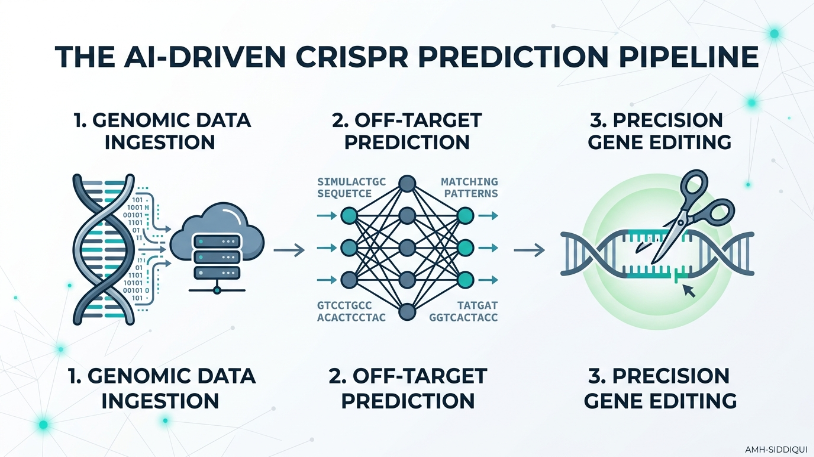
The intersection of CRISPR and AI is moving rapidly toward fully closed-loop, automated discovery platforms. Future enterprise bio-foundries will rely on generative AI engines to identify disease pathways, automatically program matching CRISPR instructions, and direct laboratory robotics to synthesize therapies without human intervention. By merging biological precision with computational speed, intelligent gene editing is turning molecular medicine into a highly scalable software architecture.
Related Readings:
- Bioinformatics and Artificial Intelligence
- Synthetic Biology: How Scientists Are Programming Living Cells Like Computers
- The Rise of Organoids: Revolutionizing Drug Discovery and Personalized Medicine
- Human Brain Vs Artificial Intelligence
- AI (Artificial Intelligence) – Key Concepts
- What Is Integrated AI (Artificial Intelligence)?
- Quantum Computing and Artificial Intelligence: The Next Technological Revolution
- Synthetic Data: The Future of AI Training Without Privacy Risks
- NIST AI RMF – A Momentary Look
- Six Essential Practices for Responsible AI Governance
- Threats of AI in Healthcare Data Management
- How Robots Are Assisting Modern Surgeries
- The Future of Remote Robotic Surgery: Can Surgeons Operate from Miles Away?
- How AI and IoT Are Driving Digital Transformation Across Industries
- Data Governance Framework and Pillars
- Data Lineage: The Missing Link in Modern Data Governance
- Knowledge Graphs: The Hidden Foundation of Enterprise AI
- Big Data Security, Privacy, and Protection
- Navigating the Big Data Lifecycle: From Collection to Insight
